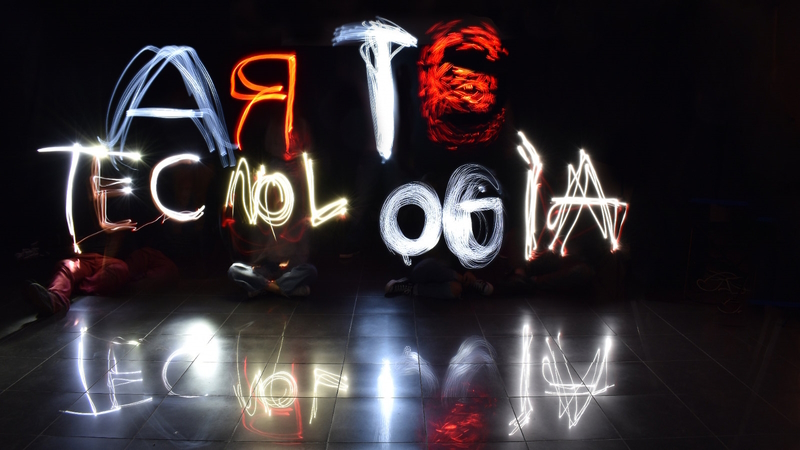
Both have a close connection to art, which began at an early age. Silvina mentions that her interest in creative fields emerged when she was a child; today, she is dedicated to visual art, software development, and design. On the other hand, Camilo explains that his relationship with art began when he was given a camera as a child and realized he could convey his vision to others. For him, art is a reflection on the past of the objects around him and a quest to experiment with little-explored creative processes.
What inspires you to create your art? Is there an artist or artistic movement that has influenced your work?
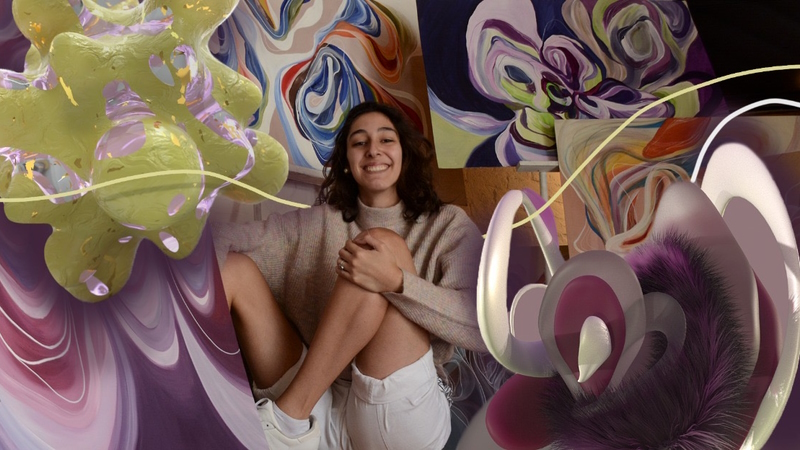
Silvina Cortés (S.C.): My artistic work focuses on exploring the shapes and textures I find in nature. I am also interested in translating the dialogue between women and their environment into an abstract visual language, and in this regard, Georgia O'Keeffe is an artist who has always inspired me.
What is your creative process? How do you decide which techniques or materials to use for each piece?
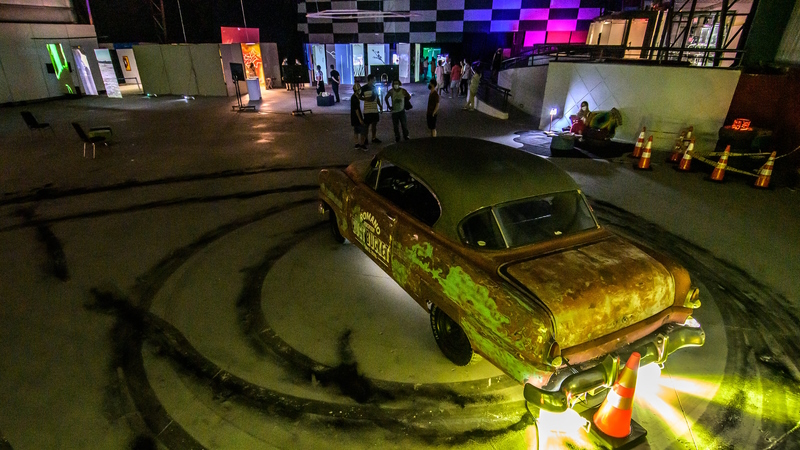
Camilo Romano (C.R.): First, I think and observe a lot. The parts in my works always have to have a well-worn, rusty quality—that’s proof of the passage of time. They’re usually discarded auto parts that no longer work. I believe the history of those parts is more important than that of parts that still function, because they’ve completed a cycle. Reinterpretation is key to my approach to art.
What disciplines do you work in, and how do you feel your degree has influenced your art?
SC: In terms of visual arts, I work primarily with painting and sculpture. In the digital realm, I work with 3D modeling and image and video production. My degree program has been essential in enriching and consolidating my artistic practice. First and foremost, I would like to highlight the interactions and exchanges I had with faculty, students, and artists in the creative field, as they gave me the opportunity to consider new approaches and perspectives on artistic creation. On the other hand, while my previous training focused on a purely visual arts approach, during the program I had access to all kinds of digital resources, which expanded my possibilities for expression and allowed me to explore new creative territories. I would also like to highlight the importance of the program’s emphasis on the development of artistic identity and the effective communication of one’s own reflective and conceptual perspective, as these are the pillars upon which I continue to create today.
Was it a challenge to integrate marketing and advertising with your background in the visual arts?
CR: For some people, this might be a simple task—promoting their work—but from my perspective, the most important thing is always to develop the idea I have in mind, and that’s more important than the marketing or advertising aspect. If a piece of art is true to its purpose, it doesn’t need to be a sensation; what matters most is that it makes viewers reflect, that it engages them and shows them new ways of thinking or interpreting a theme. My works generally tend to hide themselves when viewed; that’s why if even a single person manages to decipher one of my works, it’s much more valuable to me than if the work were seen by a massive audience and taken lightly.
What did it mean for both of you to be graduates of the first class of the Bachelor’s Degree in Design, Art, and Technology?
SC: For me, being a graduate of the first class of the Bachelor’s Degree in Design, Art, and Technology has been a privilege. Like my classmates—now colleagues—I am deeply grateful for the opportunity to be part of an initiative that, without a doubt, is shaping and will continue to shape the future of arts education through its unique combination of disciplines and approaches. I know that this great pioneering group—and I include in this everyone who has made this educational program possible—has laid the groundwork for future generations of students who are enthusiastic about the possibilities of contemporary art.
CR: Since I love exploring new avenues for my ideas, it’s a privilege to be part of the first graduating class. This is an unconventional degree program that fosters the development of powerful conceptual artistic discourses—perfect for reflecting on today’s world from different perspectives.
What advice would you give to a future graduate of the program?
SC: First of all, don’t settle—there’s always room to keep experimenting and learning. It’s also important to stay true to your own vision and be persistent. The art world can be very competitive, but if you stay focused on your passion and your goals, opportunities will arise. Finally, I think it’s essential to maintain a collaborative attitude. Connections always lead to growth and learning.
CR: Creative people must believe in their ideas, never think they’re bad, and, above all, trust that their messages are relevant to a specific audience. When we think about and develop an idea, it’s important to keep in mind that there are others who might relate to your way of seeing the world—and that’s why we have to act on it. Sometimes an underdeveloped idea can spark a fantastic story, so you should never discard anything.
Learn about the Bachelor's Degree in Design, Art, and Technology