Although more experienced teachers use technology more frequently, their digital proficiency in promoting mathematical modeling decreases with teaching experience. In other words, younger teachers demonstrate a greater ability to engage in modeling.
However, digital proficiency and the frequency with which teachers use technological tools do not depend on gender, the institution where they work, or whether it is a public or private organization, according to the findings of Gustavo Bentancor, a graduate of the Doctor of Education program, in his dissertation titled Mathematical Modeling: Teaching Strategies Using Digital Tools in the Basic Cycle of Secondary Education in Montevideo, Uruguay.
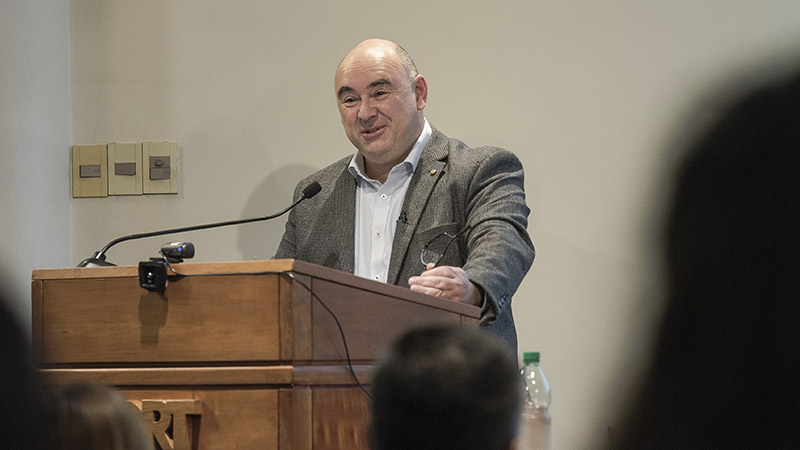
On Wednesday, July 27, in the auditorium of the Central Campus of Universidad ORT Uruguay, he presented his final graduation thesis in person. During the presentation, in addition to outlining the main features of his research, he highlighted the most significant findings of his doctoral thesis.
The purpose of Bentancor’s study was to explore, identify, and analyze the teaching strategies employed by mathematics teachers, using digital tools, to promote mathematical modeling in the lower secondary classroom at schools in Montevideo.
One of the major contributions of Bentancor’s thesis was the SEIAM model: an explanatory and interpretive framework that enables mathematics teachers to assess the extent to which they have mastered digital tools. In this regard, the graduate proposed five levels:
- Substitution: The use of technology is purely instrumental. Its purpose is to replace what can be done with a pencil and paper, carrying it out digitally instead. Essentially, this involves using technology to apply learned computational algorithms.
- Exploration: Here, the tools take on a different role, as the teacher uses them to help students visualize a particular mathematical concept or verify a result.
- Integration: A specific application is identified for mathematical work, as well as for the mathematization of problem situations. Teachers use technology to find algebraic, graphical, and tabular representations.
- Extension: Technology significantly transforms the process of modeling problem situations. The tasks associated with this level foster a deeper understanding of the concepts involved in solving a problem.
- Maximization: Digital tools are used to create new learning activities and environments that would be impossible without them. For example, this includes activities related to conducting visual geometric and algebraic demonstrations or simulating movements.
https://youtu.be/EdA9Bo2Xdfs
At the same time, Bentancor divided the model into three main layers: recognition, progression, and change. The first layer consists of the first two levels (substitution and exploration) and, as its name suggests, is intended to help students recognize the mathematical concepts presented by the teacher through the use of digital technology.
The second layer consists of the integration level and involves progress in incorporating digital tools to facilitate learning. Finally, the last layer (comprising the expansion and maximization levels) is characterized by technology transforming teaching activities.
Bentancor’s thesis shows that, although teachers aim to “help students gain a better understanding of mathematical concepts,” their teaching practices are dominated by an instrumental approach “strongly associated with the practice of algorithms and the visualization and verification of results.”
Bentancor adopted a mixed-methods approach for his research: he conducted 16 in-depth interviews, non-participant observations of four teachers, and an online survey of 212 teachers. Regarding the survey, in one question, the graduate student asked them to describe teaching strategies using digital tools that promote mathematical modeling—and that had been developed in a course at the elementary level.
After identifying more than 300 activities, the researcher categorized them into the different layers of the SEIAM model. Although teachers reported greater use of advancement and change activities, the study revealed that nearly 70% of teachers used activities from the recognition layer and possessed basic technological skills.
“Classroom observation reinforces this idea. There are differences between what is said (constructivist practices) and what is actually done (activities focused on modeling, but with only very limited use of technology),” explained Bentancor.
In his view, teachers’ ability to incorporate models into their digital teaching practices is, in general, “limited.” And this has consequences, as it makes them “more consumers of ready-made materials” than creators of their own.
The use of digital technologies by teachers is primarily focused on addressing challenging problems within the subject matter itself, while activities that connect the subject to students' real-world experiences are often overlooked.
“There’s a gap here that we can work on,” Bentancor reflected. How? “The crux of the matter lies in teacher training programs, ”he said. In his view, technology needs to be integrated into the teaching of all subjects and not “limited to a single subject,” since, generally speaking, “people tend to teach the way they learn.”
“It’s very difficult to move toward a pedagogically meaningful use of technology because digital skills are still rudimentary and because educational experiences were extremely traditional and in their infancy,” he said.
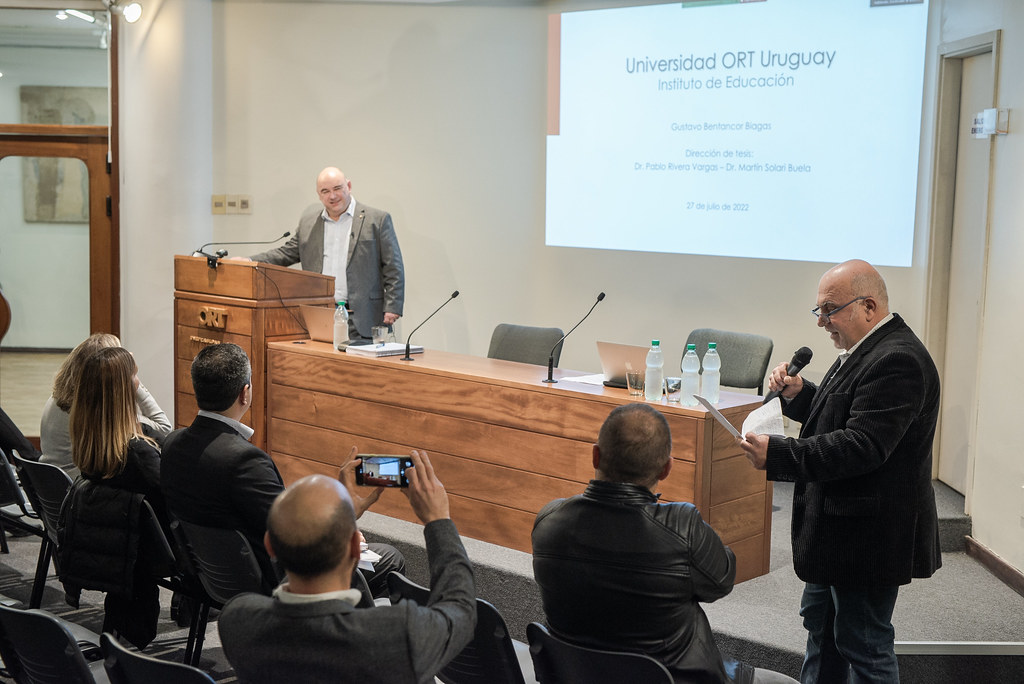
The committee for Bentancor’s doctoral defense consisted of Dr. Eduardo Rodríguez Zidán, a professor and researcher at the Institute of Education at Universidad ORT Uruguay; Dr. Alejandra Balbi, a professor in the Department of Education at the Catholic University of Uruguay; and Dr. Erik Caseres, coordinator of Educational Technology and associate professor of Mathematics in the School of Administration and Social Sciences at Universidad ORT Uruguay of Universidad ORT Uruguay.
Dr. Pablo Rivera Vargas, lecturer in the Department of Educational Pedagogy and Organization and a member of the Esbrina research group at the University of Barcelona (Spain), and Dr. Martín Solari, associate professor of Software Engineering in the School of Engineering at Universidad ORT Uruguay, served as thesis advisors.