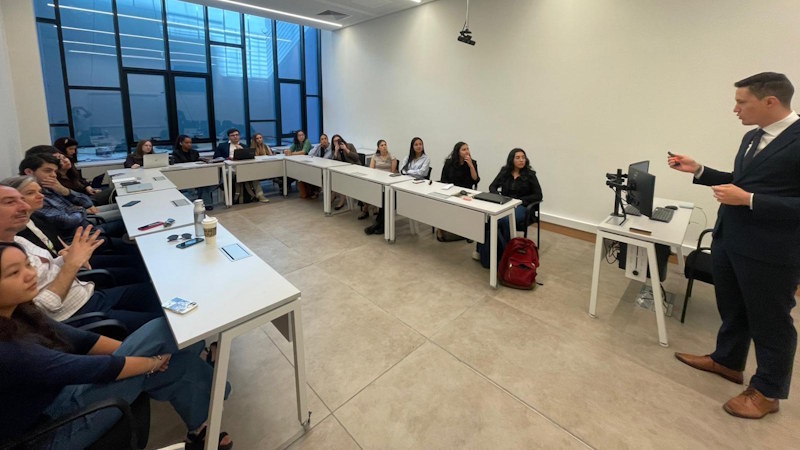
Facundo Fernández, a career diplomat, former Uruguayan consul in Guangzhou, China, and a member of the delegation that participated in the recent presidential visit led by President Yamandú Orsi, attended the first 2026 meeting of the Department of International Studies’ East Asia Research Group.
During the meeting, Fernández focused his presentation on his work at the Consulate General of Uruguay in Guangzhou, placing special emphasis on its opening in 2018, its objectives and responsibilities, as well as the opportunities offered by the diplomatic presence in southern China. Throughout the talk, he also shared personal experiences, lessons learned, and the main challenges facing the consulate in a region that is key to international trade.
A strategic region for Uruguay
The Consulate General of Uruguay in Guangzhou has jurisdiction over the provinces of Guangdong, Hunan, Guangxi, Guizhou, Fujian, and Hainan.
In total, this region is home to approximately 340 million people, which is equivalent to about a quarter of China's total population.
In this context, Fernández highlighted the tangible impact of Uruguay’s diplomatic presence: since the consulate opened, annual exports to this region have increased by 60%, representing a rise of approximately $300 million.
To put this figure into perspective, he noted that the value of exports to these six provinces is equivalent to the total value of Uruguay’s exports to Argentina, Paraguay, and Peru combined.
Three key areas of focus for the consulate
The former consul organized the consulate's work into three main areas of focus:
- Commercial presence: This includes scheduling meetings for Uruguayan companies, promotional activities, signing agreements, conducting market research, and expanding the business database.
- Cultural and academic activities: These include partnerships with universities, the signing of memorandums of understanding (MOUs), as well as the organization of exhibitions, book presentations, film screenings, and poetry readings.
- Provincial relations: This involves working directly with the six provinces in southern China, participating in trade fairs and seminars, visiting universities, and coordinating official missions. Regarding the latter, Fernández highlighted the organization of “Uruguay Weeks” in Hunan and Fujian provinces, as well as the coordination of visits by Uruguayan officials to the People’s Republic of China.
Hainan: A Growing Hub
One of the highlights of the exhibition was Hainan Province. Although it is the smallest province in the region under the consulate’s jurisdiction, has population of 10 million and is establishing itself as a hub for trade in China.
Fernández emphasized that these types of territories represent concrete opportunities for Uruguay, particularly within the framework of more diversified international integration strategies.
Growing interest and remaining challenges
During the question-and-answer session, the diplomat noted that Uruguay’s mere institutional presence in China generates significant interest in the country. However, he pointed out that market access for certain products still depends on greater participation by Uruguayan businesspeople in trade fairs and promotional events.
A space for academic exchange and research
The event was attended by students, advanced students, graduates, and faculty members, and also served as an opportunity to present the group’s work plans for 2026.
The East Asia Research Group, established in 2025, aims to establish itself as a dynamic space for learning and academic production, promoting debate, research, reflection, and collaboration with experts at the national and international levels.