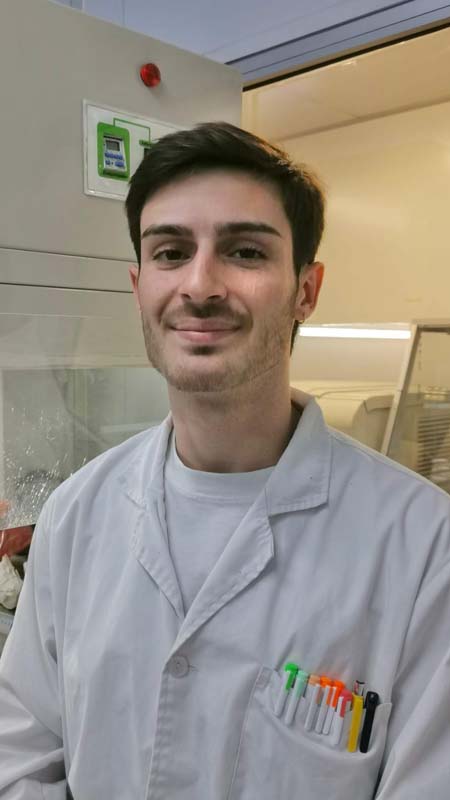
 Rocha currently teaches Introduction to Biotechnology, General Chemistry Lab, Macromolecules Lab, and Biological Chemistry, and serves as the program’s academic advisor. “I always try to get involved in everything related to teaching activities, both at the university level and in pre-university settings,” he says.
Why did you decide to study biotechnology? What attracted you to the program?
At first, when I was in high school, I was interested in a degree program that combined biology, chemistry, or genetic engineering, and my initial options were biochemistry or a bachelor’s degree in biology. While searching online for other possibilities, I learned about the Biotechnology Engineering program at Universidad ORT Uruguay. I had an interview with an advisor, during which they explained all the fields covered by biotechnology. It not only combined the areas I was interested in but also many others that I ended up liking even more, such as bioremediation, which I didn’t even know existed until then. I first heard the word “biotechnology” at the same time I learned about the program, and it opened up so many possibilities for what I wanted to pursue. I had no idea such a field existed, and that’s what motivated me to try to get a scholarship to enroll in the program, because I was absolutely certain it was what I wanted to do.
What stands out to you about having studied biotechnology?
Above all, I highlight the opportunity to become a professional in a field that is currently transforming everything. Thanks to biotechnology, we are now rethinking everything from production processes and the products available on the market to waste management and even how diseases are treated. I always emphasize to my students that biotechnology is on its way to becoming the primary way of doing things if we want a better world.
Regarding the education itself, I greatly value having studied a program like ORT. By sharing my knowledge with other students, I realize and appreciate the quality of the education we receive at the university, which is just as good as that of universities abroad.
Where did you go for your exchange program, and what was that experience like?
I spent a semester as an exchange student at Sabanci University in Istanbul, Turkey. This was made possible by a scholarship from the Erasmus+ mobility program, and it was a wonderful experience both personally and academically. Studying there allowed me to delve much deeper into fields such as molecular biology and plant biotechnology. In addition, I was able to explore a country as culturally diverse as Turkey, where I connected with people from all over the world—friends and professors alike—with whom I’m still in touch today. It’s an experience I always recommend to my students, to encourage them to see how things are done in places completely different from Uruguay, and to help them grow personally and professionally.
At Sabanci, I mainly took graduate-level courses. However, the workload was quite manageable because I had a solid theoretical foundation in almost all the subjects. This made it much easier to take the courses, despite the added challenge that they were entirely in English. It also allowed me, in a way, to stand out to the professors, who always recognized the strong foundation I brought with me.
Given your expertise in the field of algae, they're planning to offer an elective course on the subject. Can you tell me what it's about and what its objectives are?
The elective is called "Algal Biotechnology." As the name suggests, it provides students with a general overview of the identification, cultivation, and production of products derived from macro- and microalgae. Today, it is one of the leading areas of biotechnology worldwide, and therefore, I believe it is something the program should focus on. Essentially, the goal is to bridge a gap in students’ knowledge so that at least those interested in the subject have the opportunity to choose to work in this field and, above all, possess the tools to lead the projects they undertake.
The idea came to me while I was working on my final thesis, which focused on using microalgae for wastewater treatment, and seeing that other classmates had also chosen to work with algae. The course will consist of several theoretical and practical modules designed to help students acquire and deepen their understanding of essential topics in algal biotechnology.
What is the area you like best and would like to focus on?
I am passionate about plant and algae biotechnology. These are fields where there is still a long way to go, and they could play a vital role in meeting the needs of today’s society, as they have potential applications in food production, environmental bioremediation, cosmetics, and medicine. A country like Uruguay needs to make the most of all the resources at its disposal to break into this field.
What is your view of the biotechnology sector in Uruguay?
This is a sector with enormous potential that is growing day by day, largely thanks to new companies and startups that are presenting new challenges to the market. More and more established companies are choosing to adopt biotechnology-based production systems or develop biotechnology products, and in doing so, they are realizing that biotechnology professionals are ideally suited to address these new challenges. All of this helps to further boost the sector. At ORT, we believe we make a significant contribution by promoting the field, incubating companies, supporting entrepreneurs, and, above all, training skilled professionals.