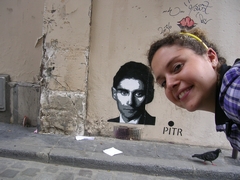
 In 2011, she received her first major recognition when her design for a Formula 1 driver’s suit for the McLaren team—created as part of a contest organized by the renowned fashion house Hugo Boss—will be featured at the race to be held in Abu Dhabi, United Arab Emirates, on November 13, 2011. She graduated in December 2008 and, in the middle of this year, presented her fashion collection called Pierrot. What she enjoyed most about her Bachelor’s degree in Fashion Design were the new challenges she faced.
How did you hear about the contest to design the McLaren Formula 1 drivers' suits? Why did you decide to enter?
At the time, I was working as a freelance illustrator and was researching trends and putting together my personal collection, which kept me glued to the screen for hours every day. That’s how I ended up on a website listing various design contests; I got hooked and signed up. The contest was open to specific countries on specific dates, so you had to keep an eye out for when the contest started in your region to be able to participate. You entered your personal information on the Hugo Boss website, then downloaded software that allowed you to design. We started with a white suit (the classic racing jumpsuit) with its specific cuts and sponsors. There was no option to create new cuts, change the fabric, or make suggestions beyond the graphic design. The design was specifically limited to the suit’s print.
What was the most challenging part of designing a race car driver's suit?
My inspiration was fire. I wanted to convey that sense of dynamism and excitement that speed generates through fire. So, using Illustrator, I drew flames and placed them on the limbs (arms and legs) and on the back of the jumpsuit design for Jenson Button (the driver featured on the company’s website). The main challenge was to make a suit that was not very dynamic and heavily branded by sponsors convey energy and speed. However, my original design was changed (due to graphic and copyright issues).
How do you feel knowing that the McLaren drivers will be using your design at the Formula 1 race in Abu Dhabi?
It really looks amazing; I won't believe it until I'm there and see it for myself.
What is it like to break into a sport like Formula 1, which is traditionally seen as a man's world?
It was something new. Sportswear has become so widespread these days that it’s no longer used solely for the activity itself; rather—I’d go so far as to say—it’s become mainstream. However, in these specific sports and at this level, the suits worn by the drivers are still made in a quasi-artisanal manner, practically tailor-made. It’s good that this tradition continues.
What is the most notable feature of the Bachelor's Degree in Fashion Design?
One of the most notable aspects is the final project (Recreation), which aims to bring students closer to the business world. That’s on the business side; as for the curriculum within the degree program, I would highlight the emphasis on theoretical courses, which are essential and, in my view, form the foundation of this degree.
What do you remember about your participation in the Recreation program (university-business integration)?
My project for Recreación '08 was in partnership with Paylana, and it was my first experience working at a textile company of that size. It was a very enriching experience, and it’s an opportunity that should be taken full advantage of.
How do you feel your degree helped you tackle the challenges this competition presented? And what did your degree program offer you overall, both academically and personally?
The most remarkable thing about college is that it presents you with new challenges. I know it sounds like a cliché, but that’s really what makes this kind of education so rewarding. It’s rewarding because everything that happens during those four years of study is the most enriching part—and, ultimately, that’s what your education is all about. You have to make the most of those challenges while you’re in college. Midway through the year, I presented my collection called Pierrot. So, the degree program served as a rehearsal for my personal project. And at this stage, you’re likely to encounter new challenges and problems to solve. The degree program provides you with tools for your personal project as well as for working in a team within a company.
“Every object, product, or creation presents itself to us, speaks to us, and communicates with us”—this is part of a text you wrote for the invitations to the 2008 Professional Design Exhibition. Could you elaborate a bit more on this idea?
This sentence explains how design disciplines combine with our skills to shape our perspectives and ways of seeing. This, along with our individual interests, is always evident in everything we do. As designers, we develop and hone a certain sensitivity to things, and that is how we work. We translate what we feel.
How would you assess the development of fashion design in Uruguay in recent years?
There’s definitely a buzz going on; I’m not just talking about designers, but a whole market has emerged for photography, magazines, advertising, various events, and trade shows, among other things—all catering to a need that had been lying dormant. This wasn’t happening a few years ago. Honestly, I think it’s great because if there’s a market, there’s work—and that’s what matters most.