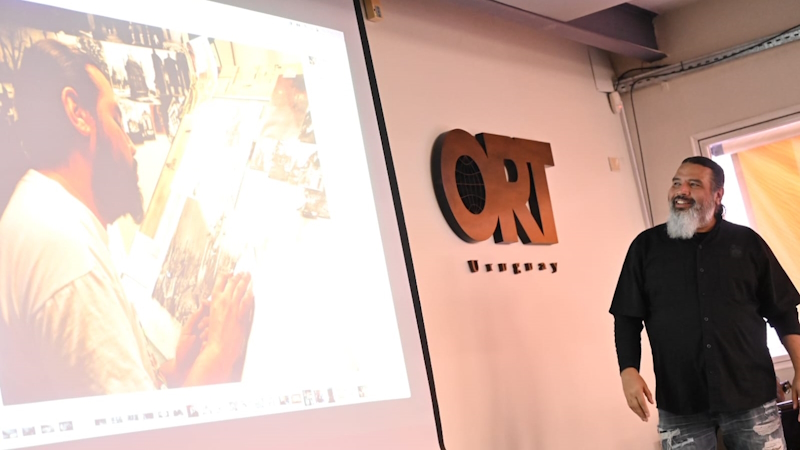
At the closing of the International Animation Festival, Salvadoran filmmaker Simón Varela gave a keynote speech in which he discussed the challenges of production design. The work begins with reading the script and progresses through (several, many) conversations with the director, exploring and seeking references, creating initial proposals, and then giving way to a back-and-forth process where the artistic direction of the entire production, the design rules, and, finally, the creation of “the Design Bible” are established.
“Today I’m a production designer; for 25 years I was a visual development artist,”Varela said, explaining how the definition of his role has evolved. In fact, he noted that in South America the role is referred to as “art director,” but in the North American market, the production designer comes first, followed by the art director(s): together, they form the teams tasked with interpreting the director’s vision.
The key is, quite simply, to understand the director’s vision and bring it to life on paper. “I’m going to show you my process and how I try to get inside his head,” he confessed.
In *Finding Nemo* (2003), he was brought on board because “the director didn’t like anything that had been developed over the previous six months.” He was asked to focus on the scenes set at the bottom of mar: “I was tasked with organizing the reef; it was visual chaos. The director admitted that ‘his life became more peaceful’ once the scene was finalized.”
Speaking about his work on *Wall-E* (2008), he explained that he always drew the character “small and low to the ground, because he feels lonely.” In that regard, he noted that “visual design can influence a film”—something that “happens more often than you might think.”
The Work Process
Most importantly, he said, is to listen to the director and then look for references (for settings and props).
People think that when you start drawing, everything just comes from your head, but that's not true. Some things do, but you also have to rely on references. When I'm working, all my walls are covered with references. I'm completely immersed in that world.

After all that, you’re left with a blank page. He said that a single scene can take him up to 80 hours of work.
He shared with the students the design bible he had developed for *Koatí*, so that ten artists could visualize the world in which the film would take place. In it, he lays out the dos and don’ts—for example, how the trees should and shouldn’t look, in every detail: the trunks, the leaves, the textures, the sizes in relation to the characters, and how they appear from a distance and up close. That, he said, “is taking into account the learning curve for any artist joining a production.”
Once his sketches are colored in, he provides detailed feedback to help improve the depth of the scene, as well as the concepts the artists are trying to convey. He noted that artists often struggle to color his sketches, but he encourages them “to take certain liberties.” Sometimes, a single drawing is created for a scene, packed with information so that the modelers can have more angles and perspectives when doing their work. However, “a lot of art is discarded and ultimately not used in the film.”
https://www.youtube.com/watch?v=AUno6CAV8Uc