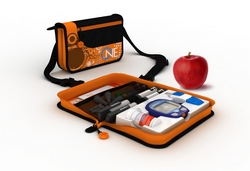
 People with diabetes lead complicated lives; this is especially true for those who rely on a daily dose of insulin to carry out their daily activities. Improving their quality of life is the goal of 22-year-old Pablo Pirotto, a student pursuing a bachelor’s degree in industrial design, who created a case designed to carry the most commonly used medications and supplies for managing this condition. The young man hopes to become even more involved in creating tools that help people with various medical conditions. In his hometown of San Ramón (Canelones), the story received significant media coverage, just as it did four years ago when Pablo won the “Design on Wheels” competition organized by the School of Communication and Design.
"For this project, the student collaborated with Bayer because both share the 'common goal of helping people with diabetes improve their lives,'" he explained.
He also noted that the "bond of trust" with Bayer provides Pablo with "many professional opportunities, ranging from presenting new ideas to addressing certain design needs that Bayer HealthCare may have in Uruguay."
Pablo is finishing up the production of 200 gift sets, each containing a Contour TS blood glucose meter, a lancing device, and test strips.
How did you come up with the idea of designing a case to help insulin-dependent diabetics carry their medications and supplies?
During a mandatory session, we had the opportunity to present an issue we were interested in addressing and working on, and to develop a solution based on our country’s productive capabilities. We also had the chance to present our project to companies that might be interested in its development and in collaborating with Recreación 12.
At first, I focused on exploring various problems I had identified and evaluating each one to determine their feasibility. In doing so, I realized that some were impossible to manufacture locally, while others required extensive research; since I didn’t have enough time for that, I ultimately decided to design a case that would include all the necessary components.
What did you take into account when planning your initiative?
When designing this kit, I drew on my nine years of experience as a person with diabetes and, in particular, on the experiences of a group of young people and parents of children with diabetes that I formed with the goal of gathering more information.
This is how I identified the most common items, including: medication, supplies, whether they used syringes or insulin pens to administer their injections, among other things; but there were small details that emerged that I believe we weren’t aware of because we were so used to the treatment, such as: the difficulty of removing and reattaching items held in place with rubber bands, how annoying it is to have to carry a backpack just to hold the cases, and how boring a completely black case was!, among others.
In your experience, how does industrial design relate to medicine beyond this specific project? Would you like to focus on developing products that bridge the gap between industrial design and medicine?
I believe that industrial design touches every aspect of our lives where there is a tangible object, whether decorative or highly functional—as I believe industrial designs focused on medicine should be.
In my view, we have a great deal to contribute, especially considering that the creative solutions we develop will be user-centered, aimed at creating the best possible experience for both healthcare professionals and patients. I would certainly love to dedicate my efforts to improving the quality of life for people with diabetes and perhaps—in the future—consider other conditions as well.
Is there just one version of the product you developed? Or did you also come up with a version for teens, one for women, and another for men?
No, as part of a school project, I developed two product lines: the first was a youth line, featuring bold colors like green, pink, orange, and gray, with abstract graphics applied via screen printing, aimed primarily at children, teenagers, and young adults. On the other hand, I developed a much more understated “executive” line—in faux leather—aimed at a more serious audience and older adults.
What did you enjoy most about the race?
Without a doubt, the Integrative Project as a whole was what I enjoyed the most. Personally, I like challenges, and this project had everything it took to be one: from challenging my own beliefs and telling the whole class that I had diabetes, to finding the courage to tackle this issue, to humbly presenting my project to major laboratories to secure their support, and everything that came from achieving that: working on a real-world project, coordinating with suppliers to bring the product to life, and presenting the project professionally.
What was the hardest part of your college experience?
The hardest part has been the last day of each mandatory session; just when I think everything is settled… it turns out it’s not enough, because there’s always room for improvement, and if there are still five minutes left, why not do it?
What are you most passionate about when it comes to industrial design?
What I'm most passionate about is the opportunity to solve people's problems and create the best possible experience. My approach focuses on the functionality of objects, and I feel that this latest project has reinforced that focus, while also revealing an area of interest with great potential for industrial design.
Are you working? Where?
Yes, I’ve been working at Carpintería Socas for about a year and a half, designing custom furniture such as kitchen cabinets, wardrobes, bedroom sets, and dining room sets, among other items. In addition, together with my colleague Pablo Soca, who is a carpenter, we’re responsible for developing various standard furniture lines and other new products that I’m sure will catch people’s attention.
What kind of work would you like to do in the future?
Today, I am in a privileged position in my career, but I would also like to delve deeper into industrial design focused on medicine, developing products that help improve people’s quality of life. To that end, I would love to join the research and development team at a company like Bayer.