
Thursday, June 3, 2021, seemed like any other day, without any major incidents. However, at 10:30 a.m. local time, social media began to fill with images of screens in the vicinity of Times Square in New York (United States), featuring photos of various people holding the Uruguayan flag. They were all wearing the same jackets with the name “dLocal” printed on them.
On June 3, dLocal, the country’s first unicorn (a designation given to startups that exceed a valuation of $1 billion), became the second Uruguayan company to go public on Wall Street. In this case, it listed on Nasdaq, the stock exchange most commonly used by technology companies.
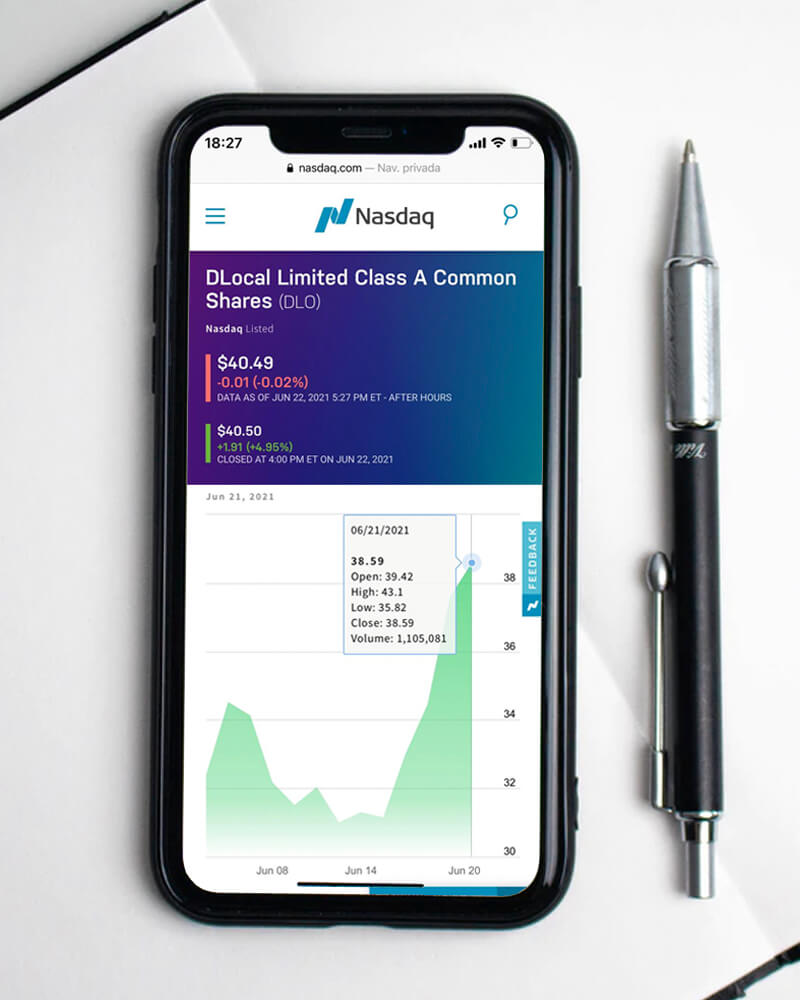
This historic milestone at the national level raised many questions: What does it mean to go public on the New York Stock Exchange? What implications does this have for the company? Why is the impact on the country so significant? Could other Uruguayan companies aspire to do the same? How?
In this interview, Rodrigo Ribeiro—associate professor of finance at Universidad ORT Uruguay and faculty member of the Master’s in Financial Management, and a partner at KPMG—answers these and other questions, helping us understand this economic and business feat.
-
What does it mean for a company to be listed on a New York stock exchange?
 Being listed on a New York stock exchange means that the company's shares can, from that point on, be freely purchased by the investing public and that buy and sell transactions are recorded on the relevant stock exchange. Therefore, there is a reference price for the stock.
 In the specific case of dLocal, its stock began trading on the Nasdaq, which is the stock exchange most commonly used by technology companies. The Nasdaq’s “stock index” provides a benchmark for the performance of technology stocks.
In technical terms, when a company is listed on a stock exchange—particularly one in New York, where there is a large number of investors—it means that the company’s shares become more liquid in financial terms. In other words, shareholders can sell their shares quickly on the market without suffering a significant loss in value.
On the other hand, for the shareholders of the company going public, this means they will now have a broader group of investors with access to their shares.
-
In 2020, dLocal became the country's first unicorn company. How does this milestone relate to its IPO on the New York Stock Exchange?
For dLocal, being valued as the country’s first unicorn is of great significance, and it undoubtedly provided a major boost to its initial public offering.
Listing on a stock exchange entails higher operating costs and stricter regulatory requirements. This means that a company must reach a certain size—in terms of valuation—in order to go public. And valuation depends not only on current business performance but also on the potential for future growth.
-
What is the process a company goes through to become listed on the New York Stock Exchange?
 It is a very demanding process that involves several different areas that need to be addressed.
 Once a strategy has been established that includes an initial public offering (IPO) as a goal, it is necessary to assess the current situation and identify the gaps between regulatory requirements and the company’s current status.
Based on this analysis, the company should begin its preparations with the aim of achieving the established goals. The process requires addressing various aspects related to corporate governance, legal matters, financial reporting, control systems, and social and environmental performance; it is also necessary to determine the need for additional resources to meet regulatory requirements (reporting, controls, investor relations), among other issues.
In addition, it is very important to present the company to investors during what is known as a road show.
The final three months of preparation are a very intense period for the management team of a company going public.
-
Following this achievement, what goals can a company like dLocal set for itself, and what challenges does it face?
Going public marks the beginning of a new phase in which the company commits to a plan focused primarily on growth objectives.
Access to capital through an initial public offering (IPO) allows a company to strengthen its business and finance its growth plan. From now on, the company will face the challenges inherent to its business, as well as the new regulatory compliance requirements imposed by the IPO, including those related to the conduct of its executives, disclosure of material information, and transparency in management, among others.
-
Many national leaders expressed their delight at dLocal’s listing on the Nasdaq and described it as a historic milestone for the country. Why is this important for Uruguay?
I think it's very important to have the example of a company that managed to go public on the New York Stock Exchange.
dLocal’s IPO is a sign that “yes, it can be done” for Uruguay’s entire entrepreneurial ecosystem. If dLocal could do it, it proves that this is a path any Uruguayan company can follow. We know that entrepreneurship is a key driver of a country’s development, and dLocal’s example is a huge help in that regard.