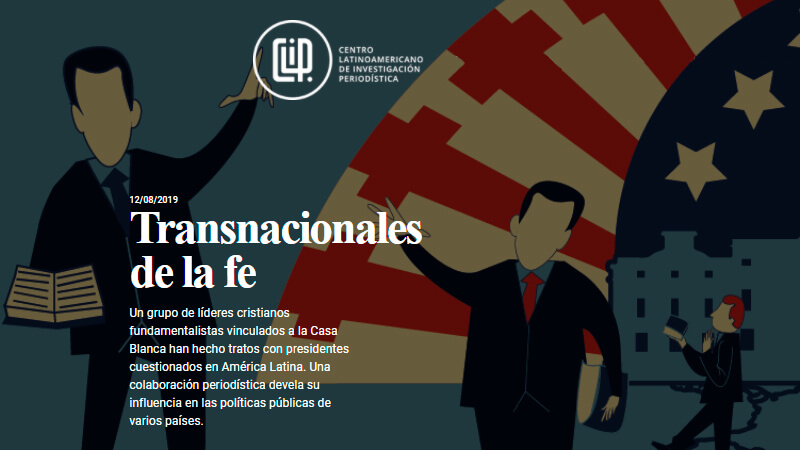
Transnational Faith is an investigation carried out by journalists from 16 Latin American media outlets, coordinated by the Latin American Center for Investigative Journalism (CLIP) and Columbia Journalism Investigations at Columbia University. Among those journalists were Tomer Urwicz and Mathías Da Silva, from the Uruguayan newspaper El País.
The project began in response to information linking U.S. agencies to evangelical groups involved in Honduran politics. When journalists from Columbia University and the newly established CLIP launched their investigation, they realized they were dealing with a regional phenomenon that extended across several other borders. Uruguay was one of them.
"Partnerships are being formed to investigate phenomena that extend beyond a single country's borders, which requires teamwork."
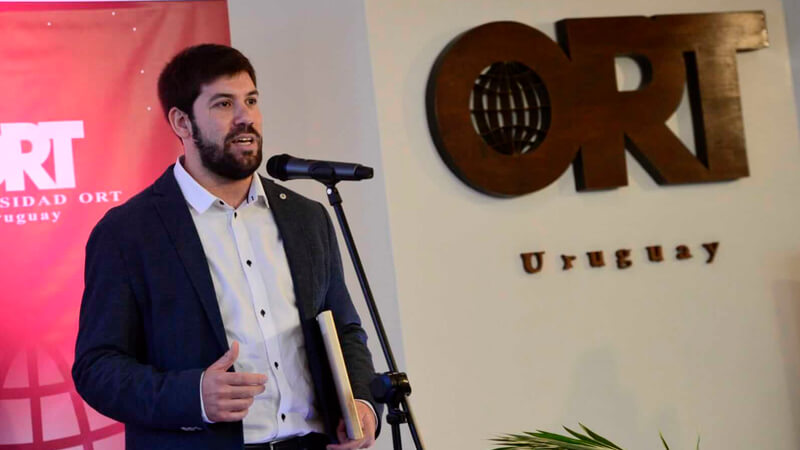
According to Urwicz, globalization and the abundance of information have led journalism to increasingly incorporate the concepts of collaboration and transnationalism. “For the most part, problems neither end nor begin at national borders. In practice, this means that partnerships are being formed to investigate phenomena that extend beyond a country’s borders, which requires teamwork,” said the graduate and instructor of the Bachelor’s Degree in Communication with a concentration in Journalismat the Faculty of Communication and Design of Universidad ORT Uruguay.
“Day of the Unborn Child” and Other Ideas from the Evangelical Caucus was the Uruguayan component of the investigation linked to Transnacionales de la Fe, which was published in El País in September 2019. Nearly a year earlier, “through training seminars and previous collaborative work,” Urwicz had been contacted for the organizational phase of the project, during which hypotheses and guiding questions for the investigation were established.
“The work in Uruguay, which had to be done alongside the rest of the news stories, required a fair amount of behind-the-scenes effort. That’s why I brought in another colleague, Mathías Da Silva, who was part of the editorial staff at El País at the time,” he said.
And so Uruguay was one of the first countries to join the research effort.
-
What was the specific starting point for your research in Uruguay?
On this issue, Uruguay presented a dual picture. On the one hand, it was a country where conservative groups had failed to halt the advance of the so-called “rights agenda”: the decriminalization of abortion, marriage equality, and adoption by same-sex couples, among other measures. On the other hand, it was the same country that, not so long ago, had served as a money-laundering route—a relatively safe haven for growing organizations and a place where a certain degree of freedom facilitated the expression of emerging groups. Thus, our investigation began with background research and the identification of connections between U.S. institutions operating in Uruguay.
-
Did you realize that something so significant—in terms of evangelical political power at the inter-American level—was unfolding while it was taking place?
In the whirlwind of journalism, one doesn’t usually grasp the depth of the topics one is investigating. In reality, the questions that underpin the investigation are different: Is it in the public interest? Does it benefit the reader? Does it involve many people? Is it feasible? What security measures need to be taken into account (for example: no communication was conducted via easily hacked social media platforms, such as WhatsApp, Facebook, or Hotmail)? Is it publishable?
Regarding the journalistic methods they used, Urwicz mentioned in-depth interviews, cross-referencing attendance and voting records, georeferencing, creating timelines, and affinity maps, among other techniques. However, he emphasized the importance of requests for access to public information. According to him, the request for access to information from Parliament was key. “There we learned firsthand about the bills that had been introduced by legislators directly involved with more conservative groups. And we got our first surprises,” said the ORT graduate and instructor.
Urwicz defines *Transnacionales de la Fe* as a “multimedia special featuring country-specific segments in the style of a special report.” As a journalism professor with a particular focus on these genres, he views investigative reporting as a call for depth: “The Uruguayan segment, on its own, doesn’t hold much value. What matters is the collaborative effort—the whole. In a world where everything is ‘instant,’ where some people think 240 characters are enough to stay informed, this type of journalism champions depth. It’s true that it isn’t mass-market, but it does have a major impact on decision-makers.”
-
What does the Ortega y Gasset Award for Best Journalism or Investigative Reporting mean for Spanish-language journalism, for investigative journalism, and for you personally?
It may sound cliché, but awards are a boost, a pat on the back, a “come on, let’s go.” For those of us who participate, they open doors and add to our résumés. In that sense, for me, it was a vote of confidence: first, from the colleagues on the jury who evaluated the work, and second, from the public’s endorsement, which underscores the importance of more in-depth and critical journalism.
But, by definition, in investigative journalism, one works to uncover something that those in power are trying to hide. That’s why, personally, I believe the real reward was being part of the investigation and the process leading up to publication. It provided us with new contacts and new opportunities for future collaborations. In that sense, and to paraphrase the coach of the Uruguayan national soccer team, the journey itself was the reward.