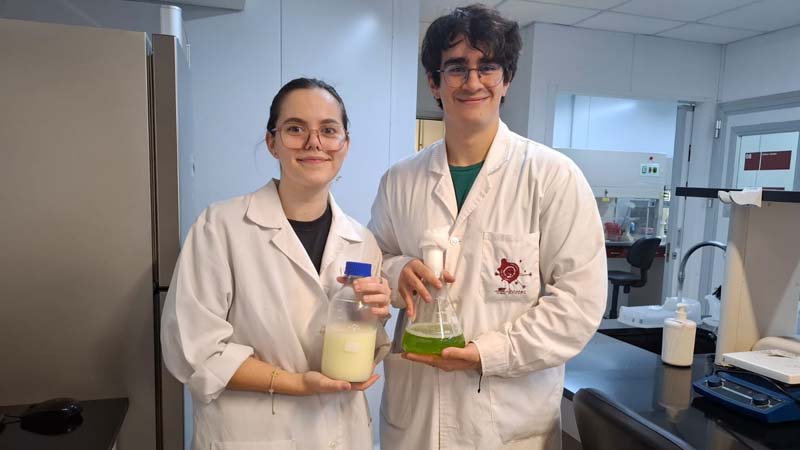
This initiative funds projects led by undergraduate students that have a positive impact on their communities. Their proposal aims to repurpose whey—a byproduct of the cheese industry— by using microalgae to produce a probiotic supplement designed to improve livestock health.
From Thesis to Real-World Impact
The project stems from her thesis, titled "Bioremediation of Sweet Whey Using Microalgae," which she began in August 2024. Whey is the product obtained during cheese production: milk coagulates, either through enzymes (sweet whey) or with the addition of acetic acid (sour whey), forming curds. The remaining liquid is whey, a byproduct that must be treated, as its disposal without treatment can have serious environmental consequences.
There are various ways to repurpose this waste, such as producing sports protein supplements (whey protein), using it as a feedstock for biofuels, or as animal feed. However, the volume produced in Uruguay—estimated by the students at 580,000 tons per year—makes it necessary to continue developing alternative and sustainable solutions.
Microalgae as agents for bioremediation and resource recovery
Faced with this challenge, the students proposed a bioremediation strategy based on the use of microorganisms, particularly microalgae. These could potentially remove compounds such as nitrogen, phosphorus, and lactose from the whey, transforming it into a less polluting medium. In turn, by cultivating them in the treated whey, they could obtain algal biomass with probiotic potential. This biomass can be used as a feed supplement for animals, improving feed efficiency, strengthening the immune system, and reducing methane emissions.
The experimental work included phases involving the adaptation of the algae to the new environment, serum preparation, growth tests, compositional analysis, and the development of small-scale cultivation protocols. In addition, the researchers suggest that the treated serum can be discharged into wastewater without harming the local flora or fauna.

Partnerships with dairy farms and companies
Initially, they worked with laboratory-produced whey, but later they were able to obtain actual samples from a small dairy farm in the area, and they now collaborate with Conaprole to obtain industrial whey of higher quality and greater consistency. This collaboration is key to scaling up the experiment and bringing it closer to real-world production conditions.
The project also draws on the previous experience of other groups of master’s students from the School of Engineering who worked with dairy farm effluents, but instead of whey, they used wastewater. Building on those experiences, Agustina and Ignacio incorporated a new line of research focused on the recovery of whey itself.
I work with rural schools
The social component of the project will be implemented in rural schools in Colonia Suiza, Colonia, which is part of Uruguay’s dairy region. There, students will conduct hands-on workshops to teach children about the challenges associated with whey, the circular economy, and the use of biotechnology to solve environmental problems. In addition, they plan to distribute experimental kits that allow for small-scale replication of microalgae cultivation and bioremediation processes, promoting active learning.
Institutional support and key partnerships
The initiative has support of faculty members and advisors, particularly Professors Mary Lopretti and Mariana Umpiérrez. This latest project is also part of the research framework funded by the María Viñas Fund, led by Umpiérrez, which involves various teams working on the revaluation of waste through the use of microalgae and fungi. In addition, they collaborate with companies such as AlgasUY, a supplier of native Uruguayan algal strains.
Sustainability, Research, and the Future
With the funding provided by Middlebury ($10,000), the team will be able to further its research, purchase specific supplies, conduct new field tests, and develop educational materials. They hope to advance the scaling of their proposal by transferring laboratory tests to larger-volume tanks, with a view toward future industrial applications. Although the project will conclude with the thesis defense and the program’s activities, the students are confident that their work will serve as a foundation for further research on the topic.
A life-changing experience
"It was a very pleasant surprise to be selected," the students said. "This support not only allows us to move forward with our research, but also to share our knowledge with the community. It is a unique and deeply enriching experience that strengthens our commitment to science in the service of society and the environment."