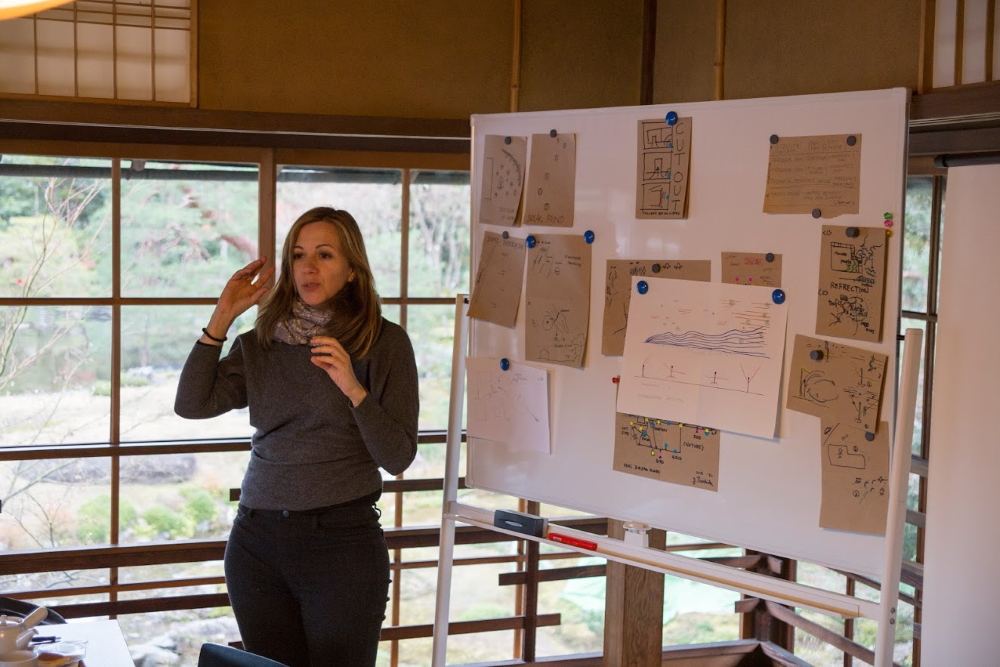
Tyana Santini lived in Japan from 2009 to 2015. That six-year adventure began some time earlier in a classroom at Universidad ORT Uruguay, where her curiosity led her to a Japanese language class.
Since then, her passion for Japan and her profession as an architect have inspired her to devote herself to the study and research of Japanese history from a natural perspective.
“I applied for a Japanese government scholarship on the recommendation of my language teacher. In 2009, two years after graduating with a degree in architecture from ORT, I went to Kyoto University to pursue a master’s degree and then a Ph.D. in engineering,” says Santini.
The master’s program focused primarily on the theory and history of urban planning and Western perspectives on the subject. It was after studying a geographer who researched Japanese cities from a natural perspective that she decided to focus her doctoral thesis on that topic. “That’s when I learned that this type of history existed—a more natural one—and that there were studies on environmental urban history that analyzed the nature of cities,” says the architect.
As he explains, in the past, these questions regarding nature were incorporated into history, but they were not the central focus. Today, however, he asserts that they are being studied more and more.
According to Santini, the way we manage nature—and our ideas about it—have changed dramatically over the years. Nature has been a resource, a way to beautify places, but today it is also viewed from the perspective of biodiversity. Nowadays, it’s not just about the greenery of a garden, but also about urban wildlife and green corridors. “I study how the way we treat nature in cities has changed based on how we relate to it,” he says.
A country with so much to discover
For Santini, the Nordic countries are at the forefront of these issues, although he points out that Japan has done a great deal to improve its treatment of nature. “They’ve carried out an impressive cleanup effort. In the 1970s, Japan had terrible pollution, and starting in the 1980s, they began cleaning everything up. Now, with the arrival of the Olympic Games—which will be held in Tokyo next year—they are trying to build highways under rivers and are also cleaning up and creating larger parks, because in Japan, the issue of density is extremely important,” he says.
His master’s degree, his doctorate, and his time in Japan allowed Santini to learn more about the country’s traditional architecture. “It’s a style of architecture that’s quite well-suited to the climate and culture. Everything is made of wood,” he says. Raised-floor homes and floor-level furniture are typical. “They sleep on a futon on the floor, and both tables and desks are low, because they usually sit on the floor,” he explains.
As for materials, he explained that Japan has very advanced technologies. “That could be applied in Uruguay. They have very good structures that are highly efficient for prefabricated homes, although they don’t last as long as they do here. Over there, a house lasts an average of 20 years,” Santini notes.
Not everything is what it seems
When it comes to caring for the environment, Santini says that from this side of the world, there’s a perception that the Japanese—and Asians in general—have a greater respect for nature because of Zen philosophy, but that idea isn’t based on anything real. “In fact, some historians claim that they didn’t respect nature because they altered it; Japanese gardens are actually highly manipulated,” he says.
He adds: “I’d say they’re just like we all used to be. There were times when pollution was rampant, especially during the industrial boom. That’s stopped now, and there are indeed many strict regulations in place to protect the environment, but in the beginning it wasn’t much different from what happened in the West or anywhere else.”
The architect is currently a researcher at ORT, where she continues to study Japan, focusing primarily on the rivers of Kyoto. “Through these studies, we can draw conclusions about how our approach to nature in cities has evolved over time. I publish articles regularly about the various steps I’m taking,” she concludes.