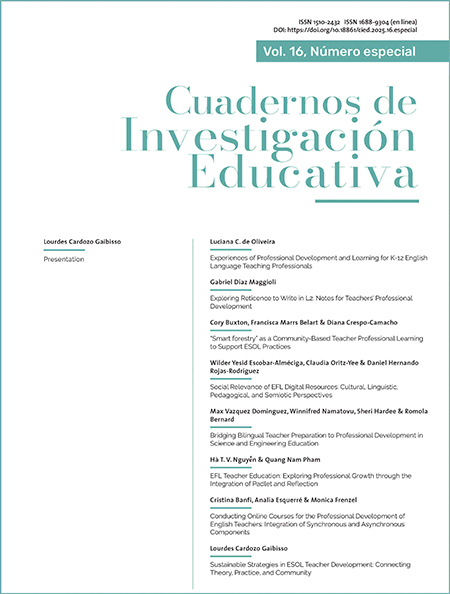
 In November 2025, the Volume 16, Special Issue from Journal of Educational Research, under the theme “Contemporary Perspectives on the Professional development for English teachers "In Service: Bridging Theory and Practice."
With contributions from researchers in Argentina, Chile, Colombia, the United States, Uruguay, and Vietnam, this publication explores current perspectives on the professional development of teachers of English as a foreign language.
In particular, this edition brings together sustainable, context-sensitive, and critically oriented models of professional development for teachers, aimed at fostering discussion about what types of support are effective, for whom, and in what contexts.
Throughout the pages, readers will find the following articles written in English:
- "Experiences of Professional Development and Learning for K-12 English Language Teaching Professionals," by Luciana C. de Oliveira.
- "Exploring Reticence to Write in a Second Language: Notes for Teachers’ Professional Development," by Gabriel Díaz Maggioli.
- “Smart Forestry” as a Community-Based Professional Development Program for Teachers to Support ESOL Practices, by Cory Buxton, Francisca Marrs Belart, and Diana Crespo-Camacho.
- "Social Relevance of EFL Digital Resources: Cultural, Linguistic, Pedagogical, and Semiotic Perspectives," by Wilder Yesid Escobar-Alméciga, Claudia Oritz-Yee, and Daniel Hernando Rojas-Rodríguez.
- "Bridging Bilingual Teacher Preparation to Professional Development in Science and Engineering Education," by Max Vazquez Dominguez, Winnifred Namatovu, Sheri Hardee, and Romola Bernard.
- "EFL Teacher Education: Exploring Professional Growth through the Integration of Padlet and Reflection," by Hà T. V. Nguyễn & Quang Nam Pham.
- "Conducting Online Courses for the Professional Development of English Teachers: Integration of Synchronous and Asynchronous Components," by Cristina Banfi, Analía Esquerré, and Monica Frenzel.
- Sustainable Strategies in ESOL Teacher Development: Connecting Theory, Practice, and Community, by Lourdes Cardozo Gaibisso.
Dr. Lourdes Cardozo-Gaibisso, a professor and researcher in TESOL and educational linguistics at Mississippi State University (United States), served as the guest editor for “Contemporary Perspectives on the Professional Development of In-Service English Teachers: Bridging Theory and Practice.”
“The authors contributing to this publication share the conviction that teacher training can become a continuous, lifelong process: sustainable, revitalizing for teachers, and beneficial for multilingual students, ”Cardozo-Gaibisso stated during the presentation of the special edition.
At the same time, he expressed his satisfaction at sharing the articles included in this special issue and at continuing to foster dialogue, with the aim of continuing to “support teachers.”
“I hope readers will discover both the strengths of current practices and the challenges facing future professional development in the teaching of English as a second language—both of which are essential for building dynamic, inclusive educational communities that are prepared to meet the needs of multilingual students around the world,” he concluded.