This project was developed by Daniela Waldeck, a student in theIndustrial Design program, forLegno, as part ofthe Integrative Project | Recreation19.
Legno—a company that designs wooden furniture for the home and targets an upper-middle-class audience—expressed interest in developing a line of children’s furniture based on the Montessori method, an educational approach rooted in respect for children and their remarkable ability to learn, Waldeck explained.
Give children the opportunity to exercise their freedom from the earliest years of development. The goal is for children to grow into adults capable of coping with life’s challenges. In Montessori philosophy, adults should act as observers and guides, providing children with the tools they need to develop and explore their environment.
One of the distinctive features of the Montessori method is assigning children “age-appropriate tasks” that complement their experiences and learning, and that they can always complete on their own. “The furniture plays a key role because it must be suited to the child’s needs—both ergonomically and cognitively—to give them greater independence.”
After studying the company and its needs, the student felt it might be worthwhile to expand Legno’s customer base and take this opportunity to develop a line of children’s furniture for early childhood education centers. “They liked the idea, so I began my research.”
After interviewing various preschools, early childhood educators, and psychomotor therapists, I concluded that the vast majority of these centers face challenges in organizing their space and that the current range of products available for this niche is very limited.
He identified three specific issues: the space taken up by the tables (since, in many cases, they prevent floor-level work dynamics from developing), the space taken up by the mats (used only during nap time), and, finally, the lack of storage furniture options.
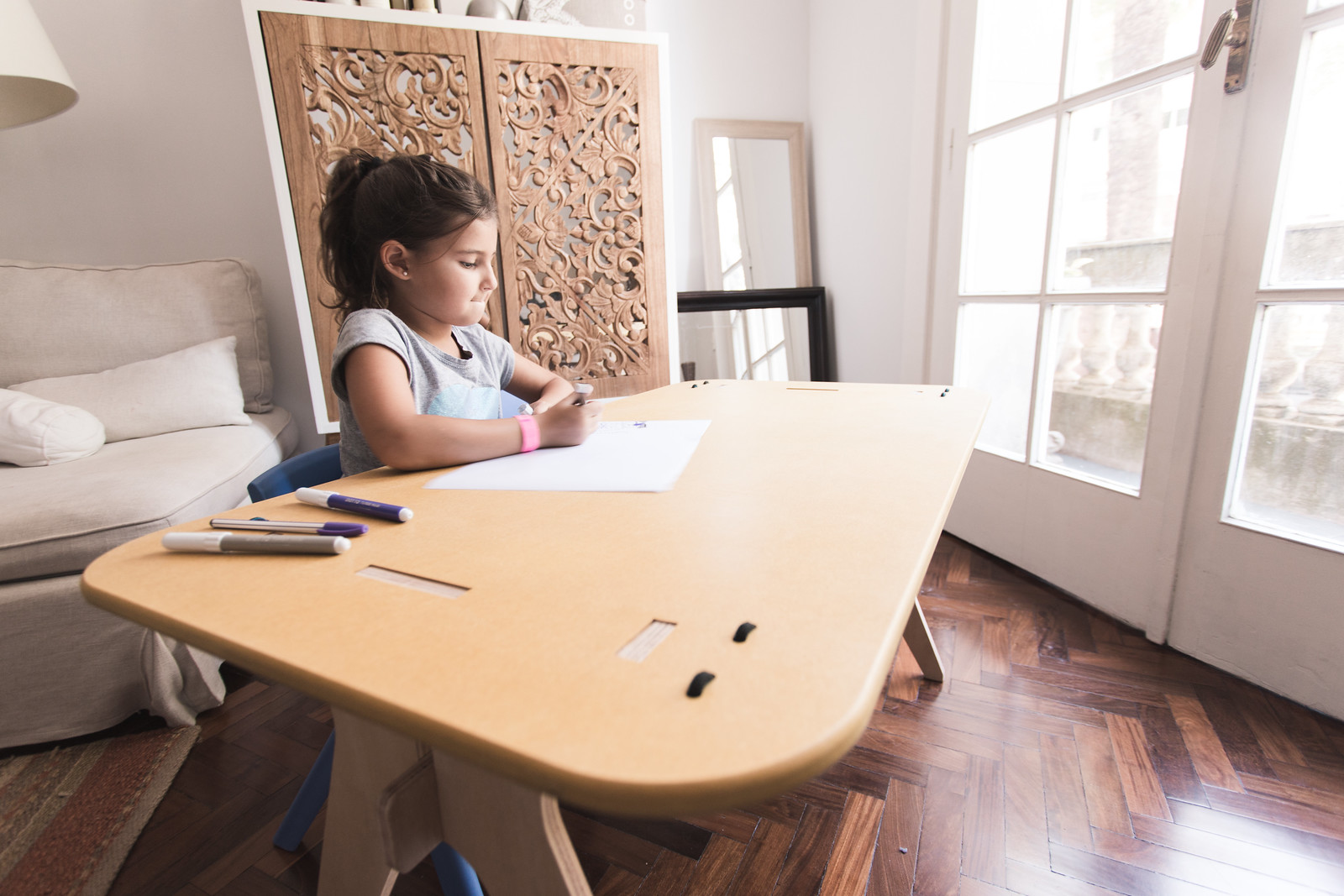
The product line presented by Waldeck offers a new take on classroom furniture: “It is no longer a passive element in the classroom, but rather a central feature and an ally in the activities that take place there.”
The set includes four pieces: a table, a storage unit, a mat, and a wall mount.
The tables can be taken apart, and the design allows children to help with the task. “When not in use, they can be hung up, freeing up floor space for floor activities,” the student explained. Two “sizes” were produced, differing in leg length: one for children ages two to three and another for ages three to five.
The storage unit can be customized to meet each user’s needs and is therefore available in four sizes. “What sets this unit apart from others on the market is its educational component, provided by the corner pieces; each drawer has a cutout in the corner that makes it unique, allowing it to fit only in a specific spot, which presents a challenge for children and helps teachers keep the classroom organized.”
The advantage of these mats is that they can be hung using the same brackets used to hang the tables. The fabric chosen makes them easy to maintain and keeps them hygienic.
Finally, the wall mount can be used to hang both tables and mats. It can also be used as a coat rack.
Incubation at the CIE and arrival at Humanitos
He acknowledged that communication had always been very smooth, right from the very first contact. “Whenever I needed feedback or had a question, they were 100% available. Even during their busiest weeks, they were always willing to meet after hours to bring us up to speed,” he noted.
This dynamic continued when they built the prototype: Waldeck spent two weeks working with them in their workshop.
"The company was very pleased with the results, and the plan is to continue working together on the project. A week ago, we contacted the CIE to move forward with the idea," he said.
At this point, the line developed by Waldeck is in the pre-incubation stage with ORT’s Center for Innovation and Entrepreneurship. “We have to conduct research and prepare to present our project to a committee that will decide whether or not to move forward with the incubation,” explained the aspiring designer.
Meanwhile, the Humanitos preschool —which played an active role in the research phase—expressed interest in the proposal. “They’re going to keep the prototypes, and they’ve already let us know that they’ll likely want more to equip all the classrooms at the preschool,” noted the industrial design student. “This allows us to test the product in real-world use and gather the feedback that’s essential for continuing to improve and move forward.”