
Departmental education coordinating committees occupy a unique position within the Uruguayan education system, although they have received little attention in academic research.
After more than a decade of teaching in the department of Soriano, Agustín Listur—a graduate of the Doctor of Education program at Universidad ORT Uruguaynoted that he had never heard of these committees before.
This observation gave rise to a series of questions that served as the starting point for his doctoral dissertation: What were their objectives? What tasks did they carry out? How often did they meet? Who led and comprised these organizations? Who benefited from them?
Thus, when he began researching the workings of departmental education commissions, Listur confirmed that it was a topic that had received little attention, although it is highly relevant because it allows for an alternative perspective on education policy.
“Educational governance in Uruguay has primarily been analyzed from a macro perspective, but a more departmental and subnational perspective on this phenomenon was lacking,” he stated during the defense of his thesis titled Educational Governance at the Departmental Level: A Case Study in Uruguay.
This research aims to contribute to our understanding of educational governance by examining the operations of a number of education commissions in Uruguay.
However, what are the departmental education coordinating committees? In Listur’s words, they are“departmental, inter-institutionalhubs composed of various stakeholders from primary and secondary education, as well as from formal and non-formal education, along with departmental governments and representatives of the private education sector.”
https://www.youtube.com/watch?v=VOJChR59drc
“The term ‘governance’ is quite polysemous, ”Listur said, since its meaning depends on the country, the author, and the field of study.
In this regard, he explained that while the concept has certain nuances at the European and North American levels, in Latin America it is typically associated with decision-making processes that arise from the interaction among multiple actors, with a focus on achieving common goals.
Governance in the field of education is understood as the framework of relationships among the stakeholders that make up the system, which enables the coordination of actions to be carried out in this field.
Listur's doctoral research focused on changes in the governance of the Uruguayan education system, driven by the Urgent Consideration Act.
In this context, in addition to analyzing the functioning of education commissions, the graduate of the Doctor of Education programdefined the concept of governance within education systems and explored its key characteristics.
To achieve this, thestudyrelied primarilyon a multiple-case studyapproach, although it also included a systematic literature review and consultations with qualified researchers.
Educational governance at the departmental level: a case study in Uruguay highlighted the uniqueness of the Uruguayan case. This was because the education system is “virtually unique in the region” due to the autonomous entities involved and the role of the Ministry of Education and Culture in steering national education policy.
“It was recognized that departmental educational governance exists—albeit with some variations, depending on the case studies—based on an analysis of decision-making processes and the interactions that arise among stakeholders in the educational community, within the framework of a set of regulations,” Listur said, referring to the findings of his research.
Research on this topic helps raise awareness of and highlight the value of these spaces, which serve to mobilize the educational community.
However, the study highlighted several challenges. Regarding the functioning of the departmental education coordinating committees, one of the main shortcomings identified was the lack of regulations, which were not finalized during the period analyzed (2021–2023).
At the same time, the national education policy plan was deemed “unambitious.” Although the plan called for the participation of multiple stakeholders, the graduate noted that effectively bringing together public and private representatives from different disciplines within a single coordination framework “is complicated.”
Listur also explained that there is a lack of clarity regarding what coordinating actions within the department entails. In particular, this is because there is no clear definition of what these bodies are supposed to do, beyond simply bringing stakeholders together. Finally, there is a multitude of overlapping regulations, which causes problems.
“We recognize the importance of promoting efficiency in decision-making and, from there, seeking certain guiding principles that identify best practices regarding the governance of these spaces,” Listur summarized.
Image Gallery

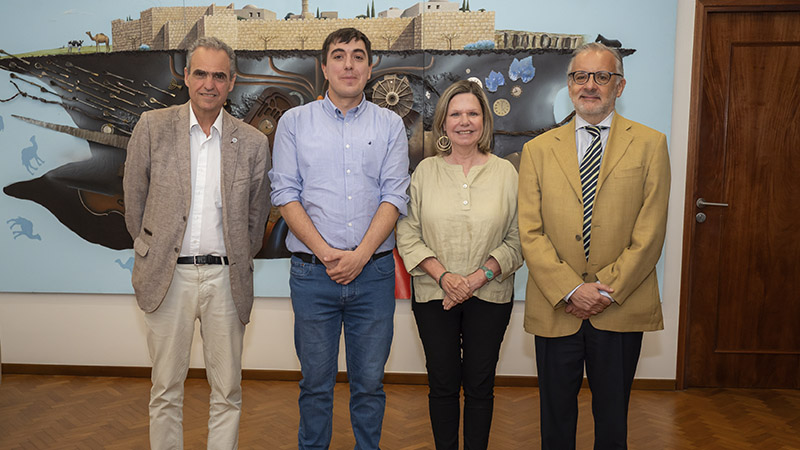
On Wednesday, October 22, 2025, Listur defended his doctoral dissertation in the auditorium of Universidad ORT Uruguay Downtown Campus.
The panel consisted of:
- Denise Vaillant, Dean of the Institute of Education and Academic Director of the Doctor of Education program.
- Javier Lasida, member of the Executive Board of the National Institute for Educational Assessment.
- Renato Opertti, advisor on international projects at the Institute of Education at Universidad ORT Uruguay.
Mariela Questa-Torterolo, associate academic coordinator of the Master’s Program in Educational Management and the Master’s Program in Trainer Development, served as Listur’s thesis advisor.