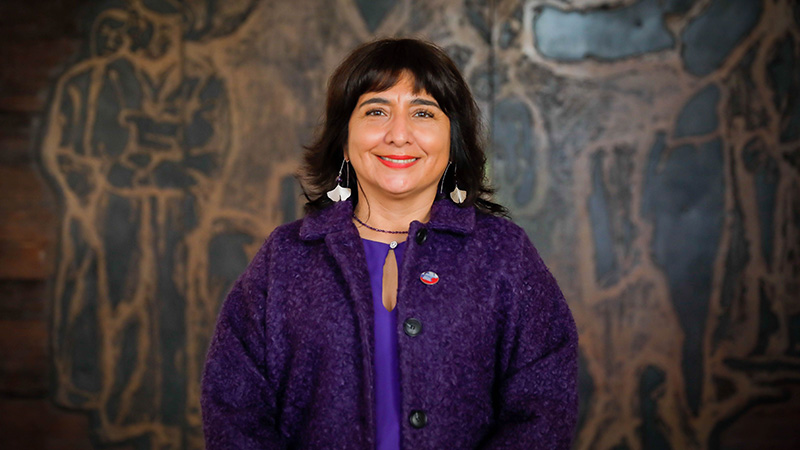
A graduate of the first cohort of the Doctorate in Education program reflected on her experience as Undersecretary of Early Childhood Education during her first few months on the job, while also discussing the knowledge, tools, and lessons she gained after completing her graduate studies at Universidad ORT Uruguay.
It’s been almost a year since you took office as Undersecretary of Early Childhood Education in Chile. How have these first few months on the job been? What’s your assessment so far?
Since early 2022, my career has taken a major turn, as up until then my professional development had been primarily focused on academia—specifically, on teacher training and professional development, research, and university administration.
As part of my commitment to public service, in March of last year, I took over theIntegra Foundation: one of the most important institutions in early childhood education in Chile—with a nationwide presence, more than 1,200 preschools, and nearly 26,000 employees—which provides opportunities for learning, development, and well-being for children ages zero to four.
Then, in September of that same year, President Gabriel Boric invited me to join his cabinet, entrusting me with the task of leading the Undersecretariat for Early Childhood Education, one of the three undersecretariats under the Ministry of Education. This is a rector body responsible for coordinating services and providing technical guidance on educational processes at that level.
During this period, my work has focused on revitalizing education and setting processes in motion to finally make things happen. I have not lost sight of the goal of advancing more substantive, long-term changes, taking into account the social context we face in the wake of the pandemic—a situation not unlike what occurred in Uruguay and elsewhere—because, ultimately, I took office during the transition back to in-person learning.
I think we still lack the perspective needed to fully understand what happened to us during the pandemic, but there’s no doubt that it has affected the education system as a whole and had a significant impact on children and their families. For example, in Chile, we continue to face many challenges when it comes to regular attendance at school and preschool.
It has been a very challenging, very interesting, and very rewarding experience that has allowed me to engage more fully in various social settings where there are children.
You are a preschool teacher, a graduate of the Pontifical Catholic University of Chile, and hold a Master’s degree in Education from the Christian Humanist Academy University of Chile. Why did you decide to pursue your doctoral studies in Uruguay, and specifically at ORT?
I started out as a preschool teacher: I was responsible for leading teams and overseeing different grade levels and groups of children. But at the same time, I was always working within the education system and at the university. I continued my studies, and little by little, I settled more permanently into university life, teaching and conducting research, and taking on administrative responsibilities.
My academic career has always been guided by a focus on the experiential dimension. I was an educator who, from that perspective, trained teachers. When I began to focus more directly on research, it was very clear to me that what truly interested me was the reality of the education system, in a very specific sense: what was happening at the micro level, in classrooms and in interactions.
I had research experience, but it was hands-on. I didn’t have a doctorate, and I began to feel the urge to pursue a graduate degree to formalize and document the work I had been doingfor 20 years. Around that time, I heard that Dr. Denise Vaillant was setting up a Doctorate in Education program in Uruguay. In Chile, as in many places, she is a leading figure. She is a role model in terms of what she writes, what she communicates, and her approach to teacher training and the teaching profession. And I really liked the Doctorate in Education she was proposing.
It was a program for a very diverse group of people, and the participants’ experience and track record were well recognized. At that point, I had been considering whether to study in Chile. Although there were some excellent programs here, none of them appealed to me from that perspective.
In that first cohort I joined, we all came from very different academic and professional backgrounds, but we all had a wealth of experience. As a result, it was a space where a different kind of discussion took place. There was a strong emphasis on bringing our experiences to the table so that we could effectively analyze them and examine them through epistemological lenses. And I really appreciated that perspective from the epistemology of the Global South—as one might say—with a situated view of knowledge and a deeper understanding of educational processes.
In particular, what lessons or tools did you gain during your doctoral program that you think are useful or help you enhance your work today?
From both a personal and professional standpoint, it has been a truly enriching experience. For me, it was a tremendous learning experience. My cohort included students from Uruguay, but also students from other countries, and that was enriching. We formed very close bonds, and to this day, I have dear friends from the doctoral program.
I think the faculty was also important. The way Denise manages to bring together such a diverse yet powerful academic group. For example, I took classes with Dr. Beatrice Ávalos, a Chilean professor who is highly regarded worldwide, and I had never had that opportunity in my own country. There were many very different people who were deeply committed to their work, which allowed us to approach topics from different perspectives, through the discussions that arose and the experience they shared with us. They were highly respected professors, but also, as people, truly admirable.
I particularly appreciate the dialogical, analytical, and much more reflective approach to educational processes in a highly diverse setting. We all brought our research questions to class, which led to a conversation that drew on different perspectives, approaches, and contexts—something I found very valuable.
I remember that all my classmates were able to conduct interesting and diverse studies. At first, I had planned to do a purely qualitative study. Then I met Dr. Celia Rosemberg, who became my thesis advisor, and she helped me broaden my perspective. I ended up conducting a very robust study using a mixed-methods approach, which taught me a great deal.
For example, I had to develop a computer program that allowed me to manage data. I went in with a certain perspective, a proposal, and certain expectations, and I was able to broaden my horizons by getting to know her work and learning from her. The dialogue that emerges and the experience that each person can gain from the graduate program are extremely valuable.
My main takeaway is that I learned a lot, at a stage in life when you think you already know everything—or at least a lot.
During your doctoral defense, you mentioned that the transfer of research findings was something that was truly important to you, and how the knowledge generated could be transformed into an educational tool. Now, two years after that defense, have you continued to research this topic? Have you been able to incorporate the evidence and some of the findings from your research into the policies you are currently developing?
The truth is, I have two half-finished posts because my life has changed. But they’re well on their way, and I hope to finish them soon. Celia Rosemberg and I co-authored a chapter in a book published by the Oportunidad Foundation titled *How to Teach Language Teaching: Essential Practices for the Initial Training of Preschool Teachers*.
Out of professional habit—I’m a teacher and an educator—I always turn the results of my dissertation into a course. Based on the findings of my doctoral research, I developed a course that doesn’t have a name yet, but which focuses on the conceptual framework related to questions, types of questions, questioning styles, and the value of questions as a teaching or pedagogical tool. I’ve used that a lot to lead workshops and, above all, to work on the continuing education of educators. Although I’ve put that on hold for now, I’ll certainly pick it back up once I’m done with this role.
My current work involves designing and guiding the implementation of early childhood education policies. So, the study was very helpful in allowing me to examine educational processes and interactions in preschool education. These days, I am very focused on applying those findings to all our work on educational pathways and the transition between preschool and elementary education, which is a very cross-cutting issue here.
I’m really looking forward to doing something with Uruguay. Another benefit of pursuing a doctorate abroad is the opportunity to learn about different educational systems. I understand that you are in the process of building and significantly strengthening early childhood education. And I believe that this presents an interest and a challenge for me—one that I hope to pursue at some point—which involves collaborating to share my country’s experience much more widely.