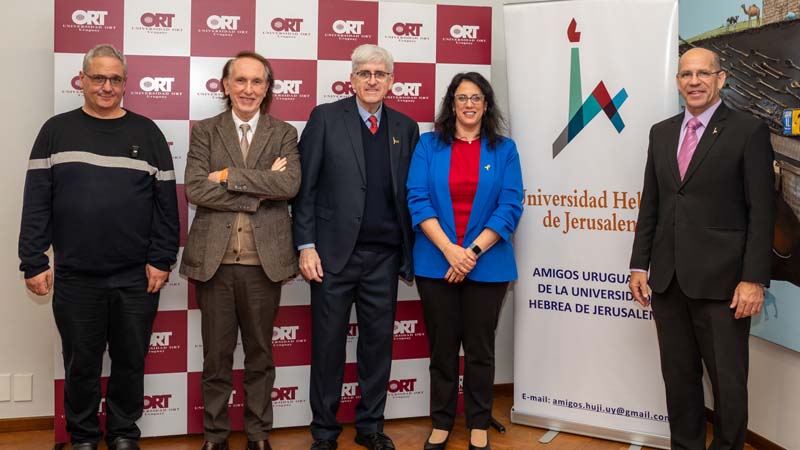
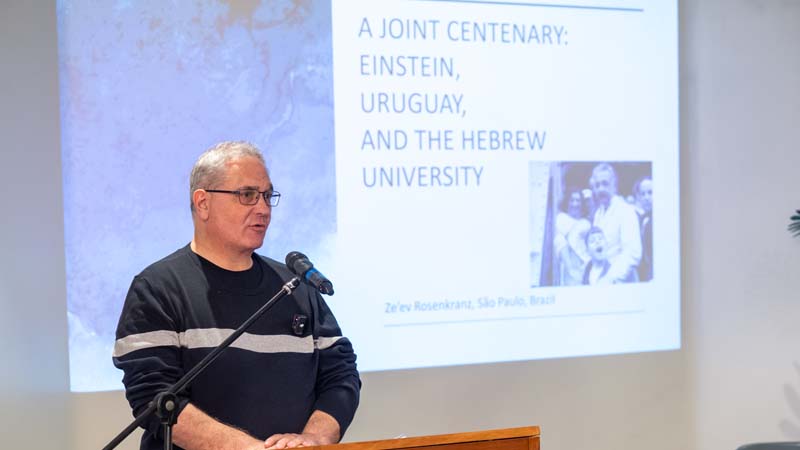
The commemoration of the 100th anniversary of the founding of the Hebrew University of Jerusalem and Einstein’s visit to Uruguay brought together prominent officials and experts: Israel’s ambassador to Uruguay, Michal Hershkovitz; the rector Universidad ORT Uruguay, Dr. Jorge Grünberg; the president of the Uruguayan Friends of the Hebrew University of Jerusalem and member of the Board of Governors, Dr. Gabriel Goldman; and Dr. Zeev Rosenkranz, an expert on Einstein’s archives, who gave a lecture on his travel diaries.
The event, organized by the Uruguayan Friends of the Hebrew University of Jerusalem and Universidad ORT Uruguay, took place in the auditorium of the Downtown Campus on August 6.
In April 1925, Albert Einstein arrived in Montevideo as part of his tour of South America, which also included Argentina and Brazil. The German physicist, already a world-renowned figure thanks to his Theory of Relativity, found himself in a small, modern, and progressive country that pleasantly surprised him.
A hundred years later, his time in Uruguay is remembered not only as an academic and cultural milestone, but also as a valuable personal account. His impressions were recorded in a personal travel journal, which was analyzed in depth by Dr. Zeev Rosenkranz—curator of the Einstein Archives in Jerusalem for over a decade—during the lecture he gave.
A journey with many motivations
According to Rosenkranz, the visit to South America was Einstein’s third major trip outside Europe. Although initially prompted by invitations from Argentina—from academics, journalists, and the local Jewish community—his tour also took him to Uruguay and Brazil.
On a personal level, Einstein was looking to get away from the hectic atmosphere of Berlin, where he was going through a marital crisis and a tense political climate. Although he wasn’t enthusiastic about the busy social schedule that awaited him, he was very interested in meeting scientists and students from each country.
His initial wish was to cross the ocean in silence, not to become a public figure besieged by tributes and receptions.
Uruguay: A Pleasant Surprise
Although he was critical of the superficiality and elitism he perceived in parts of Argentine society, his impression of Uruguay was very different. In his diary, Rosenkranz explained, Einstein wrote:“In Uruguay, I encountered genuine warmth, the likes of which I have rarely experienced in my life.” He appreciated the love for the land, the nationalism without exaggeration, and the simplicity of its people.
He found Montevideo to be a welcoming city, with charming architecture and a down-to-earth atmosphere. He also praised the country’s liberal institutions, the secular nature of the state, and the high standard of education. At that time, Uruguay had the highest literacy rates in Latin America and one of the lowest infant mortality rates on the continent.
This social and institutional climate was a direct result of the reforms spearheaded by President José Batlle y Ordóñez in the preceding decades. As Rosenkranz noted in his lecture, Uruguay had undergone a transformative process marked by significant advances: the Eight-Hour Workday Law, labor rights, legal divorce, secular and compulsory public education, the separation of church and state, and a political system committed to social welfare.
Lectures, walks, and memorable gatherings
During his brief stay, Einstein gave three lectures, each attended by about 2,000 people, organized by the Association of Engineers and the Polytechnic Association. He strolled along the promenade, went to the theater to see *La Traviata*, and held meetings with President José Serrato and the Minister of Education.
He was received with respect by both the authorities and the local academic and Jewish communities. He stayed at Naum Rosenblatt’s home and was honored at a banquet organized by the Jewish community.
Among the local figures he met, he singled out the philosopher and rector the University of the Republic, Carlos Vaz Ferreira, whom he described as“a decent man who speaks French worse than I do and is shy in company.” Although brief, the comment, as mentioned by Rosenkranz, suggests a warm and respectful view of one of the country’s most important intellectual figures.
An unfiltered look
Einstein's diary, preserved in the archives of the Hebrew University of Jerusalem, was written in private, in a telegraphic style, and with no intention of publication. As a result, it reveals his most intimate thoughts without self-censorship.
Rosenkranz noted that his time in Argentina was marked by harsh criticism of the elites, whom he considered frivolous and intellectually limited. He wrote of Buenos Aires: “A comfortable and boring city, with plenty of luxury, but lacking in romance and intellectual life.” Although he softened his judgment after meeting students who impressed him, he maintained a critical view of the country’s social life.
In contrast, his experience in Brazil was visually stunning. He was fascinated by the tropical vegetation, the geography, and the ethnic diversity of Rio de Janeiro. “It is a delight to see Portuguese people, Black people, and all kinds of individuals,” he wrote, albeit from a perspective that was still Eurocentric. He described the country as a “true paradise,” though he also acknowledged that he felt like “a white elephant among little monkeys,” an expression that today reads as clearly paternalistic.
Einstein and the Hebrew University: A Long-Standing Commitment
The commemoration of the 100th anniversary of his visit also coincides with another anniversary: the centennial of the Hebrew University of Jerusalem, an institution to which Einstein was deeply committed. He was one of its driving forces and served on the founding committee.
During his lecture, Rosenkranz also discussed Einstein’s connection to this university. The German physicist envisioned it as an intellectual refugefor the Jewish people, especially for those who were being persecuted in Europe.
A legacy that endures
Albert Einstein did not propose any new theories in Montevideo nor did he spearhead local scientific reforms, but his brief visit to Uruguay was a celebration of knowledge, critical thinking, and cultural dialogue. Through his diary—and thanks to researchers like Rosenkranz, who have analyzed it in depth—Uruguay emerges as an anomaly on his journey: a small country that managed to earn his sincere admiration.
A century after his visit, Einstein’s words about Montevideo still hold emotional and symbolic significance. They continue to speak of a country that has committed itself to education, secularism, and human development.
https://youtu.be/neM_VpyUwvE