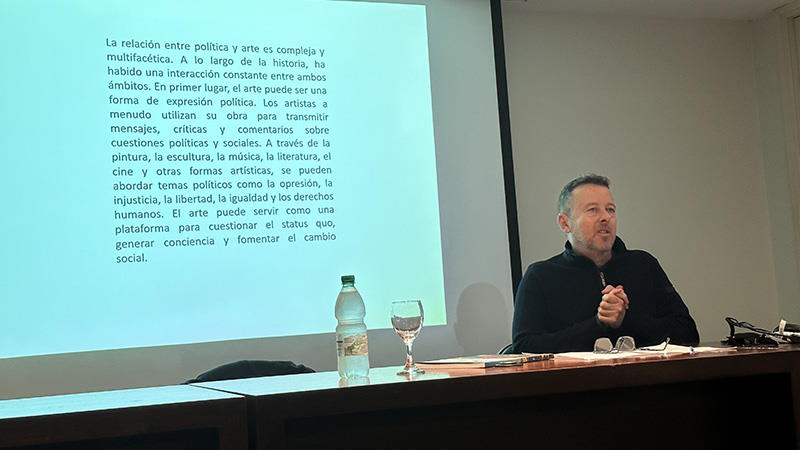
“We live in a hyperconnected and hypertransparent society: the lines between the public and the private are very blurred,” the artist stated. In today’s system, we are expected to be constantly producing content, and all of that content is in the public domain—which today is social media.
Meanwhile, the private sphere is considered “a fundamental space for the development of individuality and autonomy.” But what is the problem with everything taking place in the public sphere? “The foundations of society are being undermined because there is no counterbalance from the private sphere.”
Under the title “Art and Politics for the City”—a theme as broad as it is challenging—Alfredo Ghierra spoke at the “Culture and Communication” class for third-semester students in the Bachelor’s Degree in Communication program, taught by Professor Micaela Chebi, on June 22.
Alfredo Ghierra has studied architecture, art, and audiovisual media. Since 1994, he has held solo and group exhibitions both within and outside Uruguay. He currently lives and works in Montevideo, serving as an art director in the audiovisual field. His character Ghierra Intendente, created in 2010, is a political and nonpartisan artistic performance in which a large group of artists, architects, and designers come together to envision and plan the city.
Can art influence politics?The Ghierra Intendente collective is working to prove that it can.
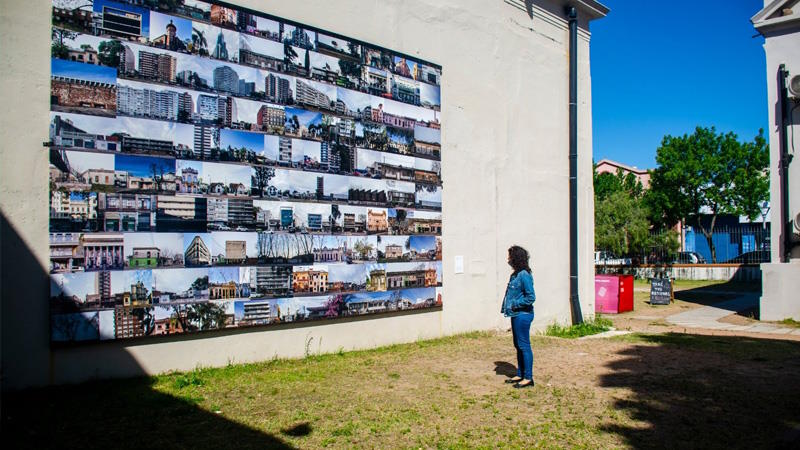
Ghierra Intendente is an art project that brings together architects, visual artists, designers, and art directors to reflect on, propose ideas for, and ask questions about the city of Montevideo. During every municipal election campaign, Alfredo Ghierra’s image appears throughout the capital as another candidate, even though it is actually a cultural performance.
Regarding his involvement in various election campaigns, Ghierra noted that politicians are taking an interest in the initiative and even “going so far as to copy some of our approaches,” such as when Daniel Martínez arrived at City Hall by bicycle. “They reach out to me; they know there are a lot of people thinking this way. I think they’re paying attention, but we’re proposing a cultural shift, and that takes a long time.” Ghierra’s campaign slogan is: “You can’t vote for us, but you can copy us,” because they aren’t so much interested in the method as they are in seeing the projects carried out.
“Art has the potential to bring about change,” Ghierra explained. “Art can shape national identities and narratives, including historical ones. The reality of what is happening is one thing, and the narrative surrounding it is another—and that narrative itself changes depending on who holds power.”
Art can draw attention to social and political issues, foster empathy, and raise awareness among the public. Works of art can address controversial topics and give a voice to minorities and the powerless.
To illustrate this, he cited several examples in which works of art highlighted situations of social criticism:
- The Potato Eaters, by Vincent van Gogh
- The Great Dictator, by Charles Chaplin
- The Abandoned City, by the University of the Republic
In closing, Ghierra encouraged the students to consider how they could do more for the city— whether through artistic performances, such as Ghierra as mayor, or by forming a political group.