
Sports are no strangers to the data revolution driven by technological advances. Every goal in soccer, every three-pointer in basketball, and every pedal stroke per minute in cycling generates a massive amount of data that only big data can make sense of.
On their own, these data points are irrelevant, but when placed in the right context and organized properly, they become valuable insights for organizations, franchises, leagues, clubs, and individual athletes.
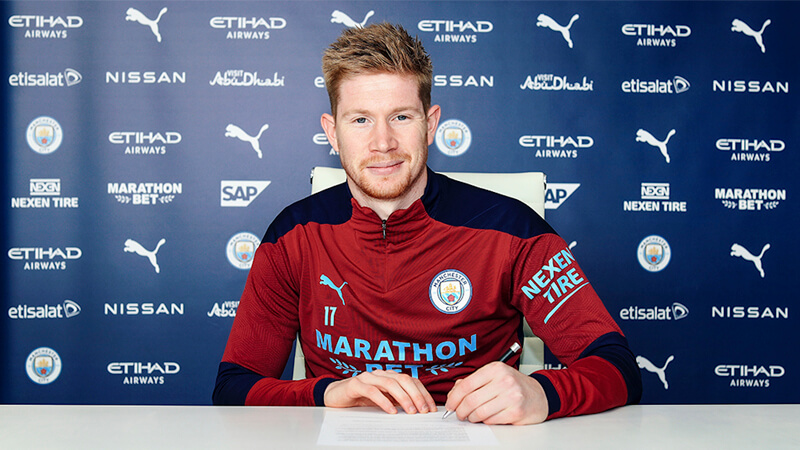
In early April of this year, Kevin De Bruyne’s contract extension made headlines in the soccer world. The Belgian player agreed to remain with the English team Manchester City following an effort by data analysts—hired by the player—to negotiate with the club without the involvement of an agent.
The analysts' study examined every relevant aspect of De Bruyne's contribution to the team and the impact of his performances on Manchester City's results so far. As a result of this negotiation, the player became the highest-paid player in the Premier League (the English league), with his weekly salary rising from £300,000 to £385,000—amounting to just over £20 million annually.
Data-driven decisions

Convinced that information is power, Juan Morosoff, a student in the Specialization Diploma in Marketing Management at Universidad ORT Uruguay, believes that “the proper processing and analysis of data provide information that is truly relevant and objective for decision-making.” He adds that, in the field of sports, this information can be directed to the coaching staff, technical department, and physical trainers, among others.
Morosoff is a graduate of the Expert Course in Sports Data Analysis and Big Data at the University of Valladolid (Spain), and of the Course in Soccer Analysis and Scouting, which is accredited by the Real Madrid University School (Spain). He says he became interested in soccer data analysis after meeting an analyst for the Egyptian national soccer team at the 2018 World Cup in Russia.
Similarly, Aldo La Marca, a graduate of the Bachelor of Arts in Communication with a concentration in Journalism at ORT, believes that data analysis in sports is “simply about giving meaning, perspective, and a clear context to that mass of numbers and figures that can be overwhelming to anyone dealing with them.”
La Marca earned a master's degree in Sports Big Data from the Catholic University of San Antonio in Murcia, Spain, and has professional experience in the field, having worked for the sports analytics firm Opta; he is currently a writer and content creator for Stats Perform, the company that owns Opta.
 Among the many apps that may be available within the data analysis related to the sports industry, what is most commonly found today, both in clubs and national teams, is strictly sports-related: the scouting and video analysis.
The first, says Morosoff, is characterized by a focus on “individualized monitoring and analysis of an athlete.” Furthermore, according to La Marca, scouting is essential “in a team’s sports planning: identifying promising young talent, measuring and tracking their progress, evaluating the performance of specific players, and researching potential players to sign based on the team’s needs, among other things.”
On the other hand, video analysis has various aspects related to a team’s overall tactical or physical performance. In other words, it focuses on “how they attack or defend, their strengths and weaknesses, how an opponent plays and how I can beat them, and more,” says the ORT graduate with a degree in Communication.
Data from the inside
These days, winging it when it comes to how the opposing team plays is a thing of the past, which is why the vast majority of professional clubs have data analysis teams. “Any team that doesn’t analyze at least the basics of an opponent is at a disadvantage,” says Estéfano Zammarelli, a graduate in Computer Science from ORT and co-founder of the AZSportech project alongside Krikor Attarian—also a graduate of the same program and currently a professor at the university—.
AZSportech is a video analysis company that grew out of the thesis project of two graduates and was supported by the university’s Center for Innovation and Entrepreneurship (CIE); its first client was none other than the Uruguayan national soccer team.
"The biggest challenge today is knowing how to filter the information gathered and interpret it in a way that makes sense to decision-makers," says Estéfano Zammarelli.

Driven by his desire to devote himself fully to soccer and coaching, Zammarelli left the company in 2018 and went on to serve as an assistant coach and video analyst at Libertad in Paraguay and Hanoi in Vietnam; he currently heads the analysis and scouting team at Nacional in Uruguay.
There, he works directly with the front office and coaching staff to provide them with all the necessary information “in a friendly manner” so that decisions can be made quickly and effectively, as much as possible.
According to Zammarelli, “data always depends on context,” which is why working as part of a coaching staff helped him see how data is viewed from the other side—which data is useful and which isn’t.

AZSportech, meanwhile, continues to work with Óscar Tabárez’s national team. The company provides him with “statistical reports, pre- and post-match analyses, opponent analyses, and synchronized match analyses, among other services,” says Attarian, who remains at the helm of the company, which works not only with Uruguay but also with numerous other clubs, federations, and coaches.
Sports teams don't live by results alone…
In the sports industry, data analysis isn't limited to strictly athletic applications. The Miami Heat's Data Platform team, led by Patricia Yelpo, who holds a degree in Information Systems from ORT, is a prime example of this.
Yelpo has been working for the NBA basketball team since 2016 and has held the position of Data Platform Manager since 2017. His team of analysts operates on the principle that the customer (Heat fans) is the top priority: “They are the ones we serve, and the better we know them, the better we can understand them.”
The Data Platform team is responsible for identifying who attends the AmericanAirlines Arena (home of the Miami Heat), who spends money on tickets, food, apparel, merchandise, and other franchise-related services and products. For this reason, data is, in her view, the most important and valuable asset.
“Our goal is to ensure that the right message is conveyed through the right channel to the right audience at the right time, always drawing on a single source of truth: the data we collect,” he says.

According to him, his team created an internal PowerApp that provides access to a 360-degree profile of each customer. It tracks everything from how long a fan has been attending Miami Heat games, which game they last attended, and which section (seats) they usually buy tickets for, to how much they spend on food, apparel, and other team-related services and products.
According to Yelpo, this data is important for “categorizing fans into different segments based on their profiles.” All of this information, once collected and processed, is then used for the franchise’s sales and marketing strategies.
Although the Data Platform team is based with the Miami Heat, it has developed a robust product that demonstrates a deep understanding of NBA data analysis, positioning it as a leader in the industry; it now also works with the Milwaukee Bucks, another team in the league.
However, the Heat’s team only handles “the transfer of data from transactional systems to data warehouses” through the aforementioned PowerApp. It is the Bucks’ own data analytics team that manages and analyzes their data, Yelpo clarifies. And it makes sense: this season, the Milwaukee Bucks are the Miami Heat’s opponent in the first round of the NBA playoffs.
In addition, the team led by the ORT graduate is also working on a project with the NBA to serve as its primary provider of data on all teams.
According to the computer science graduate, they “are proud to have been selected by the NBA after demonstrating that their products are essential and applicable in various fields.”
More modern processes for better interpretation
Both Yelpo and the other ORT graduates and students mentioned agree that technological advances are essential to the practice of data analysis. “The processes have become more robust and accurate.”
“The processes that are automated for us today were originally tracked using Excel spreadsheets sent via email, which became outdated as soon as the numbers changed,” explains the Heat’s Data Platform Manager.
“Our goal is to ensure that the right message is delivered through the right channel to the right audience at the right time, always based on a single source of truth: the data we collect,” explains Patricia Yelpo.
Along the same lines, but with a focus on sports, Zammarelli asserts that technology is essential for managing today’s enormous volumes of information and video content. “Today, you have free information on the web—already collected, analyzed, and available to everyone,” he says.
He also believes that, given this vast amount of data, the biggest challenge today lies in “knowing how to filter the information gathered and interpret it so it can be presented to decision-makers.” In his case, this means the coaching staff at Nacional; in Yelpo’s case, the marketing department or Heat executives.