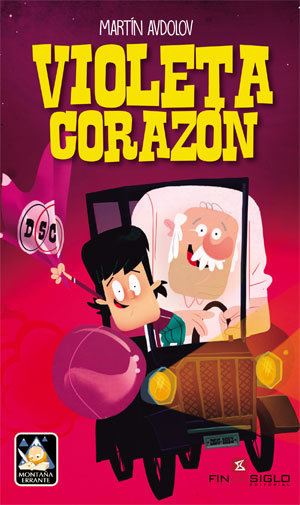
Chelo is 10 years old and has been a Defensor Sporting fan ever since he was in his mother’s womb. One day, he discovers with great excitement that his grandfather César has built a time machine using an old motorcycle that had been abandoned in the garage. Together, they set out to travel through the rich history of the club they love. They visit every significant place and event in the club’s more than 100-year history, all while making sure no one discovers their big secret.
What does a glass factory have to do with soccer? Why is the Punta Carretas lighthouse on the team’s crest? How did Defensor forever change the history of Uruguayan soccer? What does a “bombonerazo” mean? And much more.
Meanwhile, Chelo must deal with the typical problems of a boy his age: the arrival of a new sister, threats from the older kids at school, and a soccer match that will determine whether they qualify for the interscholastic tournament.
Violeta corazón is a book dedicated to Defensor Sporting fans, but also “to every child who chose not to follow the crowd.”
The author is Martín Avdolov, who holds a degree in Advertising Communication and specializes in audiovisual content. He is a professor at the School of Communication at Universidad ORT Uruguay, a freelance advertising professional, and the creative director of the production company Fábrica de Formatos, part of OZ Media.
In an interview with In situ, Avdolov discussed the challenges he faced with his first novel and what it’s like to write for a young audience.
This is your first novel. Why did you choose to write for children, and why did you focus on soccer—specifically Defensor?
It all started with a request from the publishing house Fin de Siglo. The Montaña Errante children’s book series already included novels about Nacional and Peñarol, and they wanted one about Defensor as well. They knew I was a fan and that I also wrote, so they got in touch with me. We met up, talked at length about the direction the novel should take, and a few weeks later I started writing it.
The novel tells Chelo's story, but also that of Defensor Sporting. How did you go about weaving the two stories together?
Fortunately, I had access to previous works by Luis Prats and Julio César Franzini, which provided me with a wealth of information and anecdotes. My job, then, was to adapt that information and translate it into language that would appeal to children. That’s where Chelo, her grandfather, and the time machine come in. I wanted to create a story that was both fun and touching. Reading the novel, I think I was able to achieve my goal.
To some extent, is Chelo's story your story?
I'm not as good at soccer as Chelo. But it does remind me a lot of my childhood. Especially the Sunday family lunches and the trips to Franzini with my father. Those are memories I cherish deeply, and I carry them with me always.
You say it’s a book for “purple kids,” but also for “all those who decided not to follow the grown-ups.” Why?
Because Defensor’s history is steeped in defiance. And perhaps it serves as a success story for other clubs that also lack large fan bases and big budgets. That’s why I think many children can relate to its story, regardless of which team they support.
You've created content for children before. What's the biggest challenge when it comes to communicating with them?
I’ve created quite a bit of children’s content, both as a creator and a screenwriter. I believe the main challenge lies in understanding children—putting yourself in their shoes despite differences in age and generation. To do that, you have to observe carefully and do your research before you sit down to write.
In my opinion, creating content for children is one of the riskiest jobs there is. Children don’t have to please anyone; they’re 100% authentic—they either accept you or they don’t.
From a communication standpoint, what values do you think are conveyed through your book, *Defensor*, and soccer to a young audience?
The book explores many values beyond sports, such as teamwork. I placed special emphasis on family relationships and the revival of wholesome traditions that, unfortunately, are gradually being lost. In a society that lives in a constant state of frenzy, it’s good for people to find values to hold onto: family, friends, and the club they love. All of these contribute positively as long as they are experienced in a healthy and positive way.
You're the creative director at OZ Media. What projects is the production company currently working on?
This year, TNU is premiering *Laboratorio en casa*, a children’s sitcom about science. We’re about to start filming *Los misterios de Rolo y sus amigos*, a project for which I wrote all thirteen episodes and which has already won several awards. Rolo is a very unique detective who goes on all sorts of adventures, while he and his team solve mysteries using math and lateral thinking.
I believe that Uruguayan children are gradually gaining access to high-quality national educational content. For many years, it seemed as though their intelligence was being underestimated. We are working to provide them with the best possible education.