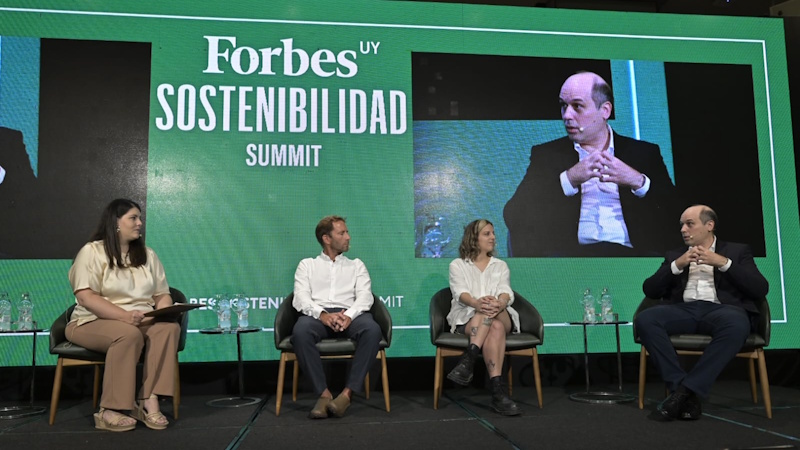
Dr. Nicolás Gambetta, academic coordinator of the graduate programs in Accounting and Taxation at Universidad ORT Uruguay; Santiago Kröger, director of Bitafal; and Nina Sinacore, creator of the Instagram account Bitácora de Playa, shared their perspectives on the importance of collaboration and innovation in times of uncertainty. The discussion took place at the Forbes Sustainability Summit 2025, organized by Forbes Uruguaymagazine and held at the Hyatt Centric on March 27.
Four Keys to Driving Change in Companies
Gambetta highlighted the four key aspects that every company must consider in order to manage risks and adapt to new challenges:
- Governance. Structuring business decisions with transparency.
- Risk management. Identify and mitigate both internal and external risks.
- Strategy. Long-term, forward-looking planning.
- Measuring progress. Assessing and measuring progress in sustainability and risk management.
“It is crucial for companies to manage risks—not only internal ones, but also those arising from the environment in which they operate,” said Gambetta, emphasizing the importance of taking action in the face of current uncertainty.
Sustainability and the Impact of Small and Medium-Sized Enterprises
One of the highlights of the presentation was the importance of small and medium-sized enterprises (SMEs) joining the transition toward sustainability. Gambetta emphasized that “if SMEs do not get involved, it will be a problem for Uruguayan society as a whole, ” calling for collective action. He emphasized that, in a globalized world, it is not just about what large companies do, but about how all stakeholders integrate into the sustainable value chain.
Collaboration between businesses and academia
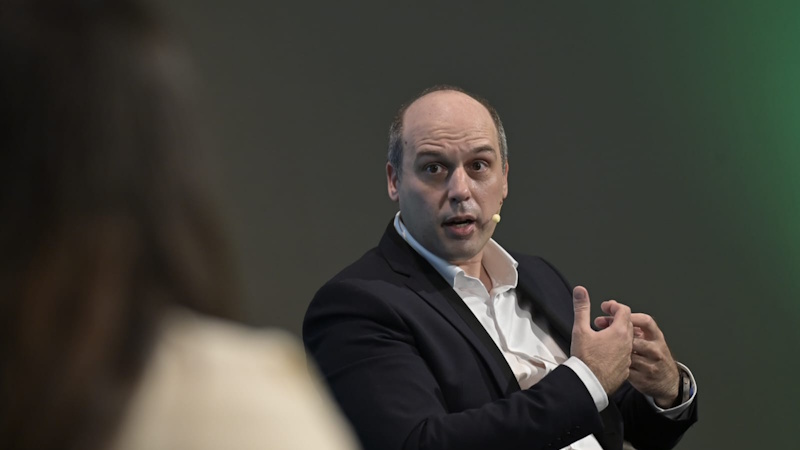
Another key issue addressed by Gambetta was collaboration between businesses and academic institutions. “It’s a collective effort,”he said ,referring to the need to share knowledge, research, and advancements. He highlighted the work done by ORT, which for years has been training professionals to tackle the challenges of sustainability. He invited companies to reach out to academia and work together to develop sustainable solutions.
Innovation for sustainable development in a changing world
Santiago Kröger, who also participated in the panel discussion “How to Drive Change,” emphasized that sustainability should not be viewed as an additional expense, but rather as an opportunity to innovate and become more competitive in the global market. “Being sustainable doesn’t mean being more expensive; it means being smarter, ” Kröger noted, opening the discussion on how innovation can serve as a driver of sustainable development.
Corporate social responsibility and responsible consumption
Gambetta stated, “The risk of staying on the sidelines is being left out of the value chain.” He emphasized that companies must actively engage in the shift toward responsible consumption and adopt sustainable practices to ensure their relevance in the future. “Sharing what you’re doing creates a ripple effect and can motivate other companies to join this process, ” he said, calling for transparency and collaboration.
Repurposing Waste and Its Social Impact
Nina Sinacore, creator of the Instagram account Bitácora de Playa, shared her personal and professional insights on how art can be a powerful tool for change.
With her focus on upcycling waste, Nina highlighted how she collects discarded objects from beaches and gives them a new lease on life through her art.
The Collective Impact: A Call to Action
The panel concluded with a reflection on the need for us all to work together to make a real impact. Sustainability is not an isolated effort by businesses, but a challenge that involves society as a whole. The shift toward a sustainable model must be a collective effort, in which businesses, academia, and consumers work hand in hand to build a more responsible future.