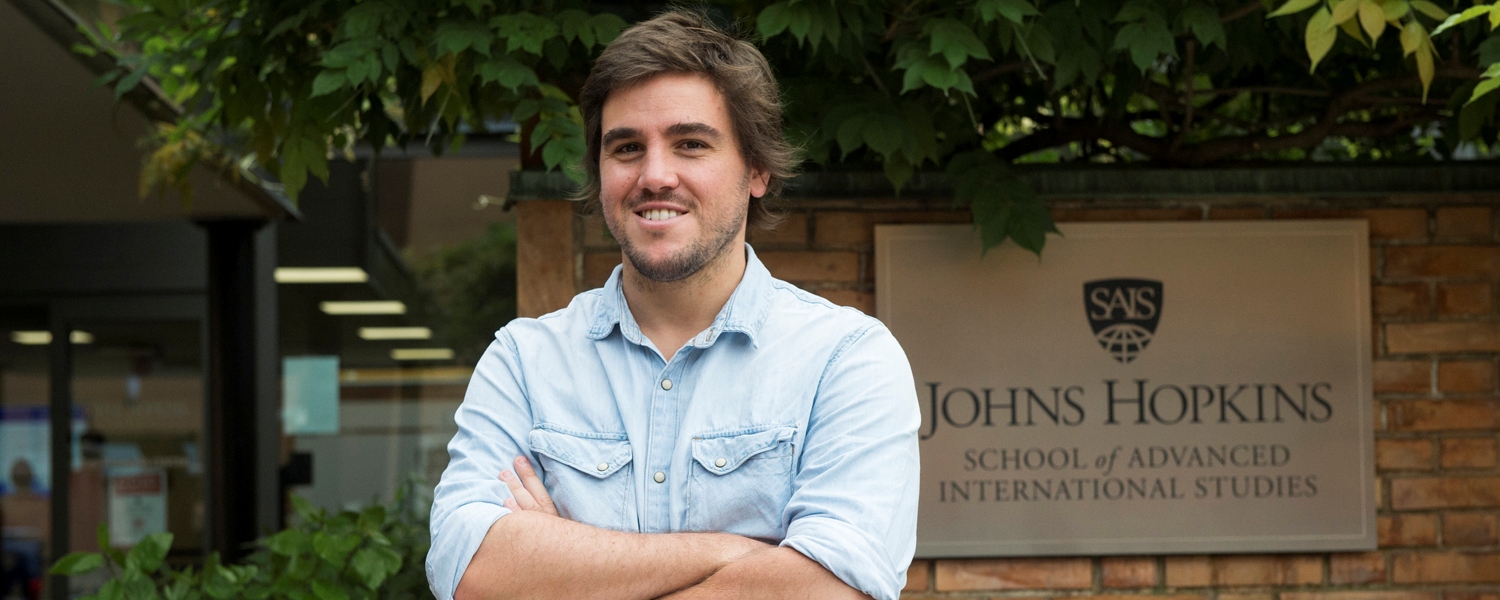
* Image credit: Fabio Fantuzzi.
Interview with Diego Murara, a graduate of the Bachelor’s program in International Studies, who is currently pursuing a Master of Arts in International Affairs at Johns Hopkins University. The master’s program lasts two years: the first year is held in Bologna, Italy; the second, in Washington, D.C.
What has your career path been like?
Before starting college, I worked at the family business. When I began my bachelor’s degree in International Studies, I changed jobs. I moved to Infonecta, a foreign trade company. After that, I worked in various departments at Merrill Lynch, which was later sold to the Swiss bank Julius Bär.
With this sale, I became a marketing assistant for all of Latin America. The marketing department underwent a major rebranding, so we needed to build a strong connection with our customers. We launched an intensive campaign that included a variety of events. While working there, I was fortunate enough to meet top-tier speakers such as the writers Mario Vargas Llosa and Isabel Allende. It was a win-win situation—both professionally and personally.
In 2014, I served as community manager for Pedro Bordaberry, and in 2015, I ran for mayor as a candidate for the Colorado Party in Municipality E. I was elected as a municipal councilor and deputy mayor. I had the opportunity to serve as mayor of the municipality on several occasions.
What skills did your bachelor's degree in International Studies give you?
The foundation I gained during my undergraduate studies is very solid. Now that I'm pursuing my master's degree, I realize that in every subject we cover, I had a very solid foundation from my undergraduate studies.
Having an international perspective on topics such as politics or finance is becoming increasingly valued. Understanding how the world works. I believe the greatest value of the program lies in its interdisciplinary nature.
The degree program was a great asset to me. The knowledge I gained from my International Studies major was essential for interacting with high-level speakers, bank clients, and people from other countries. The global perspective the program provides is extremely helpful in understanding client profiles.
What twists and turns has your career taken?
I started out studying law, but I didn't like it at all. Later, when I was deciding what to major in, I really loved all the courses in the International Studies program. I looked at them and knew I'd be eager to take them, but I had this doubt: "What good will this do me?" And the truth is, from the very beginning, I had jobs—good jobs—doing things I enjoyed.
I've always been lucky to be able to combine my work with my personal interests. While working at the bank, I asked if I could keep my job if I ran for mayor, and they told me they appreciated people getting involved in social issues, so I had the opportunity to do both.
I love politics, history, and understanding how the world works. I also love business and working in the financial and economic sectors. Why did I choose the master’s program I’m in? Because it allows me to delve deeper into these areas.
For my master’s degree, we’re required to complete an internship at an international organization, company, or government agency. I came to São Paulo to do mine, working for two months at Control Risks, a British firm that provides political risk analysis for various companies—in other words, assessing the impact of economic and financial decisions made by companies and different government agencies. It’s one of the best in the field. From São Paulo, they serve the Brazilian, Argentine, Paraguayan, and Uruguayan markets. Considering that Argentina and Brazil are currently going through a very turbulent political period, it’s amazing to be working here.
You spent your first year of graduate school in Bologna, Italy. What was it like studying at that university?
That's great. There are five programs, participants from over 50 countries, and a wide range of subjects to choose from.
Bologna is a lovely city; you feel right at home from day one. Plus, it’s very easy to travel to cities like Rome, Milan, and Florence. It’s a unique, unforgettable experience.
What are you learning in your master's program?
The master's program began in August 2017. As early as 2015, I started seeking advice on how to go about it and preparing for exams. I just finished my first year.
It focuses on global topics such as international economics, international finance, energy, and resources. The other option is to focus on specific regions of the world, such as Europe or Asia. In my case, I chose to focus on Latin America. Although I decided to concentrate on this region, the program includes comparative studies, so we cover a little bit of everything. For example, I took a course on the risks of international decision-making. At the same time, you can take language courses such as Chinese, Russian, and Arabic.