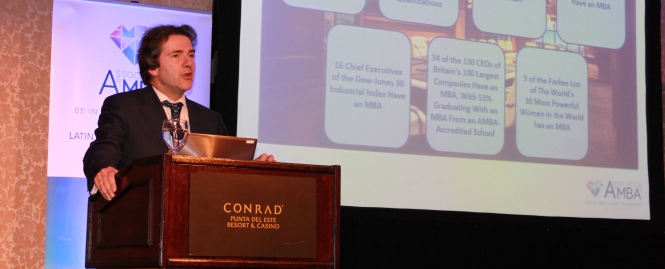
Interview with Andrew Main Wilson, MBA, Chief Executive of the Association of MBAs (AMBA) and director of the 12th AMBA Latin America Conference for Deans and Directors, one of the world’s three leading MBA accrediting bodies.
The event, which was co-organized by the School of Business and Social Sciences, took place at the Conrad Hotel in Punta del Este from Wednesday, September 30, to Friday, October 2, 2015, coinciding with the 25th anniversary of the MBA program at Universidad ORT Uruguay.
Before joining AMBA, Wilson served as Chief Operating Officer of the Institute of Directors (IoD), where he held various positions since the late 1990s. He also served as Chief Commercial and Marketing Officer at Thomas Cook and as Director of Marketing and Sales at Citibank Diners Club.
-What are the benefits of earning an MBA, especially an accredited one?
-The main benefit of an MBA is that it helps you become a better leader. If you're going to pursue an MBA—if you're going to invest all that time and energy—you'll want to attend the best school you can.
The advantage of attending an accredited school is that you know it meets AMBA’s international standards. If you aren’t familiar with the institution in detail, knowing that it is accredited is a reassuring sign of its quality standards.
The world is changing faster than ever before; it is more globalized and more uncertain. I believe it has never been more important to have a well-rounded education, with a curriculum that enables you to make decisions under pressure and master areas outside your area of expertise.
Typically, someone in their twenties may be an expert in one or two areas, but if they want to get promoted or become a general manager, they’ll need a comprehensive understanding of finance, marketing, operations, strategy, and leadership.
An MBA is the best program for gaining that experience. It’s a qualification recognized worldwide. When you go to job interviews or seek a promotion within your own company, your bosses will recognize the skills an MBA program can provide.
-What are the most important benefits of this type of conference?
-I think there are three benefits. First, discussing the key issues facing the industry and addressing the question of where the industry is headed over the next five to ten years.
Second, it’s a great opportunity to network with 50 colleagues from all over Latin America, all in one place for 48 hours. It’s the only way you can meet so many people in your industry in such a short time.
Third, it gives participants the opportunity to reflect on their own business schools and how they are performing compared to others in the region.
-What do you expect to happen at business schools in Latin America following this conference?
-I believe that people will return home to share their ideas and insights with their colleagues and explore ways to strengthen their MBA programs in the future. We should keep in mind that we have delegates from Mexico, Colombia, Ecuador, Peru, Chile, Brazil, Argentina, and Uruguay—all of Latin America’s major markets.
-Where do you think Latin American business schools are headed?
-The business school market in Latin America looks strong. It is quite unusual—compared to Europe, for example—that more than 90% of MBA students are enrolled in part-time programs.
However, I think this is a positive development at a time when the Latin American market is facing financial challenges—such as in Brazil and Argentina—because it means that the MBA program remains very sustainable.
Here, it’s common to continue working at your job while pursuing a part-time MBA. About 40% of MBA students in Latin America are enrolled in an MBA program that is at least partially funded by their employer, so they can afford to keep working and earning an income to pay for their degree.
It’s clear that many Latin Americans—ambitious young business leaders—want to gain international exposure and develop a broader understanding of business beyond their own country and region. The MBA is the best program for exposing you to ideas from Europe, North America, and Asia, as well as the rest of the continent. So I believe it has a bright future in Latin America.