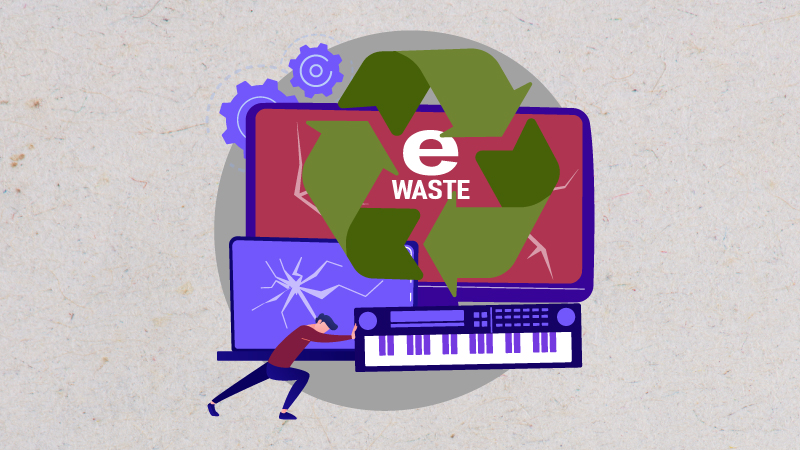
“The key is to shift the paradigm,” says Inés Tiscornia, deputy coordinator of the Environmental Management Department at Universidad ORT Uruguay: moving from a linear economy—where resources are extracted, products are made, and waste is discarded—to a circular economy, so that all resources become part of technical and biological cycles again, and implementing the principles of reduce, reuse, and recycle within these cycles to optimize resource use.
Tiscornia also leads the ORT Recicla campaign, which was launched in 2016 with the goal of improving the institution’s waste management and promoting environmental awareness. This initiative was further solidified in 2019 with the establishment of the Environmental Management Department, which focuses on monitoring waste recycling and promoting responsible consumption.
So far in 2022, the university has recycled 300 kilograms of polyethylene terephthalate (PET) plastic bottles, 1,654 kilograms of paper and cardboard, and 600 kilograms of waste electrical and electronic equipment, which at this point in the year (four months in) has already surpassed the annual average of electronic waste recycled over the past three years. Between 2019, 2020, and 2021, a total of nearly 1,800 kilograms of electronic waste was recycled.
Why is it important to reduce, reuse, and recycle?
It’s important to reduce waste because the best waste is the waste that isn’t generated in the first place. Anything we can avoid helps minimize the use of resources (raw materials, energy, water) needed to produce goods, and we’re also reducing the amount of waste we generate.
It’s important to reuse items because it extends the useful life of a product or its packaging. We can use the product for its original purpose or find a new use for it, until it can no longer serve a function—at which point we should send it for recycling.
Recycling is important because we are recovering materials that can still be used to make new things. It’s a way to make the most of the resources that were originally used to produce them, and we’re avoiding the use of new raw materials to make new products.
Some materials are infinitely recyclable (such as aluminum or glass), but the necessary technology must be available in the country for that to happen. It is also essential to have clear information about what materials are recycled and how.
What does ORT do to encourage these behaviors?
We implement initiatives aligned with these principles of environmental awareness and communicate them. In 2017, we began sorting and recycling paper, cardboard, and PET bottles. We properly manage special waste, such as electronic waste. In 2018, we eliminated plastic cups from water dispensers. In 2019, we held a sustainability fair aimed at promoting responsible consumption. We have environmental requirements for the cafeterias (which are outsourced).
In 2020, we entered a ranking that evaluates universities based on the SDGs (Sustainable Development Goals), and we received a very high rating.
In the results of the 2022 Impact Ranking published by Times Higher Education (THE), Universidad ORT Uruguay ranked between 401st and 600th out of the 1,406 universities that participated in the global ranking, based on its performance in areas covered by the 17 SDGs adopted by UN member states.
What is the goal of the ORT Recycle campaign?
What we are trying to promote within the university is a shift in mindset, so that an ORT graduate would be surprised to start working in a place where waste isn’t sorted, and so that they themselves become the driving force behind such changes. It is an integral part of a university education—to see concrete actions in their daily lives that contribute to caring for the environment.
Recycling is part of a larger effort—the goal of the ORT Recicla program—to raise environmental awareness among students and staff. To achieve this, it is essential to take concrete actions and keep the communication campaign active by providing information and new content.
How did the pandemic affect environmental awareness and recycling campaigns?
At the university, the amount of PET bottles we recycled dropped significantly. Paper and cardboard weren't affected as much, since the vast majority of them come from certain university departments that continued to operate.
People's behavior has changed in some ways—for example, they've gotten used to ordering food delivery. This comes with the major drawback of generating single-use plastic waste, such as the packaging typically used for deliveries. We see this at the university; students order delivery for lunch instead of eating in the cafeteria.
Do we generate a lot of electronic waste in Uruguay?
I would say that we tend to be careless in our use of electronic devices, and this results in a lot of electronic waste. For a long time, electronic devices were designed to have a short lifespan and be irreparable, which means that if something breaks, you have to throw away the entire device. In contrast, the current trend is to promote the repair of such devices.
Within Latin America, we are the country that generates the most waste electrical and electronic equipment (WEEE); I believe this is due to the economic situation, which allows people to buy devices such as cell phones, tablets, and televisions more frequently. But this happens all over the world.
How can we address this? By raising awareness about the importance of using these devices responsibly and disposing of them properly.
Why is e-waste so important?
This type of waste is quite complex; it consists of a wide variety of items (such as cell phones, refrigerators, and air conditioners) and contains highly toxic compounds. Dismantling this waste for recycling is a largely manual process, which makes it difficult to process.
Globally, there is a massive accumulation of this waste, and in Latin America, there are very few records of waste that has been properly managed. For several years now, work has been underway on a project aimed at improving the management of this waste stream: PREAL—the Latin American Electronic Waste Project.