 There is an oil spill in the mar is polluting the environment—how can this be resolved? Producing a bacterium that absorbs the oil is one possibility, since living organisms do not pollute. This is one of the applications of biotechnology, a term that may sound very technical but has everyday uses. On the other hand, the insulin needed to treat diabetes also comes from biotechnology, as do the development of vaccines, crops, and improved foods.
Biotechnology is becoming increasingly well-known. Politicians, journalists, environmentalists, and doctors are all talking about it. It is clearly a growing field of science. “There is an awareness of the importance of this issue,” stated Carlos Sanguinetti, M.Sc., Academic Coordinator of Biotechnology at the School of Engineering.
“When students graduate from high school, they should try to imagine what Uruguay will be like in 10 years—and that’s where each student’s vision comes into play,” added Deputy Academic Coordinator Jorge De Los Santos.
Biotechnologists are well aware of the specific applications of this promising field. Their main task is to convince investors to support their work. “It is our responsibility as researchers to raise public awareness of the importance of investing in science and the impact this can have on Uruguay’s future…a future that is not so far off,” says Dr. Lorena Betancor, a research professor of biotechnology.
Mariana Ferrari, Coordinator of the Biotechnology Laboratory, agreed with Dr. Betancor’s view and added that this is a field that is having an increasingly significant impact on the global economy.
“The biotechnology industry in the country has had to develop its own workforce by training professionals from other fields,” says the coordinator. “For these reasons, Universidad ORT Uruguay launched its Bachelor’s Degree in Biotechnology three years Universidad ORT Uruguay and aims to train the next generation of scientists.”
Biotechnology is applied both to products and processes that originated thousands of years ago—such as wine or bread—and to more complex technological developments involving plants, animals, microorganisms, and even humans. It integrates the knowledge and techniques of biochemistry, microbiology, chemical engineering, and, above all, genetic engineering. As a field with these characteristics, it requires specific training, which is relatively new in Uruguay. The Bachelor’s Degree in Biotechnology “is unique in Uruguay, and its greatest advantage is that it produces a graduate profile distinct from that of alternative degree programs,” noted Ms. Ferrari. “The most advanced students are already entering the job market. They are the ones who will showcase the graduate profile in practice and open doors for future generations,” she added.
A personalized career path
A close bond unites them. It is not only the teacher who experiments, but the students as well. Biotechnology is not taught from a blackboard, but through trial and error—by making mistakes and starting over.
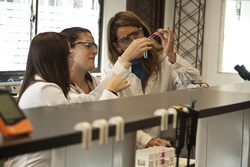
Students can work with chemicals, test tubes, and microscopes. These tools are readily available and accessible to everyone. Each piece of equipment is an integral part of students’ daily lives in the Biotechnology Lab.
The personalized approach, combined with small class sizes, is what sets this degree program apart. Students in the program complete a minimum of 140 hours of practical training each year. Through this hands-on experience, they acquire skills that help them enter the job market.
The coordinator emphasized that the degree program includes courses related to the social and economic-productive sectors, which is quite novel for science-based university programs in our country.
A passion for risk
Students who choose this major must possess certain specific qualities. “They have to enjoy working in the lab, generating knowledge, and opening doors—even if there’s darkness on the other side. They have to embrace risk, since they’ll be doing this to create new things, and new things are always risky,” said Mag. Sanguinetti.
A taste for risk, the ability to overcome setbacks, and patience are traits that, according to the Coordinator, set apart the biotechnology student who takes on the challenge of an experiment.
Currently, the laboratory is collaborating with companies on projects to produce vaccines, develop a biopesticide, and immobilize proteins, among others. These projects require hard work and perseverance, even though results aren’t always immediate—and that’s where the ability to take risks, trust in one’s work, and be patient comes into play.
Work experience
“The program teaches you about business and legal matters. You don’t become an expert, but it gives you a basic understanding that puts you ahead of others when it comes to landing a job,” said Florencia, a 23-year-old undergraduate student. “You can contribute your perspective in an interdisciplinary group discussing business or legal issues,” noted Rodrigo, a 21-year-old student.
The students believe that the knowledge they’ve gained isn’t limited to the scientific field. “You learn certain things that you didn’t see before. I used to think only of Uruguay. And now I realize that Uruguay is just three million people—that’s it. You learn to think big,” added Florencia. “It really broadens your perspective on things,” concluded Miguel, a 28-year-old student.
Dr. Betancor maintains that the program incorporates fundamental scientific, business, economic, and social elements. “A key strength is the heavy laboratory workload and the use of state-of-the-art materials and equipment. This approach is innovative and therefore sets it apart from other similar programs in the region,” she said.
“Academically speaking, it gives you valuable experience when applying for a job. Based on what I’ve learned here and the kind of work we do, I consider it a meaningful experience. I see that we have a significant advantage,” said Lucía, a 29-year-old student. Furthermore, the Academic Coordinator did not hesitate to state that “the job market is looking for people with this kind of training.”
Furthermore, abstraction plays a significant role in the program. Students engage with a parallel line of thinking—one grounded in science—where terms such as molecules, protocols, cultures, and transgenics are part of their everyday vocabulary and activities.
A fun lab
The mid-morning light reflecting off the test tubes, workbenches, and microscopes brings the laboratory to life.
But what really brings the lab to life is the arrival of those eager to get their hands on the materials laid out—in order—on the three large workbenches set up there. The materials are no longer left untouched; instead, the students begin to handle them, just like a child who sees a box of toys and can’t wait to take them all out.
It’s striking that the white refrigerator doesn’t contain food but rather chemicals. The lab coats the students wear are also white. They’re part of their everyday attire, which contrasts with their colorful shirts, scarves, and jeans. Their conversations revolve not only around biotechnology but also around their daily activities and concerns; however, when it comes time to focus on the protocol (experimental procedure), it becomes the center of their attention. They move back and forth, consult the instructor, get frustrated if they fail to achieve their goals, and smile when they see the concrete results of the assigned task.
The lab is just like life itself: there are frustrations and joys, obstacles and achievements; there are responsibilities to fulfill and goals to reach. It’s a journey that requires hard work, patience, and perseverance, but along the way, there’s always a sense of fulfillment. In short, it’s a place where people come together.
Interview published in January 2013
News
"The job market is looking for people with this kind of training"
January 21, 2013
There’s an oil spill in the mar polluting the environment—how can it be resolved? Developing a bacterium that can absorb it is one possibility, since living organisms don’t pollute. This is one of the applications of biotechnology, a term that may sound very technical but has everyday uses.