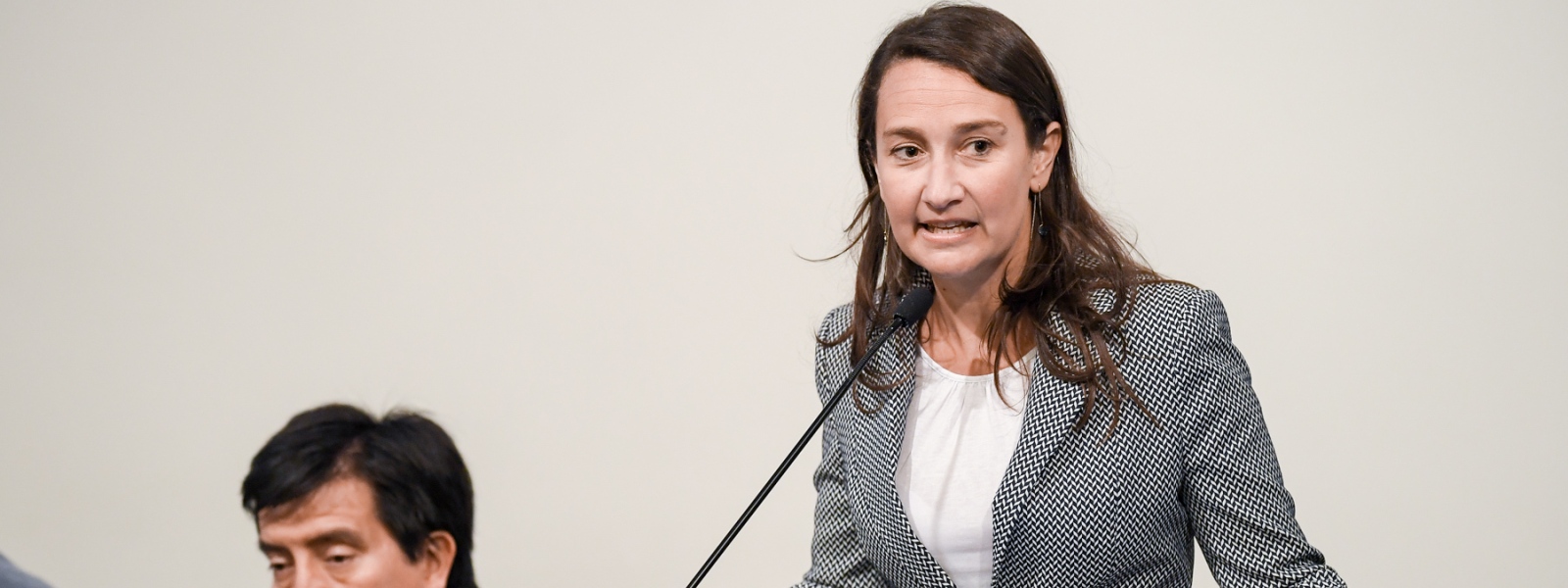
“Through Mercosur, we have a truly broad agenda for negotiations with third parties,” said Ambassador Valeria Csukasi, Director General for Integration and Mercosur Affairs at the Ministry of Foreign Affairs, during the 7th Specialized Seminar on International Trade.
The event, which took place on Thursday, October 25, 2018, was organized by the Chair of International Trade and the Department of International Studies at Universidad ORT Uruguay featured presentations by Ambassador Valeria Csukasi, Diego Fernández, a member of the Trade Policy Advisory Office at the Ministry of Economy and Finance, and María Noel Laborde, director of Viasendo.
The Digital Certificate of Origin: A Work in Progress
According to Diego Fernández, the Digital Certificate of Origin (COD) is a tool designed to facilitate trade, offering—among other benefits—significant cost savings for all parties involved.
The COD project was developed by Aladi as part of a process that has been underway for a decade and includes a database for validating digital signatures. In Uruguay, Agesic is the agency responsible for overseeing digital signatures.
“Uruguay is embarking on a path toward the widespread use of the COD,” Fernández explained. Since April of this year, the COD has been used in trade with Argentina and Brazil, with the aim of helping to eliminate the use of paper in Mercosur trade. “There are theoretical benefits, as well as those verified by customs authorities, ” Fernández said. “In reality, we can see that its use is growing every day.”
Fernández said that they are working with Paraguay to adopt the COD in 2019 and set a date for phasing out paper, and that they are in discussions with various business associations to that end. In addition, there are plans to implement a pilot program involving Chile, Mexico, and Colombia, with the ultimate goal of securing the participation of all ALADI member countries.
The Evolution of E-commerce
"Transactions are no longer conducted in person; instead, they are increasingly taking place on websites or marketplaces," explained María Noel Laborde, an economist, as she outlined the concept of cross-border trade and provided statistical data on Internet penetration at the global and national levels.
According to the speaker, two interesting trends are emerging in the e-commerce sector: first, the global scale of e-commerce; and second, the fact that transactions are increasingly being conducted via mobile devices.
Laborde explained that international trade is shifting away from being exclusively business-to-business (B2B) toward a business-to-customer (B2C) or consumer-to-consumer (C2C) model. In this context, intermediation costs are reduced and reaching customers is simplified, which means that SMEs have increasing opportunities. “A key factor in this is having strategic partners, ” he noted.
Similarly, the logistics sector is undergoing a major transformation, shifting its focus from B2B to B2C. Customs authorities are also in the process of adapting to this new reality.
Laborde concluded his presentation by highlighting the challenges of cross-border trade, including the high risk of fraud, the need to develop payment methods, the challenge of tailoring messages to different audiences, and the importance of treaties and agreements that facilitate smoother transactions.
“There is potential for Uruguayan companies to enter the U.S. market and reap the benefits. The question is whether we’re taking advantage of it,” he said.
Negotiations and Opportunities
“Through Mercosur, we have a truly broad agenda for negotiations with third parties,” said Ambassador Valeria Csukasi when discussing the status of the country’s international negotiations.
Negotiations with the European Union (EU) began more than 20 years ago; however, the ambassador noted that, ideally, such processes should be completed within two years.
Csukasi explained that the EU’s interests span several sectors that compete with those of Mercosur, whose strongest area is agriculture. “The problem we face when negotiating is that we have to understand Mercosur for what it is,” he said, adding that while it is not possible to impose a negotiating agenda, it is possible to propose alternatives.
“We haven’t fully figured out, on either side, where the boundaries lie,” he explained. “There are certain concessions that Mercosur cannot make,” he added, which has kept negotiations at a standstill for the past six months.
The ambassador said that maritime traffic, the dairy industry, and the automotive sector are among the most significant issues in the negotiations. One possible explanation for the lack of progress is the refusal to acknowledge that the demands have reached a limit that cannot be exceeded.
“We still believe there is an opportunity in these negotiations,” Csukasi admitted, adding that Mercosur’s renewed negotiating stance has attracted trading partners with whom there has always been an intention to reach agreements, such as the European Free Trade Association (EFTA) and Canada.
“The negotiations with Canada are highly pragmatic, and that’s fantastic for Mercosur,” he said, explaining that the Canadian representatives know what they want and how to achieve it, and are open to exploring different options. “There is a real chance of reaching an agreement next year.”
Full lecture:
https://youtu.be/7Y5SR_lAryM?si=1KDY5MnNIwqmdBd7
Image gallery:
