https://www.youtube.com/watch?v=TKNk7Z7UxOU&t
The event “Results of the 2nd Edition of the Sustainable Development Monitor” took place on Friday, December 3, 2021. Presenters included Dr. Nicolás Gambetta—academic coordinator of the graduate programs in Accounting and Taxation at Universidad ORT Uruguay, Level I researcher with the National System of Researchers (SNI), and Executive Advisory Board Member of the Australian Studies Center— Mariella de Aurrecoechea, MBA —Director of Strategy and Innovation at Deloitte Spanish Latin America, Sustainability Leader at Deloitte S-LATAM, and Partner in charge of the Risk Advisory practice in Uruguay— and María Croci, MBA —Executive Director at DERES - Companies for Sustainable Development—.
The three dimensions
The Sustainable Development Monitor (SDM)—which has academically has by the Deloitte Chair in Management and Accounting for Sustainable Development at Universidad ORT Uruguayaims to periodically measure indicators of the economic, social, and environmental performance of DERES member companies and analyze how these indicators evolve over time.
The MDS was developed following a careful review of academic literature and a study of similar tools from around the world. The monitor consists of 17 indicators, organized into three dimensions— environmental, social, and economic/governance—which are aligned with the United Nations Sustainable Development Goals (SDGs).
It has been determined that each dimension carries nearly equal weight: environmental: 33% (comprising four indicators, each weighted at 8.25%); social: 33% (comprising five indicators, each weighted at 6.60%); and economic/governance: 34% (comprising five indicators, each weighted at 5.67%, plus three indicators, each weighted at 1.89%).
For each of the 17 indicators , a target was set based on a technical benchmark or the average score achieved by participating companies for that indicator, calculated by industry sector (this is a methodological change included in the second edition to account for the characteristics of each industry sector in these indicators).
Results
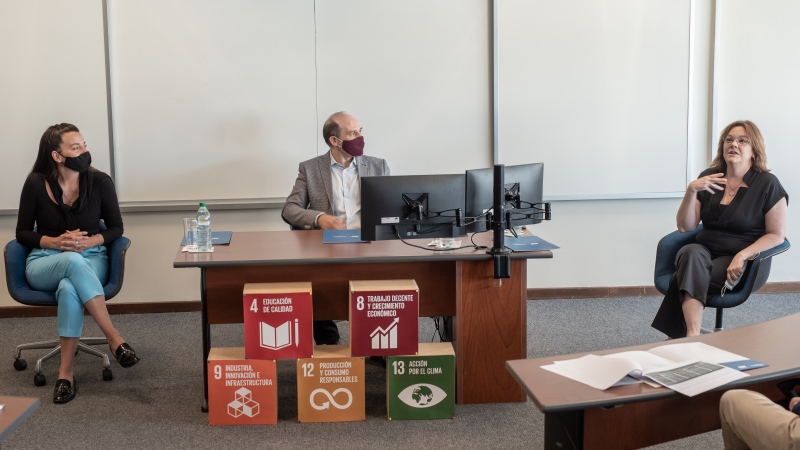
Forty-two DERES member companies participated in the second edition, for which the MDS was calculated for the years 2019 and 2020 (in the first edition, 27 companies participated, and the MDS was calculated for the years 2017 and 2018). “We are very happy and proud to have doubled the number of participating organizations this year,” Croci noted regarding this pioneering tool for Uruguay.
The 2020 Sustainable Development Monitor shows an average score of 56.01 for participating companies, while the score for 2019 was 56.21, with 100 being the maximum.
The slight decline in the MDS in 2020 compared to 2019 reflects mixed performance across its three dimensions. The social dimension saw an increase, rising from an average of 19.38 in 2019 to 19.65 in 2020. This is due to an increase in corporate investment in R&D and a decrease in workplace accidents.
Meanwhile, the economic/governance dimension rose from 24.56 in 2019 to 24.71 in 2020. “We have companies with very active boards of directors; there were very few fines among participating companies; practically all of them have a code of ethics; and there is also a positive balance regarding the ratio of fixed to variable compensation. We are making good progress in this area,” noted Gambetta. These points, which are currently being successfully implemented, fall under the economic/governance dimension.
Finally, the environmental dimension showed a decline. The average score in 2020 was 11.66, down from 12.26 the previous year. This is because indicators related to the efficient use of resources—such as energy, water, emissions, and waste—have deteriorated. Given that the maximum score for this dimension is 33, this is where companies have the greatest opportunity for improvement.
“To make progress in the MDS, it is essential to continue providing information on the organization’s data—keeping in mind that the financial data is anonymous—and to measure and improve the efficiency of resource use,” added Gambetta.
In terms of average results by industry, the "Finance, Insurance, and Real Estate" sector posted the strongest performance on the MDS, rising from 60.04 to 62.19. This sector was followed by "Transportation and utilities," which rose from 59.95 to 61.21, and "Industry," which rose from 55.16 to 55.63.
Finally, Aurrecoechea stated: “The goal of the MDS was to assess how organizations are performing in terms of environmental, social, and economic performance. In Uruguay, there was a need for a tool that could demonstrate this, promote transparency, and provide input for public policymakers.”
The Impact of COVID-19
Experts attributed certain declines in the MDS results to the effects of the coronavirus. In terms of environmental performance, business activity declined, leading to a decrease in all indicators (energy, water, emissions, and waste) and lower resource efficiency, as a certain level of activity is maintained without the corresponding revenue.
Social performance “improved only slightly, but it did improve” and showed mixed results. In 2020, there was an overall improvement, but there was less training, less social and corporate responsibility, and higher turnover. This is clearly due to the fact that employees worked remotely because of mobility restrictions resulting from the health emergency.
On the positive side, Gambetta noted that there was an increase in research and development (R&D). “Companies took advantage of the slowdown to think about how to emerge from the crisis and how to transform themselves. There was investment in R&D. We encourage them to keep it up.”
In terms of economic and governance performance, there was a marginal improvement, with mixed results. COVID-19 contributed to lower revenues, but on the other hand, profitability increased (likely due to lower operating costs). Also in this area, there was an improvement in women’s participation in leadership roles, an indicator where consistent progress is being made.
“The impact of the pandemic is evident and can be analyzed in each of the indicators. The SDM captured what was happening in this regard. This is positive because it means that companies are providing us with very good information—they are sharing high-quality data—and, furthermore, the results show that the Sustainable Development Monitor is a robust tool for measuring companies’ triple bottom line, ”the expert stated.