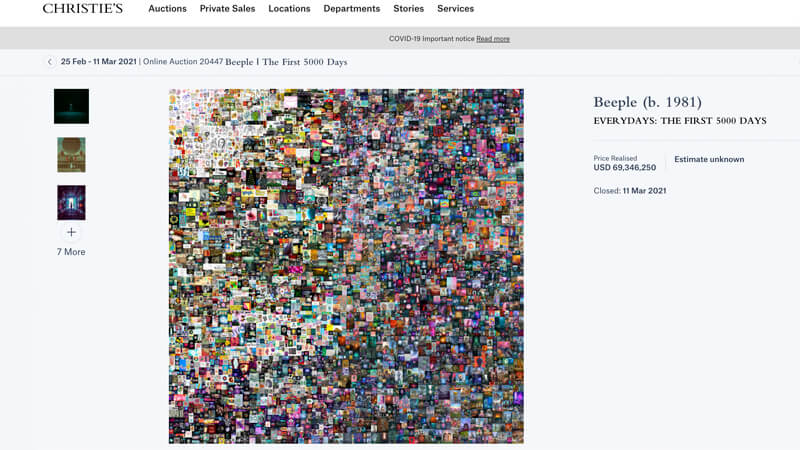
For the first time in history, a fully digital work of art has reached a value of $70 million. In early March of this year, the London-based auction house Christie’s sold the piece *Everydays: The First 5,000 Days* by American-born artist Mike Winkelmann (better known as Beeple) for that amount.
The event garnered significant international attention because it was a work created entirely digitally, in a context where videos, GIFs, memes, and photos are constantly being reposted all over the internet. How, then, is it possible that a digital piece has acquired such value?
According to the academic coordinator of the Bachelor’s Degree in Design, Art, and Technology at Universidad ORT Uruguay, Fabián Barros, the key lies in non-fungible tokens, which operate on the basis of blockchain technology.
-
What impact does it have on the art world that a completely digital artwork has sold at auction for nearly $70 million?
This isn’t the first time a digital object has been sold at auction. For example, just a few weeks ago, Jack Dorsey’s first tweet was auctioned off for $2 million. But the fact that a work of art created and distributed entirely in digital form has reached this market value marks a disruptive shift in the way we produce and consume digital art.
A piece of digital art, like any other digital product, is a set of data that can be manipulated, distributed, modified, or replicated through digital channels.
Because of this, digital artworks have historically been very difficult to sell. But thanks to new distribution technologies, digital art has been able to make the leap into the art market.
This is good news because, on the one hand, it expands the market, and on the other, it opens up new opportunities for artists to make a living from their work.
-
What are the characteristics of the artwork in question?
"Everydays: The First 5,000 Days " is a digital collage that, in a way, serves as a retrospective. It is a compilation of thousands of digital artworks that Beeple created daily over the course of 13 years. The collage blends abstract, surreal, absurd, subjective, and figurative images with themes such as fear, society, technology, wealth, and politics.
However, what makes this work unique is not its technique or content, but rather the technological platform used to distribute it.
The work is the first to be sold at a major auction using what are known as unique ownership identifiers for non-physical objects, or non-fungible tokens (NFT s). An NFT is a certificate that grants ownership of a unique digital item, whether it be a visual work, a piece of music, a written text, or any other digital product.
-
How do NFTs work, and what do they mean for the world of digital art?
NFTs allow you to sell images, memes, GIFs, videos, music, and all kinds of digital artwork as if they were physical objects. They operate using blockchain technology, a data structure in which information is grouped into interconnected sets (or blocks) on a timeline. The information in each block is encrypted and can only be altered by modifying all subsequent blocks. This makes blockchains reliable and secure, enabling the development of cryptocurrencies, such as Bitcoin.
However, unlike cryptocurrencies, which aim for widespread adoption, NFTs were created so that digital items can become unique, authenticated, and certified pieces with a single owner who has the right to sell the work.
-
What requirements must a piece of digital art meet in order to incorporate the use of NFTs?
For a digital artwork to incorporate an NFT, it must use blockchain technology. In other words, it must be a piece of cryptoart.
Crypto art is a category of digital art that emerged in the late 2010s, alongside the development of Bitcoin. Crypto art quickly grew in popularity due to its unprecedented ability to be bought, sold, or stored by anyone in a decentralized, secure, and verifiable manner.
What makes NFTs extraordinary is that their potential is unimaginable. We may be witnessing the dawn of a new legal, independent, and self-regulated industry for the production and consumption of artistic content.
-
Are NFTs the missing piece that digital art needed to achieve the same value as traditional art?
The crypto art market is booming. According to Bloomberg, the sector generated approximately $250 million in 2020, representing a 300% increase over 2019.
NFTs allow digital artists to expand their reach through new mechanisms and new commercial platforms. All signs point to blockchain technology having arrived in the art market to stay, to the point of making Beeple one of the three most valuable living artists in the world, alongside Jeff Koons and David Hockney.
In the news
- Controversy: Digital Art Is Gaining Value, Radio Sarandí