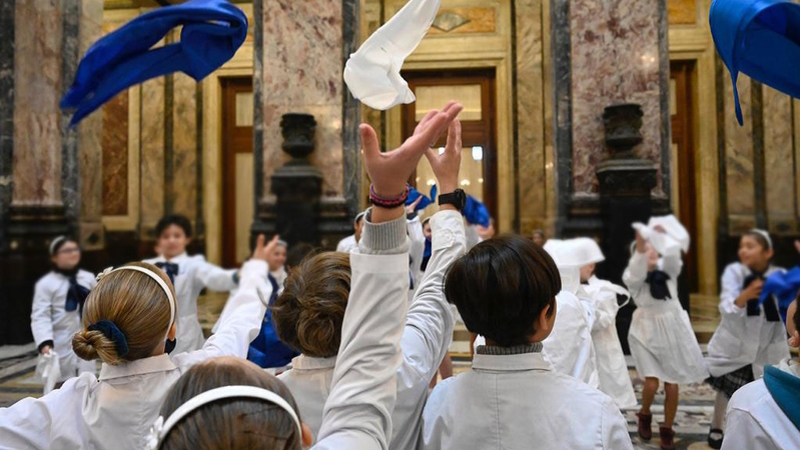
Whether in borrowed clothes, outfits made especially for the occasion, or even uniforms or white tunics, there are countless variations in the attire people have worn while dancing the pericón at school, but white, light blue, and yellow scarves are always a common thread.
This distinctive dance continues to be practiced in elementary schools, even as the years go by. But unlike the payada or the guasquería—cultural performances typical of rural areas—the pericón had never been recognized as part of our country’s intangible cultural heritage… Until now.
In mid-June 2023, the Ministry of Education and Culture (MEC) designated the national pericón as part of Uruguay’s Intangible Cultural Heritage. According to Analía Fontán, a graduate of ORT’s Master’s in Education program and coordinator of the publication *Pericón: ¡Aura! *, which was presented on the day of the declaration ceremony in the Hall of Lost Steps at the Legislative Palace, this move settled a major debt the country owed to an element that is fundamental not only to Uruguayan identity but also to schools.
Fontán earned his master’s degree in 2018, when he completed his studies with the thesis ¡ÁHURA! The Practice of Pericón in Uruguayan Schools, from an Educational Perspective, supervised by Mag. Adriana Careaga. In it, the graduate sought to understand the incorporation and persistence of Pericón as an identity-forming and integrative practice associated with school celebrations and rituals.
Five years after submitting her thesis, the author remains involved in research related to this distinctive dance form and its teaching in schools (where it is not included in the curriculum as a required subject). In this interview, she discusses the progress made over the years and shares her views on the significance of the recent statement issued by the Ministry of Education.
Have you conducted any research related to the pericón in the Uruguayan educational system since completing your thesis? What were the main findings or insights you were able to draw from that research?
I have never been able to step away from research. After completing my master’s degree, I continued to work on the subject, organizing workshops on traditional folk dances at various teacher-training institutions, primarily at the Artigas Teachers’ Institute (IPA) and the Higher Institute of Physical Education (ISEF).
I also took on the task of coordinating a publication that brings together the perspectives of various researchers I invited to contribute, exploring the pericón from a range of artistic disciplines: music, dance, visual arts, theater, literature, and film.
My goal was to produce an up-to-date reference work on the subject that would open the door to new perspectives and reflections on this practice. In that regard, I can tell you that the findings have been numerous and highly significant for rethinking the pericón in the 21st century, 200 years after it was first documented in the Río de la Plata.
In your thesis, you mentioned that, in 2007, Argentina had designated the pericón as its national dance. In Uruguay, in 2010, when the payada was recognized as intangible cultural heritage, the same was not done for the pericón. Thirteen years later, the MEC granted that recognition to the pericón. What were your initial reactions when you heard the news, considering all the information you had gathered for your thesis a few years earlier?
When I began my research in 2017, I contacted the National Cultural Heritage Commission (CPCN) to interview Leticia Cannella, who heads the Department of Intangible Heritage. At that time, the issue had not yet been brought up.
I myself spoke with Cannella about this omission and argued in favor of launching a consultation process to designate it as cultural heritage, based on the data from a national survey I conducted among more than 1,000 teachers from all corners of the country, with the endorsement of the Council for Early Childhood and Primary Education.
Since then, I have been supporting and collaborating with the CPCN throughout that process, while continuing to work on the publication I mentioned earlier, which has just been released as an inventory of the pericón as part of Uruguay’s Intangible Cultural Heritage.
The activities related to the research that led to the publication *Pericón: ¡Aura!* can be viewed on the project’s Instagram account.
Why is it important to draw on culture—or the various elements that make up our culture (such as the pericón)—when establishing educational guidelines?
It is impossible for me to answer this briefly, but I refer readers who wish to explore this topic further to an inspiring essay by Inés Dussel, titled*Cultural Transmission Under Siege: The Trials and Tribulations of Shared Culture in Schools*.
From my current perspective, we must reexamine the epistemological foundations of school systems, starting with our own beliefs about the role of culture in the experience of learning and teaching.
I find it hard to understand why Cultural Theory isn't covered in the initial training of teachers, so that we can take a critical look at ourselves in our role as educators and recognize that we are true cultural agents.
I have included below an excerpt from the concluding remarks of my thesis, which I hope will help clarify my perspective:
Re-examining the world and ourselves from a cultural perspective. Envisioning the inclusion of Cultural Studies in the curriculum for the initial training of teachers, in an increasingly challenging context. The “globalizing” and individualistic culture, a myriad of local and collectivizing cultures, a “world with multiple intersections between cultural configurations that, moreover, have shifting boundaries and meanings” (Grimson, 2011, p.198). Implementing recognition policies (Fraser, 2008) where exile and migration abound, along with dynamics of fragmentation and social exclusion. As educators, we must ask ourselves whether we are capable of recognizing the cultural paradigm from which we teach or how we position ourselves in relation to “the others,” their practices, and their cultures. Do we truly understand the complexity and implications of cultural transmission? Where else but in school can we begin to recognize and appreciate the diverse practices of popular tradition, including music and dance? How, then, from Benjamin’s (2006) perspective, can we find “a place for the present in the history of culture”?
Do you think this statement from the MEC is a sign that cultural considerations may begin to carry more weight in the development of education policies? Could this recognition also be a sign that the education system is trying to move artistic content up the list of priorities?
I hope this statement will serve to prompt reflection on the place we give to the pericón in education and its potential as a practice that brings together diverse forms of knowledge that connect us to history, music, dance, oral literature, and the copla… At the same time, they connect us to a community of belonging, to an active, dynamic tradition that sustains us through its continuity, yet remains open to change and to our present-day needs.
At a time when it is very common to question the values of the last century—especially those related to the role of women and discrimination—why did you assert, based on your research, that teaching the pericón in school is a unique opportunity to address socialization, as well as issues of social fragmentation, discrimination, and rootlessness?
Precisely because it is a symbolic practice that speaks to us of coexistence and the celebration of difference. It is a circle dance, a gathering of the community, that allows each member to be recognized through the unfolding of each figure: chains, pinwheels, mirrors, bridges. These are only possible if the bodies coordinate, listen to one another, wait for one another, take risks, and intertwine, only to come together again, switch partners, and thus build an experience that almost always becomes memorable and meaningful.
Many teachers are aware of this, which is why they encourage this practice. They do so by recognizing the value of enjoyment and identifying what needs to be addressed in order to create the conditions for genuine and meaningful learning.
In your thesis, you also mentioned young people’s lack of motivation to take an interest in the pericón. Based on your research and experience, what do you think is needed to foster a genuine interest in this dance?
A study should be conducted from the perspective of those who learn and dance the pericón. Many of the teachers interviewed note that, at times, there is an initial resistance, but people’s perceptions change once they experience this dance firsthand.
In my thesis, I analyze certain factors that, from an educator’s perspective, contribute to this initial resistance among children and young people. As Dussel argues in the essay I mentioned earlier: “Today, schools are competing with other cultural agendas. And they are competing at a disadvantage.”
Even so, many teachers manage to motivate and inspire their students through:
- various strategies that involve viewing dance as a game in which all bodies can participate
- strategies that also involve listening to and articulating children’s needs so that the activity is enjoyable
- propose challenges that the group commits to taking on and carrying out
- to evoke emotions and memories from both a collective and an individual perspective
That is what we focus on in the teaching labs for dance instructors at the IPA.
Based on your experience not only as the author of the thesis, but also as a graduate of the National School of Dance, a Master’s degree holder in Education, and a researcher and instructor in the Dance Teacher Training Program, what tools could teachers ideally use when teaching the pericón in their classes?
Part of the work I have been doing in recent years, as a trainer of trainers, has been precisely to create opportunities for developing teaching strategies that promote reflective and creative instruction in traditional folk dances in schools.
One such tool designed to support the teaching and learning of the pericón is a website created with funding from the Ministry of Education (MEC), through the National Institute of Music and the Competitive Grants for Culture.
This website features a range of activities related not only to the pericón and its history, but also to its music (via a radio station where you can listen to various pericón pieces), theater, and literature, all explored through a series of connections—both traditional and contemporary.
It also includes a tour of the pericones by Juan Carlos and Pedro Figari, as well as an interactive map that is continuously updated with contributions from visitors, allowing users to geotag photos, videos, and stories of the pericones that have been performed in various towns, schools, and cultural venues across the country.
In any case, to foster a genuine sense of ownership of traditional folk practices, it is important to have solid conceptual tools that enable us to convey the value of these cultural assets—with passion and a sense of responsibility. We are passing on culture, working to create memories and foster emotional connections, and contributing to the development of identity.