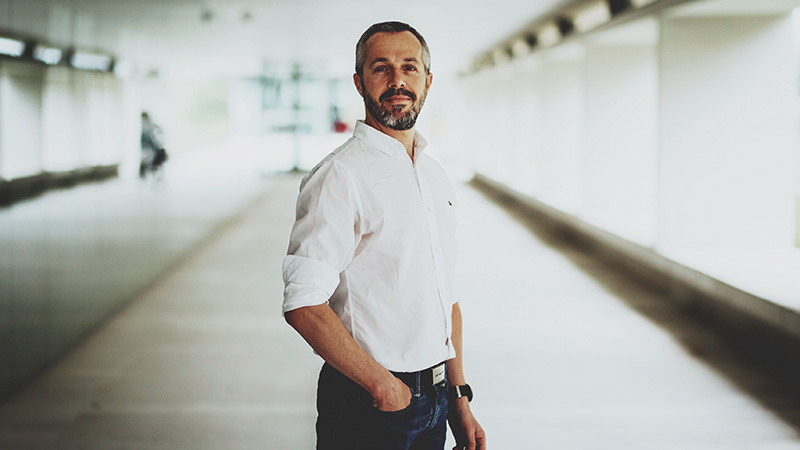
How and why did a Spanish professor decide to travel more than 10,000 kilometers for an academic exchange? What motivated him to spend two months in a country he had never visited before? Why did he feel it was important to temporarily leave his home and be away from his loved ones in order to connect with teachers and academics on the other side of the globe?
José Luis Aparicio-Herguedas arrived in Uruguay in early October. He didn’t know much about the Uruguayan education system or Universidad ORT Uruguay, but he came with two clear goals. First, he wanted to learn more about what was being done in this part of the world regarding the training of teachers and educational leaders. Second, he sought to lay the groundwork for future collaboration between ORT and the International University of La Rioja.
Destination: Uruguay
While working on his doctoral dissertation, Aparicio-Herguedas read several studies by Dr. Denise Vaillant, dean of the Institute of Education at Universidad ORT Uruguay. “She is a leading figure in the United States in the fields of teacher training and educational leadership,” said the professor at the International University of La Rioja.
So he decided to send her an email, in which he expressed his interest in learning more about Vaillant’s areas of expertise and laying the groundwork for future academic collaboration. “She kindly replied within a couple of days, saying, ‘Go ahead, let’s talk about what we can work on together,’” Aparicio-Herguedas said.
Once she had her university’s support and the green light from ORT, she set out to secure funding to finalize her stay in Uruguay during October and November 2023. He found it through the Ibero-American University Association for Postgraduate Studies (AUIP): an organization that, among other things, awards scholarships to academics so they can undertake immersion stays in Ibero-America and compare the two realities, as well as promote mutual collaboration. Likewise, the International University of La Rioja also awarded him a scholarship so he could undertake the long-term stay in Uruguay.
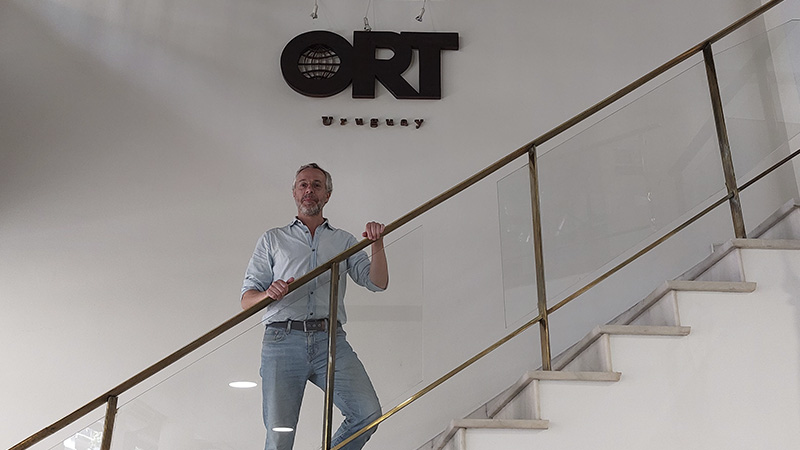
I’ve come to learn and share. To meet Denise Vaillant and her entire team. To show what I do and to see what’s done here. Above all, to work together.
An effort that paid off
“How can someone living abroad who wants to connect with someone from a different background go about doing so?‘To create synergy, you have to go there, and that’s the effort I’ve made. It’s a big effort, but in my opinion, it’s very rewarding,’ replied Aparicio-Herguedas.”
The thing is, as he explained, building the foundation for a partnership primarily requires face-to-face interaction. “You can’t build personal relationships over Zoom,” he said.
Therefore, for him, the experience is based on the “desire to reach out,” since that is how the university works—or should work: as a network. “I don’t understand why people act in isolation; it’s important to connect with others,” he said.
Since he came to Uruguay, among other reasons, to learn about leadership, he found certain parallels between his experience and the concept of network leadership he had studied. It is a practice in which people recognize what they still need to learn and what they can contribute to others, and decide to “connect, network, collaborate, and create synergies.”
But, in this context, Aparicio-Herguedas feels a bit like an “oddball.” The reason is that academic exchange programs are practices that are slowly falling by the wayside, because they require an effort that, while worthwhile, not everyone is willing to make.
It has been an enriching experience full of contrasts in every way.
The Importance of Opening Doors
There are several public and private organizations that help academics learn with and from one another, according to Aparicio-Herguedas. In his view, this is “wonderful” because it allows him to compare himself with others and “receive invaluable feedback ” on his professional experience in teaching and research.
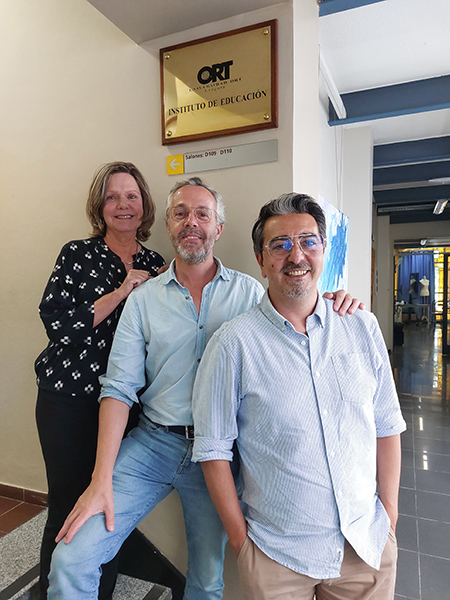 The Spanish professor—who currently teaches courses in two undergraduate programs and a master’s program focused on the initial training of teachers and educational leaders at the International University of La Rioja— he didn't want to remain confined to his own context. “I know what teacher training is like in my own context, but I don’t know what it’s like elsewhere, and I wanted to see that contrast—to compare myself and compare us,” she said.
To this end, he held meetings with the academic staff and faculty members at the Institute of Education to gain a better understanding of how teacher and educational leader training is conducted in Uruguay. He provided an outside perspective on the training programs, served on the committees evaluating the final projects for the Master’s in Education, and, among other things, will be the guest editor for a special issue of the journal Cuadernos de Investigación Educativa.
“A spirit of collaboration has taken root, allowing us to work together on research and educational innovation projects, bringing the two countries and universities closer together through new forms of cooperation on teacher training and educational leadership within the Ibero-American context,” he added.
However, academic exchange programs require a vote of confidence from the host institutions. “You need someone to open the door for you and say, ‘Come in,’” Aparicio-Herguedas explained.
“At the Institute, they’ve realized that if you don’t open the door to others, they won’t come in. If you don’t build the trust needed for others to contribute, they won’t contribute. And I’m grateful for that, because if you aren’t given the opportunity to learn, it’s impossible to do so, ”he added.
I know that's how things work—by asking for opportunities and making the effort to be there and not let anyone down.
A suitcase full of knowledge
Would Aparicio-Herguedas recommend the experience of participating in an academic exchange program? Absolutely, and for many reasons. “When I think about my future prospects, there are nothing but advantages. It’s worth the effort, given the benefits I gain from the exchange,” he replied.
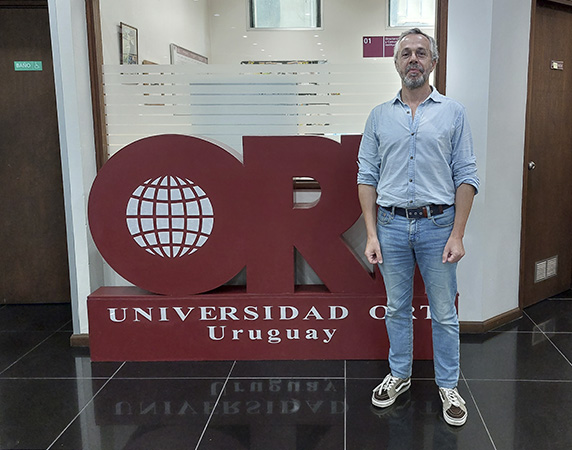
One of the main benefits is the relationships you build. “Interacting with other people, seeing how they think and how they work, are vital experiences,” he said.
He also highlighted the new opportunities that the program offers. He is leaving Uruguay with a different perspective—one that is more open and comprehensive—on teacher training and the development of educational leaders here.
At the same time, the door remains open for co-authoring articles or conducting research with the faculty and staff at Universidad ORT Uruguay. “I think this will be the starting point for doing more things together. It’s that surprising, but it’s that simple,” he summarized.
However, these benefits are not one-sided. According to Aparicio-Herguedas, everyone stands to gain. “In the end, you realize that the person who comes in contributes to the environment. When that person leaves, they have been enriched by the environment I’ve been in, and ideas for the future have been generated—ideas that are tremendously valuable,” he emphasized.
What opens doors and creates opportunities for collaboration is being there. And I’m clear on that; I know that whenever I need to collaborate with someone, I’ll have to make the effort.
What’s the next destination? Before his trip to Uruguay, Aparicio-Herguedas had spent some time in Colombia. He said that in a year or two, he plans to reach out to other institutions again and continue “networking.”
“In my case, it’s part of my profession. And it will continue to be part of my life, because this isn’t over yet, ”he concluded.