How did the idea of pursuing a master's degree abroad come about?
It arises after completing one's degree, with an awareness of how essential it is for personal and professional growth, especially in an increasingly dynamic, complex, and competitive world.
In any case, before starting the specialization program, I spent two or three years working at companies in the industry, which allowed me to apply and build on the knowledge and skills I gained in college. I worked at medical equipment companies, with RFID (Radio Frequency Identification) technologies, and in software development.
Did you already know which specialization you were going to pursue in graduate school?
Although I had some idea of the fields I wanted to specialize in, I hadn't completely made up my mind, and when I started looking at the options, it became even more difficult because of the sheer number of opportunities.
I've always been interested in the aspects of electronics related to the field of medicine—partly because of my senior thesis project, and partly because I've always wanted to improve people's quality of life.
It is in this context that the field of Artificial Intelligence (AI) has emerged—a subject that is now emerging as the foundation of all technological development and which, combined with my knowledge of electronics, will open up countless possibilities for me.
What was the college application process like?
The most complicated and time-consuming part was researching both potential master’s programs and the universities offering them. Generally, the application process involves submitting the required documentation for both university admission and a student visa. In addition to academic transcripts and diplomas, the documentation typically includes a statement of purpose and letters of recommendation.
Regarding the letters, I would like to thank my advisor, Ismael Garrido, and Dr. André Fonseca for their support and encouragement in taking on new challenges.
Once I had decided on the master’s program, the next step was to choose a university that was internationally renowned in that field. I always kept the cost in mind, as well as the fact that the program had to be taught in English, so that I could improve my proficiency in the language.
What is the master's program about, and why is it often associated with the field of computer science?
The master's program focuses on the most important aspects of the field, such as Autonomous Systems, Big Data, Deep Learning, Machine Learning, and Neural Networks, among others, and also covers their main applications, not only within the technology sector but also in sectors such as healthcare, finance, and others.
Although this is generally a topic related to computer science—and one that requires expertise in that field—my classmates come from a variety of backgrounds, such as physics, mechanical engineering, and communications. I believe this is because advances in artificial intelligence will create countless opportunities across all fields.
How does this relate to electronics?
Electrical engineering, in conjunction with computer science, will continue to form the foundation of new technological developments. In many ways, it is essential for implementing AI in fields such as medicine and education, as well as in industry and even in decision-making. In the vast majority of cases, electrical engineering will be responsible for establishing the necessary interfaces with other systems.
You always mention the importance of artificial intelligence in the medical field. What are some of its potential applications?
As technological advances make it possible to develop electronic devices that connect to various organs of the human body—including the brain—the possibilities offered by AI will pave the way for the early diagnosis and treatment of many neurological diseases, such as Parkinson’s or Alzheimer’s. Furthermore, they could provide solutions to vision and mobility problems; research in this area has been underway for quite some time.
Furthermore, simpler interfaces capable of continuously monitoring specific parameters, combined with medical databases, will make it possible to predict the onset of certain diseases and correct deviations in specific treatments or in the dosage of medications to be administered.
How did studying at Universidad ORT Uruguay help you Universidad ORT Uruguay on this new challenge?
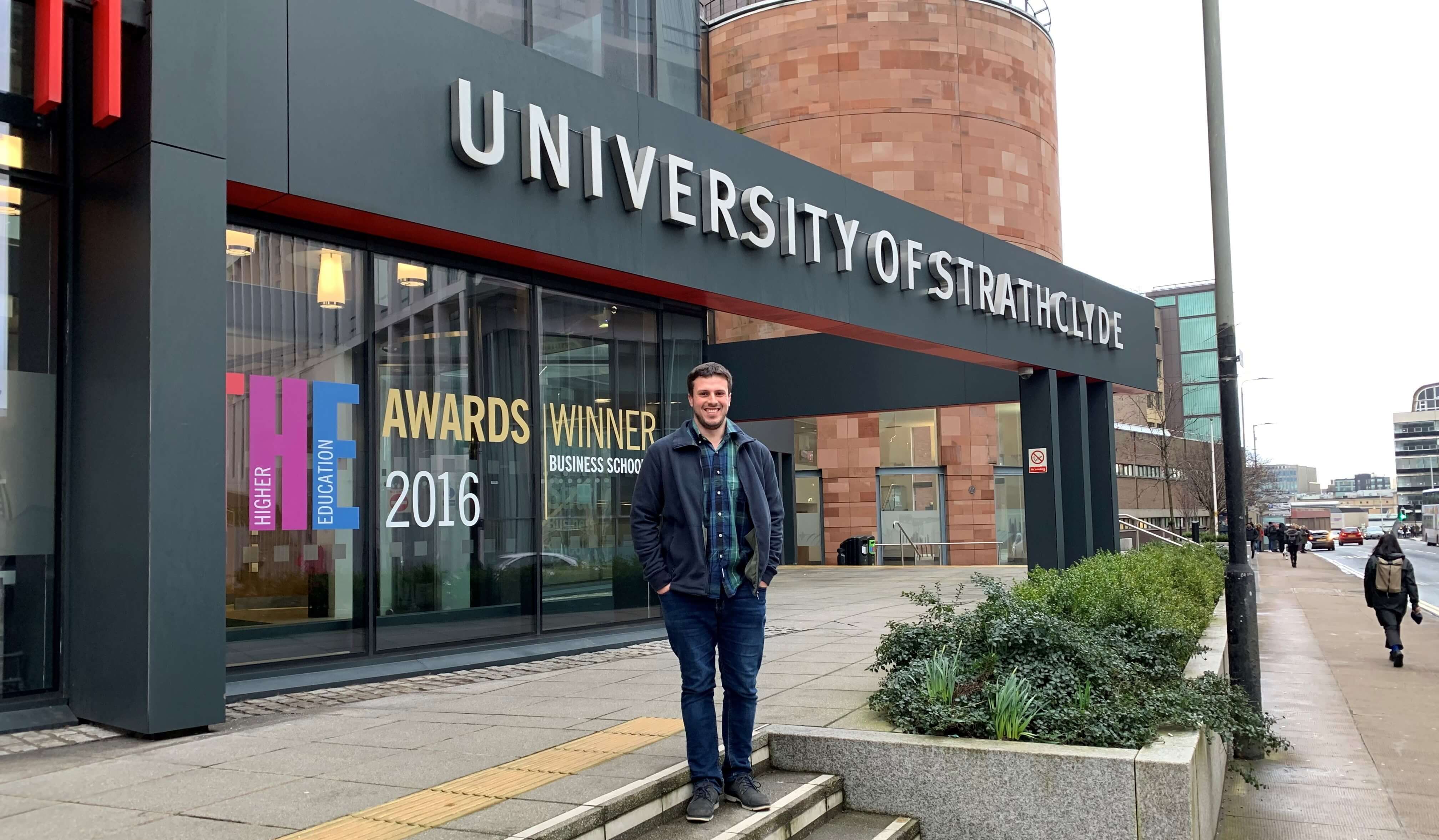
I am increasingly grateful for what ORT has given me, both professionally and personally. Even during my early work experiences, I could see the value of the training I received, and now, in this highly demanding environment at a university as prestigious as the University of Strathclyde, that feeling is even stronger.