https://youtu.be/AscNq8xR8uE?si=Gt3URR9ftwcdO05Y
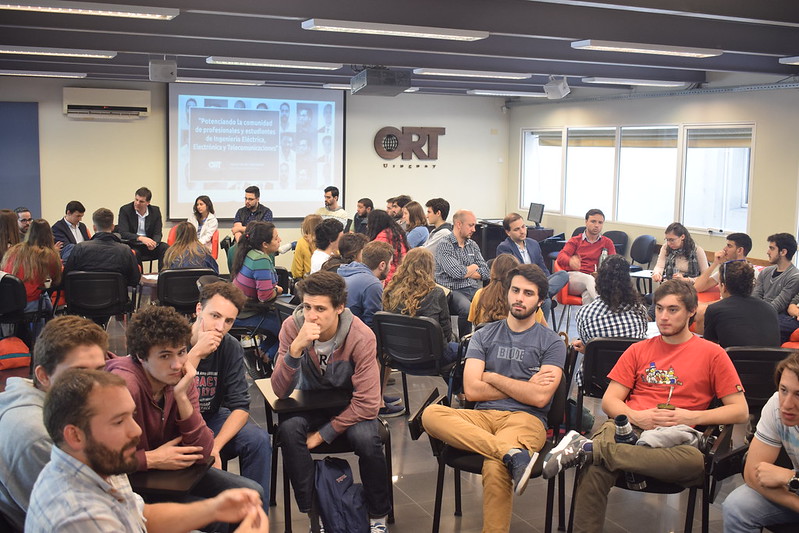
More than 40 students from various semesters and eight graduates participated in this exchange event, which took place on October 29, 2018. Over the course of just over an hour, the students rotated through three breakout sessions to explore different fields: entrepreneurship, telecommunications, and renewable energy and home automation.
During the event, students had the opportunity to learn more about the programs they are studying and get answers to questions such as:
- How do you break into the job market?
- What opportunities are there in Uruguay?
- What are the risks of starting a business, and what does it take to do so?
- What are the benefits of studying and working at the same time?
- How do you start a business when it seems like everything has already been done?
- Is it better to pursue a master’s degree or to enter the job market first?
The graduates began by sharing their experiences, but rather than making the conversation too personal, they managed to connect with the students’ concerns and offered them insights for their professional futures. They all emphasized that these fields offer great opportunities and open the door to many career options.
They emphasized that retraining and adapting to the needs of an increasingly dynamic future is both a necessity and an opportunity for these professionals, so staying informed is a competitive advantage.
Take the case of Sebastián Bardacosta, a telecommunications engineering graduate who became passionate about the opportunities offered by technology in the home automation and renewable energy sectors.
Sebastián was part of the La Casa Uruguaya project, which won the 2015 Solar Decathlon Latin America and the Caribbean in Colombia, and is now a shareholder in the company founded by some of the project’s members. He also works at Trios Lighting, where he oversees lighting control and home automation projects that are integrated into the company’s lighting designs.
Entrepreneurs Nicolás Cremona, Gonzalo Díaz, and Juan Pablo Saibene explained that while starting a business in these sectors may seem difficult, it is certainly possible—you just need drive, confidence, and a great team. They also reviewed the ecosystem of support for entrepreneurs that exists in Uruguay, starting with the Center for Innovation and Entrepreneurship, the university’s project incubator, and explained that the key to developing a project is to focus on problems to be solved.
In 2011, Nicolás, along with Gonzalo and other partners, founded Smartway, a company specializing in the design of innovative technological solutions for controlling machinery and vehicles. Meanwhile, Juan Pablo made the leap into the world of entrepreneurship a year ago with Qualabs, a company dedicated to developing and marketing technological solutions for the processing, distribution, and aggregation of multimedia content.
For their part, telecommunications professionals Martín Ljubicic, Andrés Burel, Germán Milano, and Marcelo Sniadover emphasized that while technical knowledge is important, other skills are equally essential, such as teamwork, effective communication and the ability to articulate ideas clearly, being proactive, and continuously developing one’s skills.
Martín, Andrés, and Germán work as telecommunications project managers for three major telecommunications companies in our country: ANTEL, Claro, and Nokia. Marcelo, in addition to serving as the telecommunications manager for the Judiciary, founded a telecommunications company that provides technology infrastructure solutions in the areas of systems, security, and communications at the corporate level.
For the Alumni Relations Office, this was yet another opportunity to foster connections and strengthen ties between graduates, future professionals, and the university. “For us as a university, it is extremely important to stay informed about what our graduates are doing—how many decide to start their own businesses, how many secure excellent positions in the job market—and these events provide an opportunity to connect, create a reason to gather, and see how the network continues to grow from there,” said Ana Laura Trias, Graduate Coordinator at the School of Engineering.
The event was co-organized with the Academic Coordination Office for Electrical, Electronic, and Telecommunications Engineering.
Tips for students:
- “Pay attention to market trends; don’t limit yourself to what you see in the classroom—technology is advancing very quickly. Be curious and take advantage of the opportunity to build your professional network while you’re in college.”
Juan Pablo Saibene, B.S. in Engineering, MBA - “No one becomes an expert overnight, so I recommend focusing on mastering one topic or area at a time and remembering that practice makes perfect. Be curious, do your research, and don’t set limits for yourselves.”
Marcelo Sniadover, Engineer - “Go for it—you can do it. It’s hard work and requires time and effort, but it’s possible. When things start to fall into place, the sense of accomplishment and the satisfaction of having overcome challenges is incredibly rewarding. If you have an idea and want to start a business at ORT University, there’s plenty of support available, and the Center for Innovation and Entrepreneurship plays a key role in helping you take those first steps.”
Nicolás Cremona, Engineer - “I loved the degree program I studied, and I loved even more knowing that I can design and create tech products on my own. My advice: set short-term goals to find that extra motivation that pushes you forward and makes you want more.”
Gonzalo Díaz, Engineer - “Try to supplement the education you receive in college and get into the field as soon as possible. Seeing real-world cases and immersing yourselves in the business and its technical aspects—even in the early stages of your career—gives you a different perspective and another opportunity to make the most of your coursework.”
Andrés Burel, Engineer - “The telecommunications field is very dynamic; technologies are constantly advancing, and it’s essential to keep pace with these changes. A good engineer must be able to understand, apply, and add value in the face of this constant challenge. It’s not just about acquiring theoretical knowledge as you progress in your career, but also about developing skills such as analytical thinking and problem-solving abilities.”
Martín Ljubicic, Engineer - “Don’t expect anyone to teach you the what, the how, and the why. Asking questions is always welcome, but it should only happen after you’ve gone through your own learning processes. Being self-taught and questioning the knowledge you’ve acquired is what will set you apart from other professionals.”
Germán Milano, Tech-MBA - “Get certified as soon as possible and get out on the field.”
Sebastián Bardacosta, Engineer