Entrepreneurship with a positive impact
A purpose-driven business is defined by the clarity of its mission and goals, focusing on creating a positive social and environmental impact while also being economically viable.
These projects aim to innovate in order to solve social or environmental problems by offering scalable and replicable solutions.
These organizations are defined by their commitment to making positive impact a central part of their business model.
Benefits of Sustainable Business
Consumer trends are evolving. Consumers are increasingly prioritizing factors such as the actual need for a product and the impact it has on the environment and society.
They also consider how companies integrate into the value chains oflarge corporations or governments, fostering mutually beneficial relationships and strengthening win-win partnerships.
In Uruguay, online sales of sustainable products have increased by 22%.
At the same time, financing and investment options for the development ofsustainable ventures have been expanded.
In addition, various incubators and accelerators—both private and government-run—support entrepreneurs focused on sustainability tohelp them grow their businesses.
When choosing a workplace, many people prioritize organizations that make a positive impact and align with their personal values.
In fact, 44% of Millennials and 49% of Gen Zers have made decisions about their careers based on personal ethics and the extent to which their values are reflected in the company.
Regulations designed to protect the environment and society are becoming increasingly specific, placing greater demands on organizations.
In Uruguay, regulations governing the use of plastics and comprehensive waste management have already been implemented.
Notably, the National Law on Comprehensive Waste Management (Law No. 19,829/2019), which seeks to prevent and reduce the negative impacts of waste management by considering the full life cycle of products, from design to final disposal.

Another relevant regulation is the Resolution on Reducing Plastic Waste Generation (Resolution No. 272/2021), which promotes the reduction of plastic wasteand discourages the use of single-useor short-lived plastics.
Finally, the Plastic Bag Law (Law No. 19,655/2018), in effect since 2019, regulates the production, sale, and use of plastic bags, achieving a reduction of between 65% and 85% in bag consumption at large retail stores and an average reduction of 70 %. As described by Giselle Della Mea:
We shape the world we live in. The planet is a given; the Earth is what we have, but the world of humanity is the way we choose to live in it.
Uruguay and the 2030 Agenda
Uruguay has made significant progress toward several socioeconomic goals, particularly in Sustainable Development Goal (SDG) 7 “Affordable and Clean Energy,” where it ranks among the top five countries globally in terms of positive impact.
However, there are still challenges to be addressed, such as the delay in meeting the SDG 4 “Quality Education,” and SDG 10, “Reduced inequalities.”
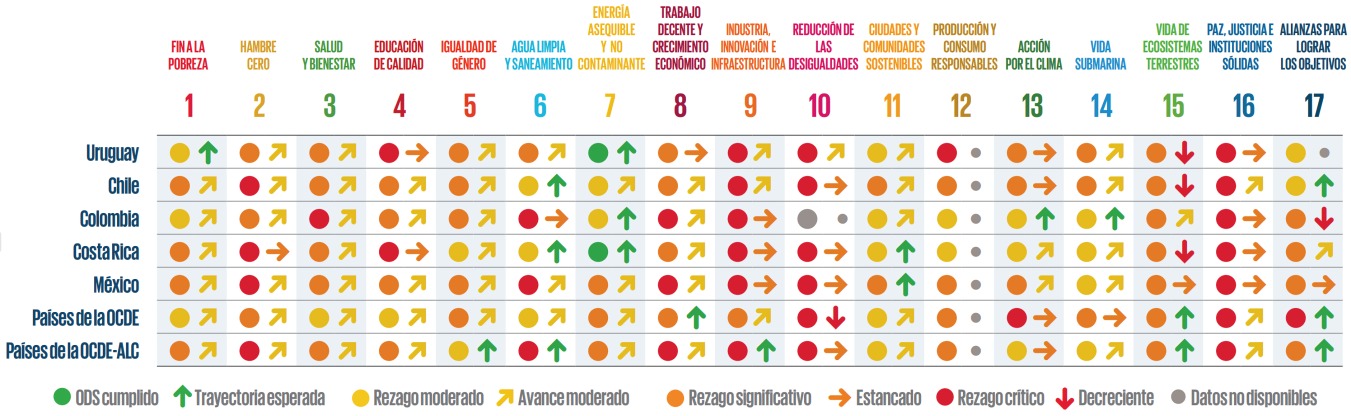
As in other countries of the Organization for Economic Cooperation and Development (OECD), particularly those in Latin America and the Caribbean, efforts must be stepped up to make progress toward the Sustainable Development Goals.This includes areas related to sustainable production and consumption, as well as climate and biodiversity issues (SDGs 12 through 15).
In addition, there is an urgent need to address the governance and security issues outlined in SDG 16, “Peace, justice, and strong institutions.”
Emerging economies
The new economies call for a shift in approach:
- From fulfilling desires to prioritizing needs.
- From an individual approach to a collective one.
- From individualism to interdependence.
- From an extractive model to a regenerative one.
- From competition to collaboration.
- From a profit-driven financial sector to one grounded in values.
- From dissociation to integration.
- From vertical, closed organizations to open, horizontal, and transparent structures.
- From short-term profits to long-term value creation.
Learn about theMaster's Program in Creativity, Innovation, and Communication