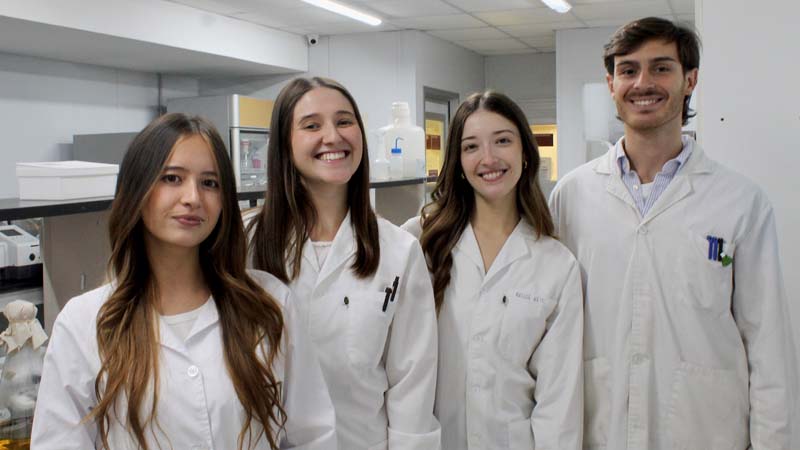
The PhycoTech startup is made up of three biotechnology engineeringstudents —FiorellaToniotti, Marcia Martínez, and Matilde Klett—and a graduate of the program, Facundo Rocha.
The project began as a thesis project and has since evolved into a biotechnology startup with international reach, combining academic research and entrepreneurial spirit.
Microalgae as a biotechnology platform
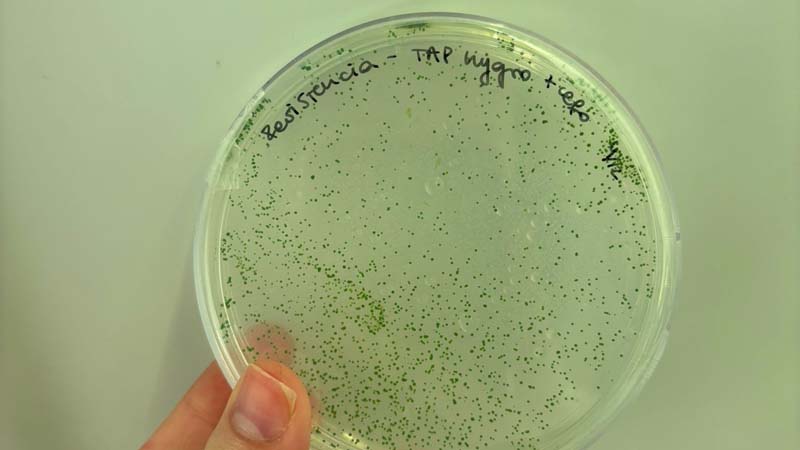
PhycoTech works with genetically modified microalgae to produce recombinant proteins, with an initial focus on the cosmetics industry. Microalgae offer numerous advantages over other production systems: they are easy to cultivate, require fewer nutrients, are more cost-effective, and are biosafe for use in contact with human skin.
In addition, they naturally possess antioxidant, anti-inflammatory, photoprotective, and proliferative properties, making them an attractive platform for the development of innovative cosmetic ingredients.
An added value for the cosmetics industry
In addition to these intrinsic properties, the team brings a key advantage: the expression of specific proteins, which enables the development of more targeted and effective treatments.
“It’s like adding an extra layer of functionality to something that already has many benefits,” explains Fiorella Toniotti, highlighting biotechnology’s potential to create more personalized products.
From the Lab to Entrepreneurship
Although the project originated in an academic setting, the transition to entrepreneurship was supported by the curriculum of the degree program itself. Throughout their studies, the students took courses in biobusiness, management, and economics, which introduced them to business principles and enabled them to envision a path beyond the laboratory.
Throughout this process, the university’s Center for Innovation and Entrepreneurship (CIE) played a central role, providing guidance, mentoring, and support to help transform the scientific idea into a business venture with commercial potential.
Awards that support the project
PhycoTech received several awards and grants that were essential for advancing the project's development and validating its proposal.
Among the main ones are:
- VIN – Idea validation, with financial support of $5,000, which enabled the team to take the first steps and validate the biotechnology platform.
- New Entrepreneurial Talent Award, presented by the Galician Association of Entrepreneurs in Uruguay, which includes a cash prize of $5,000 and a training program related to the Camino de Santiago.
- Start Fellowship, an international program that will enable Matilde Klett to participate for four months in an accelerator in Switzerland, where she will receive training in business model validation, specialized mentoring, and additional funding of approximately $7,000, as well as the opportunity to connect with international investors.
“These awards are a form of validation that encourages you to keep going and believe that the idea makes sense,” says Marcia Martínez.
Learning to think like a business
In addition to the awards, the participants took part in mentoring programs such as CITES and other training initiatives, where they began to address key issues such as intellectual property, business models, commercial strategy, and scalability.
“We come from the scientific world, and learning to think like a business is a whole process,” Marcia acknowledges, adding that these opportunities allow them to incorporate complementary perspectives without losing their academic focus.
Next steps: scale up and enter the market
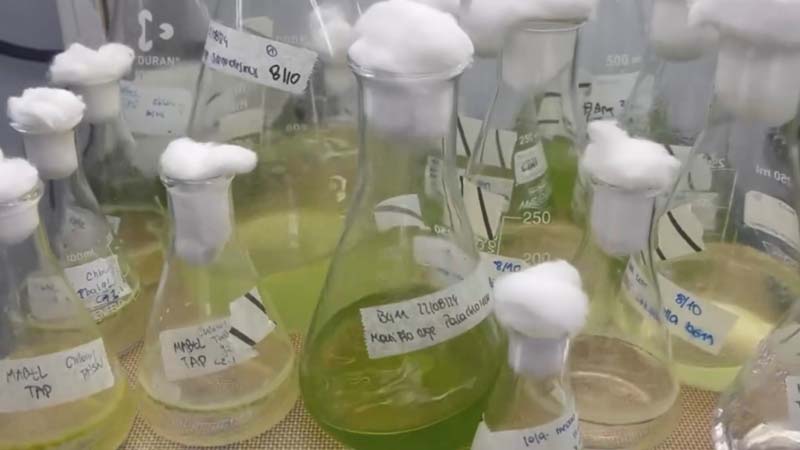
In the medium term, the team’s goal is to move toward a pilot-scale operation that will allow them to produce the ingredient in larger volumes. To that end, they are seeking partnerships with companies that can provide infrastructure and expertise in industrial scaling.
At the same time, they are making initial contacts with a cosmetics company, have received advice on product formulations and validation, and plan to establish contacts in Europe and the United States to explore new markets and potential partnerships.
A growing market
The first market PhycoTech is targeting is the cosmetics industry, a growing sector that is increasingly interested in sustainable ingredients and greener production processes.
“It’s a market that’s growing rapidly and seeking greener alternatives,” says Fiorella, though she acknowledges that the size of the local market also poses challenges.
A message for other students
At PhycoTech, the message for those who want to start a business in biotechnology is clear: go for it.
“Discuss your ideas, reach out to teachers and the CIE, ask for help, and get feedback,” recommends Marcia Martínez. “The tools are there, and so is the support.”
For the team, the program not only provides a solid scientific foundation but also the opportunity to turn ideas into real projects with a significant impact and long-term potential.
Learn more about Biotechnology Engineering