
According to the United Nations Environment Programme (UNEP), in 2024, the construction and building sector was the largest emitter of greenhouse gases, accounting for more than fifth of all global emissions. And the outlook does not call for major changes by 2025. The situation is alarming.
The construction has a significant and concerning environmental impact, as, globally, it is responsible for approximately 23% of air pollution, contributes to 40% of the contamination of all available drinking water, and, among other things, generates 30% of all solid waste.
“The measure of intelligence is the ability to change,” Albert Einstein once said, though you don’t have to be the physicist to understand that: we need to change, and we need to do it now.
Transforming the construction industry
As we can see, the construction sector has been identified by numerous international organizations as one of the sectors with greatest environmental impact in the world, as well as one of the major sources of greenhouse gas emissions.
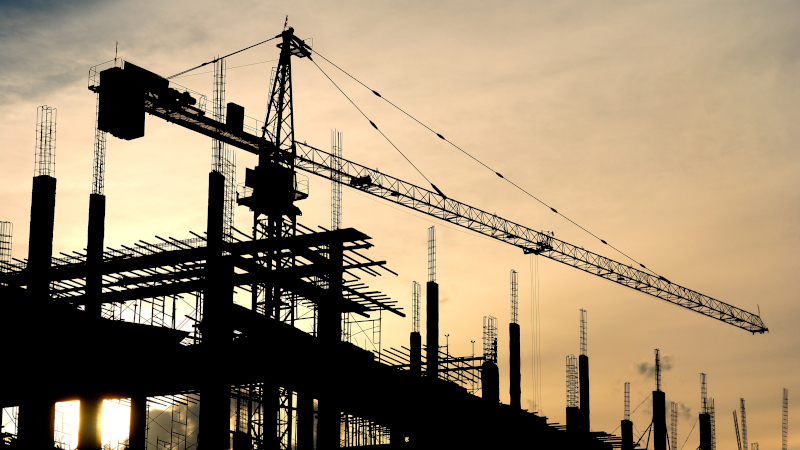
Likewise, sustainable architecture has proven to be a real and effective alternative for changing course and steering the construction industry toward an environmentally friendly future.
Transforming the construction industry through sustainable architectureis no longer an option, but a necessity.
Below, we will examine some of the most recent statistics on the impact of construction on our planet and see how the ORT School of Architecture and its Specialization Diploma in Sustainable Architecture promote tangible solutions, embodied in three final projects that apply bioclimatic strategies, renewable energy, and efficient resource management in Uruguay.
Construction sector: figures that call for change
Construction involves more than just erecting buildings and developing infrastructure: it entails intensive use of natural resources (water, wood, minerals), high energy consumption, and a significant contribution to rising global pollution.
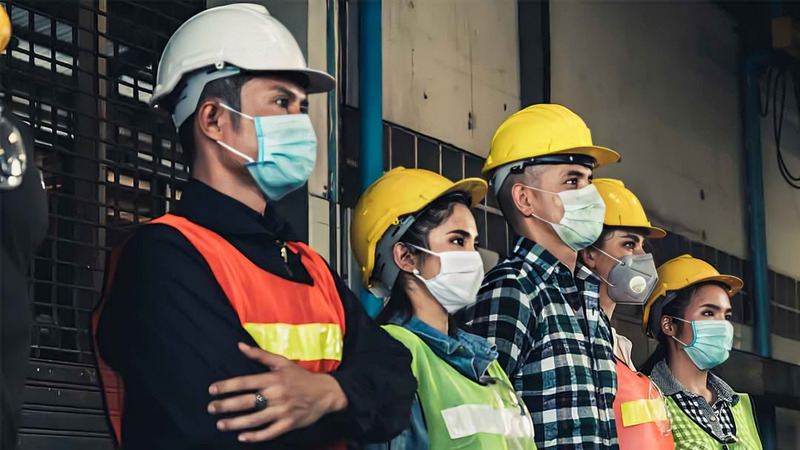
Several sources confirm this fact:
- The largest emitter of GHGs: In 2024, the United Nations Environment Programme (UNEP) identified the construction and building sector as responsible for more than one-fifth of global CO₂ emissions
. - Air pollution: A report by LEAF Latin America indicates that about 23% of air pollution comes from construction.
- Drinking Water Contamination: According to the United Nations, up to 40% of water pollution is associated with construction and poorly planned urbanization.
- Solid Waste Generation: In practice, about 30% of global solid waste comes from construction.
- High carbon footprint: The production of cement and steel, combined with the long-distance transport of these materials, has a significant impact. The UN and UNEP emphasize the need to decarbonize the industry, adopt alternative materials, and widely implement sustainable design techniques.
These figures highlight the urgent need to rethink the way we build, both technically (materials, renewable energy) and in terms of design (passive strategies, biophilia).
In this regard, sustainable architecture stands as a smart and comprehensive solution that combines energy efficiency, a smaller carbon footprint, and user well-being.
- You might also be interested in reading: “Sustainable Architecture and Renewable Energy: The Future of Construction”
Sustainable architecture: What is it, and why is it so important?
Sustainable sustainable architecture applies social, environmental, and economic criteria to reduce the impact of buildings throughout their entire life cycle.
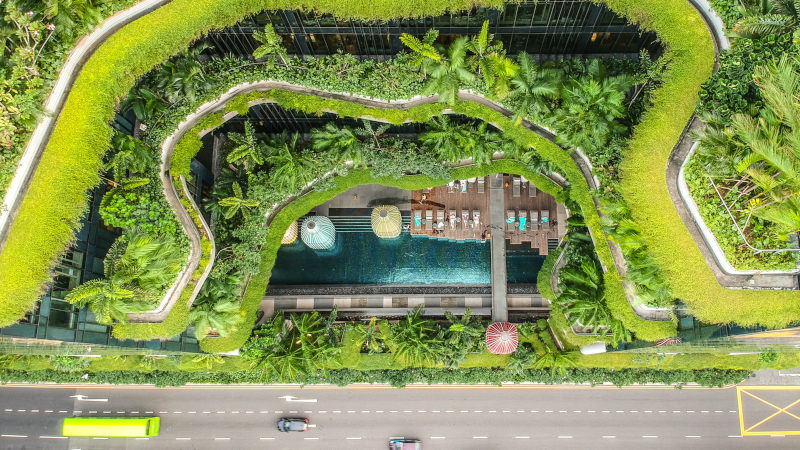
More than just a passing trend, this is a holistic approach that seeks to harmonize:
Energy efficiency
- A bioclimatic design that takes advantage of solar orientation and natural ventilation.
- Use of solar panels, air-source heat pumps, geothermal energy, or biomass to reduce the use of fossil fuels.
- Optimized insulation and building envelope to reduce the demand for heating and cooling.
Resource Management
- Responsible water use: rainwater harvesting systems, energy-efficient appliances, and graywater recycling.
- Use of local, recycled, or low-carbon materials (certified wood, concrete with recycled aggregates, etc.).
- Reducing waste during construction and promoting the circular economy.
Human well-being and quality of life
- Connection with nature (biophilia), incorporating vegetation indoors and outdoors.
- Natural lighting and ventilation to improve occupants' health.
- Thermal and acoustic comfort, with a focus on productivity and the enjoyment of spaces.
Economic and Market Outlook
- More and more companies, banks, and governments are requiring energy certifications (LEED, BREEAM, EDGE).
- As demand for sustainability specialists grows, new job and entrepreneurial opportunities are created.
In an environment where the construction industry bears significant responsibility for CO₂ emissions, sustainable architecture not only reduces the environmental footprint but also adds aesthetic, functional, and social value.
In this way, sustainable architecture has become a key factor in the paradigm shift that our planet so urgently needs.
- You might also be interested in reading: “What Is Sustainable Architecture and How Does It Contribute to a Culture of Sustainability”
Professional training in sustainable architecture
Uruguay has made significant strides in the integration of renewable energy, positioning itself as a leader in wind and hydroelectric power generation in the region. However, the construction sector still needs to make a qualitative leap to bring sustainability to every project and improve the energy efficiency of buildings.
https://www.youtube.com/watch?v=7t0f3cMg_0I
In this context, Universidad ORT Uruguay meets this vital need with cutting-edge academic programs.
The Certificate of Specialization in Sustainable Architecture
This one-year graduate program combines theory and practice to train professionals capable of leading projects that meet international sustainability standards.
Recognized by the Ministry of Education and Culture (MEC), the Diploma is structured into modules covering, among other things:
- Bioclimatic Design and Energy Efficiency: Analysis of wind, sunlight, and cross-ventilation; use of software such as Sefaira, EDGE, and Climate Consultant
- Materials and Certifications: Reduction of embodied energy in materials (wood, CLT, low-impact concrete) and preparation for certifications (LEED, BREEAM, EDGE).
- Renewable energy: Photovoltaic panels, solar thermal, wind power, aerothermal energy, and geothermal energy.
- Water and Waste Management: Rainwater harvesting and wastewater treatment, minimization of construction waste.
The curriculum for the Specialization Diploma in Sustainable Architecture culminates with the presentation of final projects in the Sustainable Design Workshop III, where students demonstrate in practice all the skills they have acquired.
Learn about the Specialization Diploma in Sustainable Architecture
3 final sustainable architecture projects
On Monday, December 9, 2024, the School of Architecture at Universidad ORT Uruguay its end-of-year ceremony and diploma presentation for the first class of graduates from the Specialization Diploma in Sustainable Architecture.
In this context, three projects that bring the program’s vision to life:
EcoWork Offices
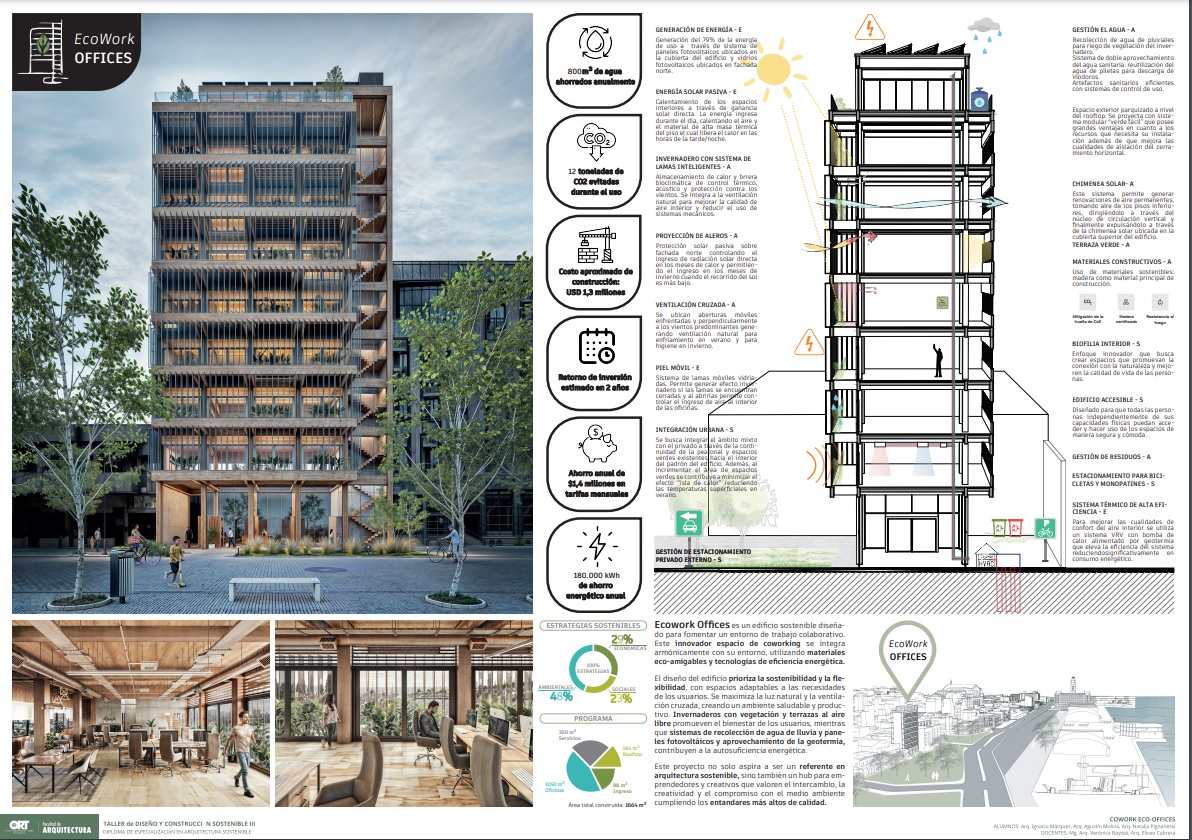
- Authors: Architect Natalia Pignanessi, Architect Agustín Molina, and Architect Ignacio Márquez.
- Location: Montevideo.
- Key Strategies:
- Bioclimatic design: Use of SunPath and Climate Consultant to position eaves, photovoltaic panels, and solar chimneys.
- Eco-friendly materials: Hybrid structure consisting of 85% wood (CLT, glulam) and 15% concrete, PVC windows with double-pane glass.
- Power generation: Photovoltaic panels on the roof and north facade, and a geothermal VRV system that reduces HVAC energy consumption by up to 70%.
- Certification: EDGE Advanced, with energy savings of 79.61% and water savings of 45.12%, and a 98% reduction in embodied energy in materials.
This project demonstrates how a coworking space can be transformed into a highly efficient building, with healthy interior spaces and a close connection to nature (biophilia).
Entreviñas: Sustainable Boutique Hotel
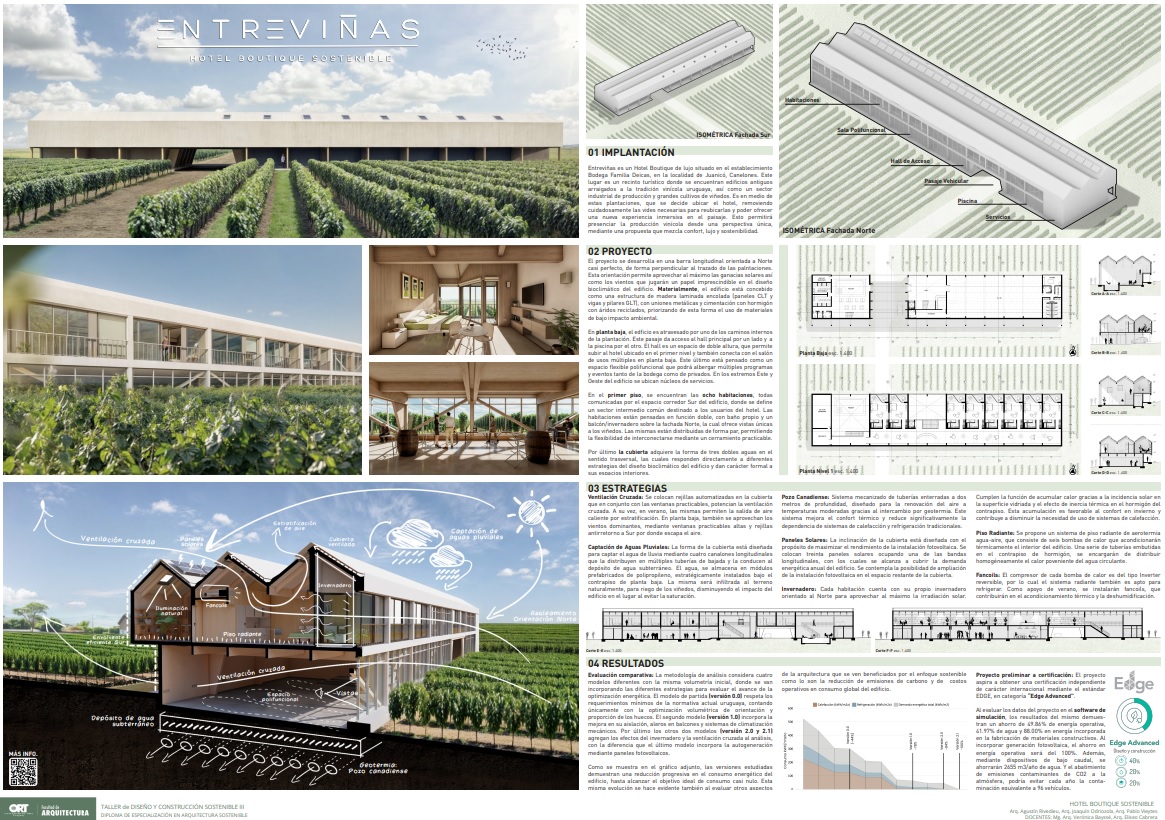
- Authors: Architect Agustín Rivedieu, Architect Joaquín Odriozola, and Architect Pablo Vieytes.
- Location: Familia Deicas Winery, Juanicó (Canelones).
- Key Features:
- Integration with the vineyard landscape: Cross-ventilation, geothermal energy, and solar panels to meet annual demand, and controlled sunlight exposure for energy efficiency.
- Thermal Insulation and Thermal Inertia: Use of recycled concrete in subfloors, Sefaira simulations to optimize the building envelope.
- Rainwater Harvesting: Underground reservoirs for vineyard irrigation and responsible water management.
The results include a significant reduction in energy demand, operating costs, and the carbon footprint, demonstrating how wine tourism can combine luxury and sustainability.
Familia Deicas Boutique Hotel
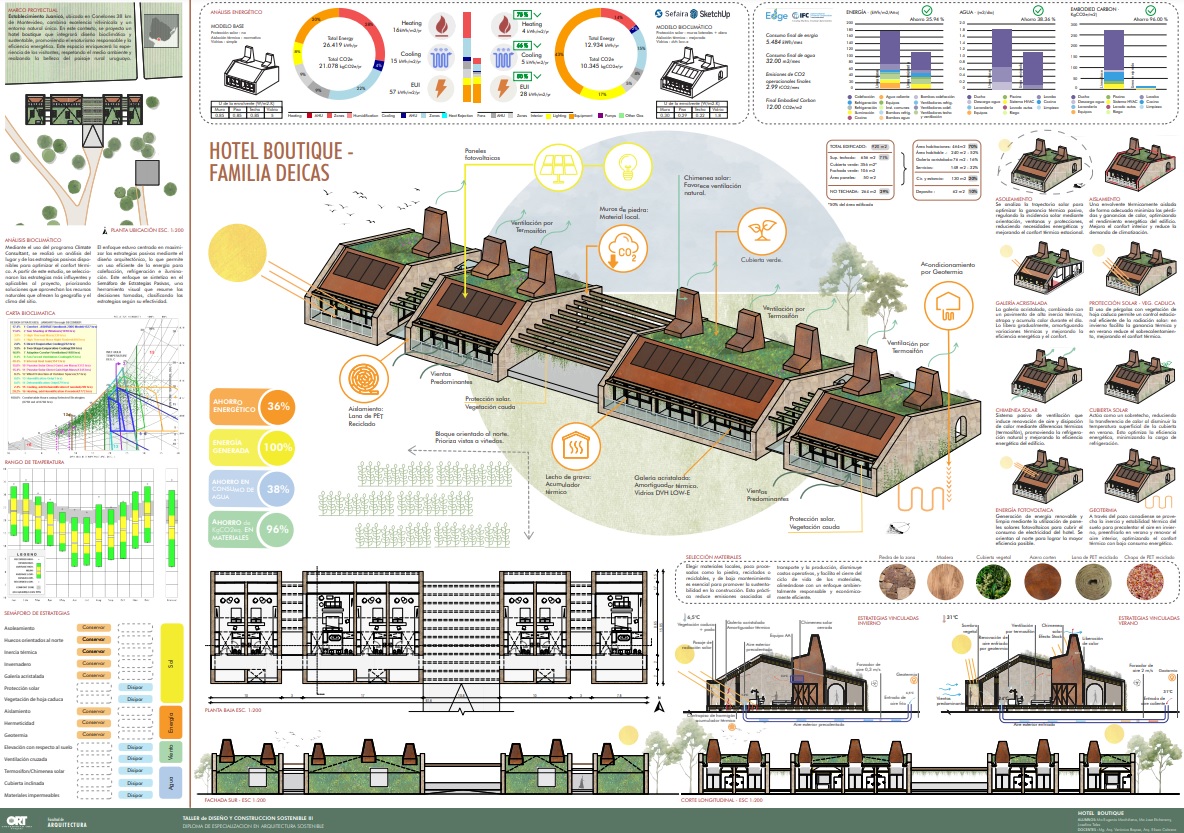
- Authors: Architect María José Etcheverry, Architect María Eugenia Machiñena, and Architect Josefina Teles.
- Key Strategies:
- In-depth bioclimatic analysis using Climate Consultant 6.0, combined with Sefaira to study different versions of the project (base model vs. model with insulation, with sunshades, among others).
- Thermosiphon ventilation and solar chimney: A passive system that reduces electricity consumption for cooling and heating.
- Low-impact building envelope: Walls made of local stone, recycled PET wool as insulation, Low-E double-pane windows, and recycled plastic sheets.
- Generation and use of renewable energy: Geothermal energy (ground-source heat pump) to preheat or cool the air, and photovoltaic panels that cover 100% of the electricity demand.
- EDGE Certification: Savings of 35.94% in energy, 38.36% in water, and 96% in embodied carbon.
A project that blends wine culture and hospitality with environmental sustainability, demonstrating that aesthetics, comfort, and respect for the environment can coexist harmoniously.
- You might also be interested in reading: “Sustainable Architecture and Wood Construction in Río Negro, by Architect Eliseo Cabrera”
Architects specializing in sustainable architecture
When asked about the contribution of this first group of graduates to the profession’s shift toward sustainable practices, architect Eliseo Cabrera, the project director La Casa Uruguaya, professor and academic coordinator of ORT’s Specialization Diploma in Sustainable Architecture, noted:
“The caliber of this first cohort of graduates is outstanding, both in terms of their commitment to advancing sustainable practices and the technical and professional skills they have developed.”
In Cabrera’s words, “They are true trailblazers; I am confident that their contribution to the evolution of the field will be significant.”
Why study sustainable architecture at ORT?
Given this situation, the demand for professionals specializing in sustainability is constantly growing, and Uruguay is no exception. In this regard, Architect Cabrera noted that sustainable architecture is synonymous with good architecture; therefore:
“Those who wish to become leading architects, gain access to better job opportunities, and fully develop their careers should seriously consider completing their professional training in sustainable architecture.”
The Specialization Diploma in Sustainable Architecture from the School of Architecture at Universidad ORT Uruguay :
A cutting-edge academic program
Renowned instructors, a blend of theoretical and practical teaching methods, project-based workshops, and the use of up-to-date software (Sefaira, Edge, and others).
Flexible methodology
In-person classes and the option of an extended classroom, combining training with professional practice.
Emphasis on practical application
The final projects (such as the three described here) demonstrate that the strategies taught are not mere concepts, but that that yield clear metrics (energy savings, CO₂ reduction, certifications).
Direct connection to the market
The rise of sustainability is creating opportunities for consulting firms, architecture firms, and engineering firms looking to set themselves apart through innovation and environmental stewardship
- We also recommend reading: “15 Reasons to Study Sustainable Architecture at Universidad ORT Uruguay”
A transition that cannot be put off
The construction industry will remain under scrutiny by international organizations unless fundamental changes are made to the way buildings are designed and constructed. The figures speak for themselves, and in light of this reality, sustainable architecture ceases to be a niche option and becomes a necessary condition for the industry’s evolution.
Examples that lead the way
Projects such as EcoWork OFFICES, Entreviñas and Hotel Boutique Familia Deicas represent different facets of sustainability—collaborative offices, hospitality focused on the wine experience—and demonstrate the adaptability of environmental strategies to a wide range of building types.
From a 70% reduction in HVAC energy consumption to the use of recycled materials in cladding and roofing, these examples demonstrate that innovation, creativity, and respect for the environment can coexist without sacrificing beauty or profitability.
The central role of academic education
The Faculty of Architecture at Universidad ORT Uruguay not only offers an academic program but also fosters the development of true agents of change.
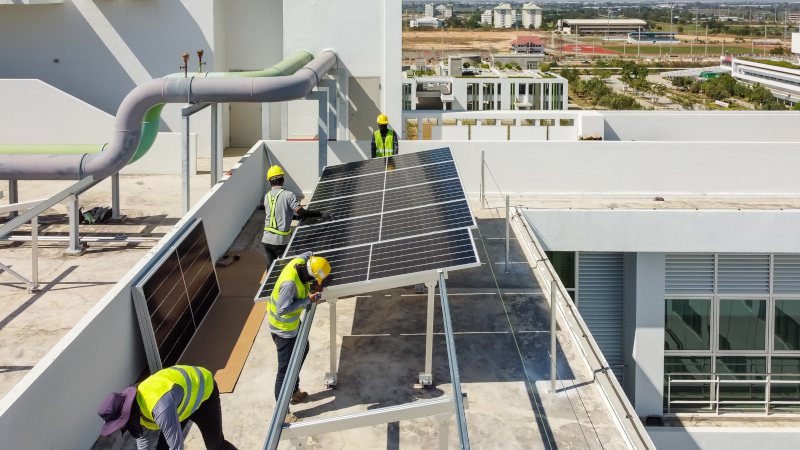
The first cohort of graduates has demonstrated the effectiveness of renewable energy (solar and geothermal), efficient water management, and the optimization of the embedded carbon footprint.
This reinforces the idea that local talent, when properly trained, can lead the transformation toward cleaner and more humane construction.
A call for immediate action
Sustainability requires concrete action and commitment. From the selection of materials and the layout of spaces to the adoption of new technologies and user education, every decision counts.
The Specialization Diploma in Sustainable Architecture provides the necessary tools for those seeking to break into the job market, lead multidisciplinary teams, or start a business in the construction sector with an approach that balances economic, environmental, and social considerations.
Join the sustainable construction revolution
Do you want to transform the industry while building a future that’s responsible toward the planet? Learn more about the Specialization Diploma in Sustainable Architecture. Learn about the curriculum, courses, available scholarships, and the benefits of being part of the ORT community.
Perhaps the next EcoWork Offices, Entreviñas, or Hotel Boutique Familia Deicas will be your final project, and you’ll be able to show the world that responsible construction and architectural excellence can go hand in hand without compromising creativity or profitability.
https://www.youtube.com/watch?v=ypQOZw7_1Zs
In short, sustainable architecture is emerging as the surest path to addressing the environmental crisis facing the construction industry.
Through concrete actions, specialized training, and an inclusive approach, we can rethink the way we understand the design of cities and buildings, ensuring that future generations see the construction industry as an ally of the planet, rather than a factor in its decline.
The time to act is now. Our commitment to sustainability not only defines the success of our generation, but also shapes the legacy we will leave for future generations.
Learn about the Specialization Diploma in Sustainable Architecture