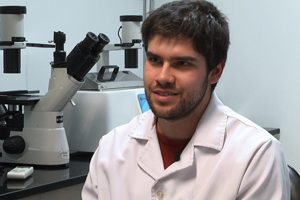
 “Handling large volumes of data is becoming increasingly common, and we need people who can manage that information. It’s very important for computer science to support biology,” explains Federico Machado, Bachelor's Degree in Biotechnology.
He and his thesis partner, Roque Giordano, developed five programs designed to improve day-to-day laboratory work and demonstrate that “biotechnology involves programming too,” as Machado points out.
Although biotechnology involves highly specialized and technologically advanced processes, there are tasks and analyses that require manual data entry or are performed using automated methods. The integration of information technology into these processes helps prevent errors and reduces processing times, making it a valuable and essential tool.
“During a lab session, we had to keep creating an Excel spreadsheet over and over again and entering data to get the results of a study. We realized that wasn’t necessary,” says Giordano. “That’s when the idea for the thesis came up—which, at first, was just to create a single piece of software.”
The result, however, was much more fruitful than a single program, as the thesis process yielded five: PlaqueReader, LabAdmin, PrimerVerifier, BatchPrimerMaker, and SeqEditor. All shared the same goal: “to create something usable that would provide a practical solution to problems that arise in the laboratory,” as both researchers state.
Each program is a standalone tool within the suite, with its own specific functions. All of them were developed using Java and are based on open-source software, so anyone can download and use them.
PlaqueReader
This program takes concentration data from a sample provided by a device called a Multiskan and automatically generates a graph based on that data, as well as interpolating the missing values.
Before developing the software, a table was created in a spreadsheet to generate the graph, and unknown data points were interpolated from the graph using calculations based on the equation of a straight line. This process—which is time-consuming, tedious, and prone to errors when repeated—is precisely what PlaqueReader eliminates.
LabAdmin
It is a laboratory inventory management system. It allows you to create and view a map of the laboratory, including furniture and zone divisions, so that you can assign materials and substances to each zone and know where they are located.
PrimerVerifier: This program complements the work of the previous one. Using digital data from a sample and a pair of primers, the software determines the outcome of the polymerase chain reaction.
In this way, it predicts whether the DNA will replicate or not, and also warns in advance if a primer might lead to a false positive by replicating the DNA but duplicating other nucleotides in the sample rather than the ones originally sought. This helps prevent errors.
BatchPrimerMaker
This program focuses on the use of primers, which are nucleotide sequences with specific characteristics that, under certain conditions—when used in the polymerase chain reaction (PCR) technique—enable the replication of DNA from a sample.
Each substance may have specific primers. Therefore, if a primer amplifies a specific DNA sequence, this serves to demonstrate the presence of that substance.
PrimerVerifier uses a nucleotide sequence and the parameters specified by the user to automatically generate primers for that sequence. It then provides a list of possible primers and other useful data for the study, such as the sizes and nucleotide sequences of the fragments.
SeqEditor
It is a nucleotide sequence manager that translates nucleotides into amino acids and performs related calculations. Before the software was developed, students had to use complex external programs or programming libraries whose inner workings were unknown to them in order to perform these calculations.
This program allows you to perform these calculations without relying on them, using a reliable open-source tool for the calculations.