“Montevideo, 2015. Artigas Mausoleum.
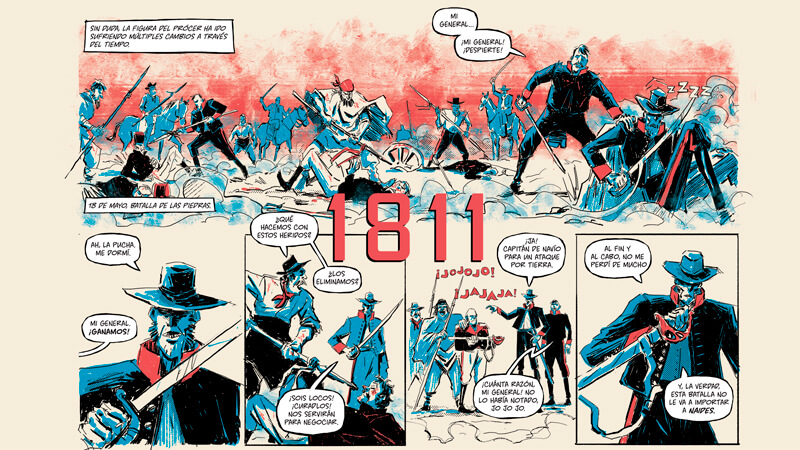
These are dark times of crime, corruption, and Tinelli. Every now and then, the universe must restore its balance to counteract the prevailing chaos. A cosmic force enters the scene, destroying the urn containing the remains of our national hero.
With these words and images of a sinister skeleton donning the clothes of a young, weakling who has fainted from fright, the first part of *Prócer Zombie* begins.
This is a comic featuring a rather unconventional José Gervasio Artigas as the main character, created by the studio Silva Bros in 2015, which was selected by the Ministry of Education and Culture’s Competitive Fund for Culture. The project’s success and momentum were such that the brothers behind the studio, Leonardo and Andrés Silva, went on to produce two more installments of Prócer Zombie.
Andrés has a graduate in Graphic Design from Universidad ORT Uruguay says that he is currently focused on the studio he has run with his brother since 2010. “Silva Bros is a collaboration between two brothers who share a passion for video games, TV shows, animation, and movies from the 1980s and 1990s.”
In addition to the recognition he received for *Prócer Zombie*, Silva also honed his design skills in other fields for international clients. While studying at ORT, he submitted an entry in response to a real-world call for entries for a poster competition organized by the Italian university Nuova Accademia di Belle Arti (NABA) and the Office of the United Nations High Commissioner for Human Rights (OHCHR). That was the beginning of his role as art director for that organization in Switzerland, a position he held until 2016.
In this interview, Silva talks about his various professional experiences, the reasons why he decided to pursue a Bachelor’s degree in Graphic Design at ORT, and the projects that interest him most today.
-
What is a typical workday like for you as a designer and illustrator?
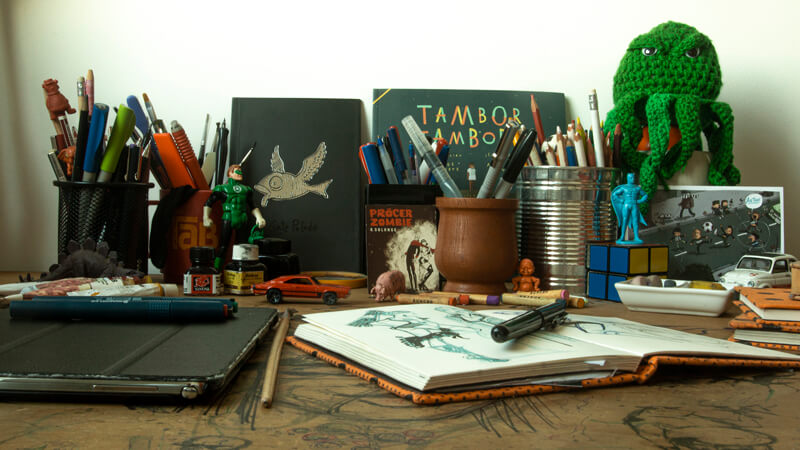
In my daily routine, when I wake up, the first thing I do is make myself a cup of coffee, and for about an hour I watch YouTube channels that interest me or browse content on the social media accounts I follow. Then, when I start working for my clients, I try to be as efficient as possible and finish my workday between 5 and 6 p.m. Finally, I spend some time planning and creating content for Silva Bros.’ social media channels.
-
What are the challenges and opportunities that arise in everyday professional life?
With a pandemic underway, I think maintaining productivity is quite a challenge. It’s important to identify and track those regular customers who may not be the most pleasant, but who provide financial stability.
I also think it’s essential to make time for personal projects that you’re eager to develop and bring to life. Creating valuable content allows you to reach potential clients who share your interests.
-
What has the growth process been like for Silva Bros Studio?
For many years, we ran a blog where we posted illustrations as a hobby. Then, little by little, paid commissions started coming in. I’d describe Silva Bros as a collaboration between two brothers who share a love for video games, TV shows, animations, and movies from the ’80s and ’90s.
Currently, the projects we work on most frequently are those related to publishing and advertising.
-
What was it like to make the decision to launch your own project, Silva Bros?
We’re unique in that we’re a family-run studio. People always say you shouldn’t mix family and work, but I think that’s what sets us apart. We have a very strong sense of teamwork. Our experiences and much of our daily life are reflected in the kind of content we create. It’s part of our identity.
-
How do you remember deciding to pursue a Bachelor's degree in Graphic Design at ORT?
During my childhood and teenage years, I spent my afternoons at a friend’s house whose father was an architect. I saw blueprints and drafting tables everywhere, and I really liked that technical language. Later on, when I was finishing high school, I felt that my calling lay more in the arts.
My brother, at that time, had finished his degree in Digital Animation Technician at ORT, and that led me to look into college programs related to design.
-
Which skills you acquired during your studies are useful in your work?
 If I look back ten years, I never would have imagined that semiotics would play such a major role in my career. Over the years, my brother and I have created several comic books (or graphic novels, as many call them).
However, if I had to name just one person, it would be Carolina Curbelo. She was a teacher who had a profound impact on my education. To this day, I have a wonderful relationship with her—so much so that I occasionally drop by her classes to present projects and share a bit of my story with her students.
-
What was it like to serve as art director for the OHCHR in Switzerland?
I remember my time at the OHCHR in Switzerland as a huge responsibility.
My story with them began when I was a student, in a sixth-semester course. We had an assignment with a real-world theme for a poster contest organized by NABA and the OACDH. I submitted my work and took the opportunity to enter a contest, where I won first prize in the “Participation” category.
Five years later, I received an email from an official at the OHCHR telling me that they were interested in hiring me to produce a series of promotional materials to mark the 20th anniversary of the Vienna Declaration and Program of Action and the establishment of the OHCHR.
This event was to be an open house at the Palais Wilson building, their headquarters in Geneva, Switzerland. The project took approximately three months to produce. They were very pleased with the result, and I ended up working for them for another five years, producing corporate designs and graphic campaigns.
-
Right now, what professional challenges motivate you the most, and why?
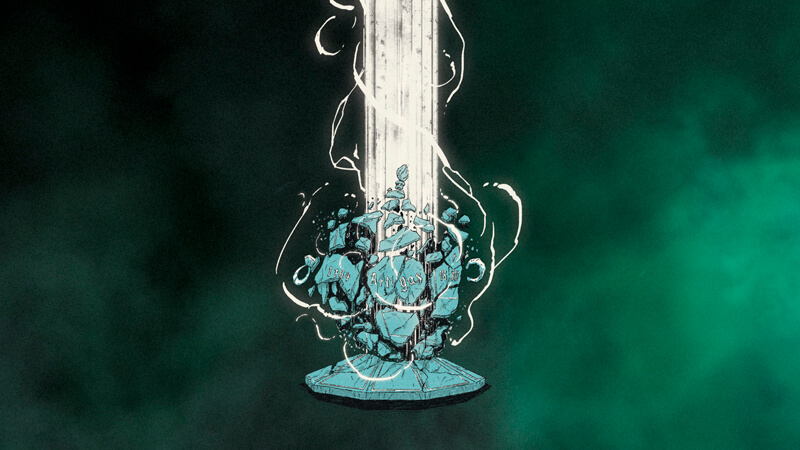 I'm inspired by projects that manage to evoke an emotion in others, such as Zombie Hero, a publishing project that began with a sketch of a hypothetical movie poster showing a rotting hand in a baggy uniform emerging from the ground. This sparked curiosity and generated several comments on our social media, so we decided to submit it as a project to the Ministry of Education and Culture’s Competitive Grants for Culture, for which we were ultimately selected.
That project culminated last year in a trilogy, and it has opened up the possibility of exploring other pieces, which my brother and I are already working on.
-
What kind of legacy would you like to leave through your work?
Not long ago, a friend asked me why I do what I do. My first answer was pretty lame. She asked me again, and this time I told her that I was seeking immortality through my creations. It’s a philosophical question we should all ask ourselves. We always need to challenge ourselves.