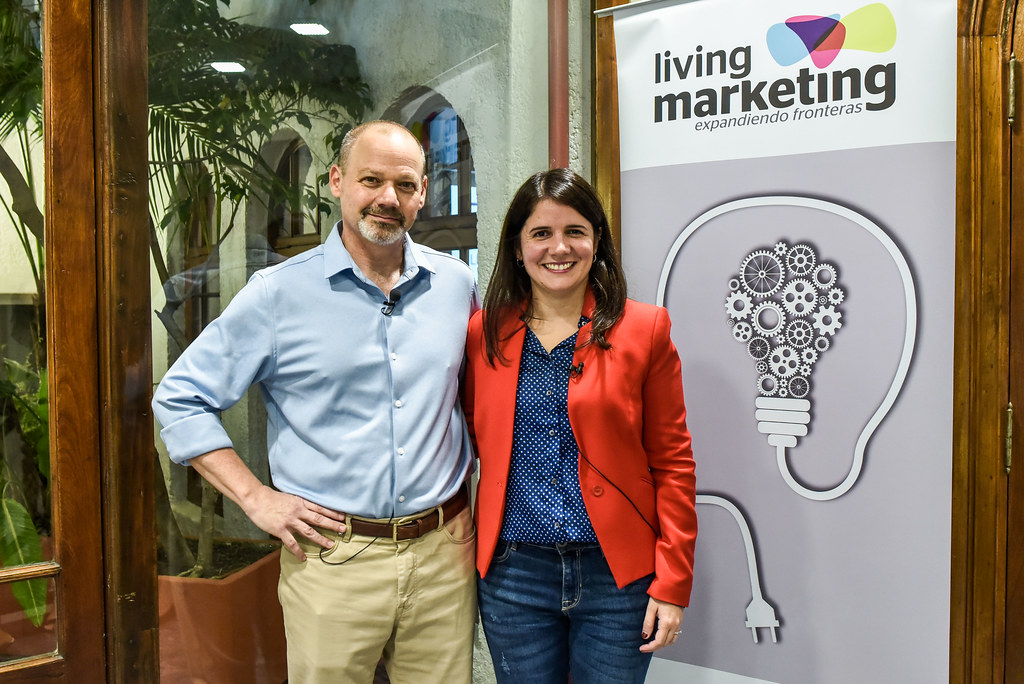
“People will forget what you said, they will forget what you did, but they will never forget how you made them feel.” This quote from American writer Maya Angelou summed up the central message of the presentation by Dr. Ricardo Kaufmann, director of Kaufmann & Asociados, financial manager of Palacio de la Música, and associate professor of General Administration, and by Mariana Machado, MBA, manager of marketing, communications, and business development at Guyer & Regules and professor of Services and Relationship Marketing, titled “Customer Experience Management (CXM): The Future of Marketing.”
The event, which took place on April 10, 2019, at the Pocitos Campus of Universidad ORT Uruguay was part of the Living Marketing series of meetings, addressed how to manage the customer experience, how customers perceive their interactions with the company, and how to ensure they experience it holistically.
The experience: what drives people
Customer Experience (CX), or customer experience management, is the new paradigm driving marketing. It is based on two ideas: experience is what motivates people, and customers define it through their needs.
Kaufmann broke it down in numbers, citing data from CX consulting firms:
- “79% of consumers want to know that a company cares about them before making a purchase” (Wantedness).
- “89% of customers feel frustrated because they have to repeat their issues to the company” (Accenture).
- “65% of shoppers believe that a positive experience with a brand is more influential than big advertising” (Temkin Group).
- “86% of shoppers are willing to pay more for an excellent customer experience” (Temkin Group).
- “By 2020, customer experience will surpass price and product as the key brand differentiator” (Walker - Customers 2020: A Progress Report).
So, according to Machado: “In the age of the customer, companies have to adapt—not because it sounds nice, but because the market demands it.”
In this way, business ideas are developed“from the outside in”in three steps: coming up with the idea; finding out how customers perceive it; and putting it into action.
The fundamentals of marketing are changing. We must identify what customers want and transform the company accordingly.
What is CX?
“Customer experience is a natural evolution in the age of the customer,” the authors quoted from the book *Outside In: The Power of Putting Customers at the Center of Your Business* by Harley Manning and Kerry Bodine.
The book adds that CX is “what products and services your company offers, how it runs its business, and what your brand stands for. It is what your customers think happened when they tried to learn about and evaluate your product, tried to buy it, tried to use it, and perhaps tried to get help with a problem. Furthermore, it is how they felt about those interactions: excited, happy, and calm, or nervous, disappointed, and frustrated.”
In short, it's how customers perceive their interactions with the company.
Machado outlined three levels of how customers perceive their interactions. The first level is whether the interaction meets the customers’ objectives; the second is whether it provides them with a benefit or ease of use; and the third and most comprehensive level is whether it makes a difference in their experience.
"The better the customer experience," Kaufmann said, "the better the business results."
CX as a business discipline
Machado emphasized that the key to improving profitability lies in viewing CX as a business discipline. To that end, it is important for the company to have a designated leader—someone dedicated to managing CX with a holistic approach.
Experts suggest six steps to move forward:
- Strategy and Experience Management.
- Listen to the customer.
- Measure.
- Design.
- Implement.
- Corporate culture.
When is experience gained?
The customer experience is shaped by every interaction with the customer, regardless of the channel. In marketing, the ways in which a customer can interact with a company are referred to as “touchpoints.” The challenge posed by this new paradigm is one of consistency: viewing the experience as a whole.
The speakers recommended bringing all managers together to assess how customers perceive the overall experience—taking into account the entire journey, from the moment they park until they leave.
How do we measure the experience?
The key tool is listening—at every level and across all channels of communication with customers. We need to systematize the ways we gather information—for example, through surveys—to measure customer loyalty and their willingness to recommend the company.
Kaufmann and Machado discussed the importance of “emotional management.” It is through emotions that memories are formed. And CX aims to ensure that customers remember their experiences with the company.
Full lecture:
https://youtu.be/WdfUkL82HxU?si=4HCCERzw5TuuqT1K
Image gallery: