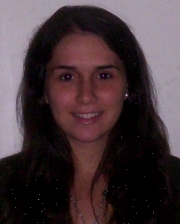
 Name: Denisse Toledo Gallo
Age: 22
High School: Doctor Andrés Pastorino High School
Degree Program: Bachelor of Arts in Economics
Occupation: Economic Analyst, National Chamber of Commerce and Services of Uruguay
Interview published in December 2011.
In 2008, Denisse began pursuing a bachelor’s degree in economics at Universidad ORT Uruguay. In early 2011, she completed an internship at the Center for the Study of Economic and Social Reality (CERES). Later that year, in April, she began working as an economic analyst at the National Chamber of Commerce and Services of Uruguay. She is currently in her final semester of the program.
- In what year did you choose to study at ORT, and why?
- In 2008, I began pursuing a Bachelor’s degree in Economics at Universidad ORT Uruguay. A major factor in my decision to study at this institution was—and still is—the university’s strong reputation both nationally and internationally. It also offers many opportunities for professional growth.
- How did the idea for the Bachelor's Degree in Economics come about?
- Since my junior year of high school—when I was 17—I knew I was interested in economics, but I wasn’t sure which major to choose. Today I know that by pursuing a Bachelor’s degree in Economics, I made the right decision. Talking to both graduates and current students was essential in sparking my interest in the major. What caught my attention the most and sparked my interest in Economics was what we call Macroeconomics and everything it covers: inflation, competitiveness, unemployment, as well as the financial sector, among other topics.
- How would you rate the course?
- One of the most important things ORT gave me was the close relationship I was able to build with the professors, who are generally very approachable and willing to answer questions—whether in class, via email, or even over the phone. This is essential when you’re looking to deepen your knowledge. The facilities are also spacious and comfortable. We spent several afternoons studying in groups at the university and felt right at home. The entire staff is always friendly and welcoming.
- What do you remember about your school years?
- I remember the first day of school when I walked in and didn’t know anyone and had no idea what it would be like to study there. Today, I’ve made great friends with whom I’ve shared four years, and I’ve internalized much of the knowledge the professors have imparted to me. I also remember the long afternoons of mandatory classes: arriving at eight in the morning and leaving at ten at night when the school was about to close. I also remember lunches with classmates and snacks between classes, as well as the all-night study sessions preparing for midterms.
- When did you start working?
- In January 2011, I began an internship at CERES, where I compiled relevant economic indicators and was responsible for selecting articles on the global economy.
- Where do you currently work?
- Since April 2011, I have been working as an Economic Analyst at the National Chamber of Commerce and Services of Uruguay. I work in the Institutional Affairs Management Department, whose general objectives include preparing reports, organizing seminars and roundtables to present to members and the general public, and maintaining a constant presence in the media to convey the chamber’s views on issues relevant to the country, among other responsibilities.
The reports and studies I am required to prepare cover current issues and span all sectors of the economy that are relevant at the national level: credit trends, accountability, exports and productivity, the informal economy, energy strategies, and others. In addition, we produce two semi-annual reports and one annual report analyzing the country’s economic situation.
- Do you think ORT prepared you for the job market?
- Absolutely. When I started working, I felt I had the tools I needed to do the job. I think the mandatory internships are one of ORT University’s strengths. These assignments allow you to put theoretical knowledge into practice, and that has made it easier so that when you start working, you don’t have to start from scratch in certain areas but already know how to handle things—that is, where to find certain data, how to analyze it, what comparisons to make, how to interpret it, among other things.
- What are your plans for the future?
- Once I finish my bachelor's degree, I want to specialize in finance, so I am currently looking for graduate programs in this field and the schools that offer them.