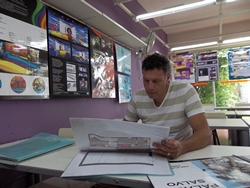
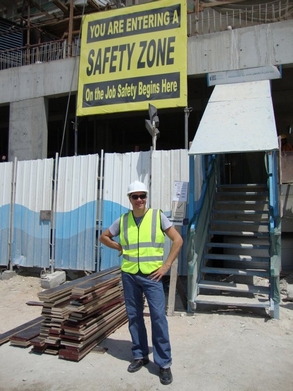
 He watched the World Cup in South Africa at the Uruguayan embassy in Qatar. He spent several months that year living in 40-degree heat. Although he never fully adapted to the culture of that country, the seven months he spent working at a consulting firm in Doha marked “a milestone” in his career, as he himself describes it. Carlos Francia, a graduate with a Bachelor’s degree in Interior Design and a professor at the School of Architecture at Universidad ORT Uruguay, traveled to Qatar in February 2010 to “fill in the gaps” at a local firm. As he explains in this interview, much of his work during his time there consisted of “resolving the issues that arose between the interior design, architecture, and engineering departments.”
Although he admits he expected to find “a more cutting-edge company with greater advancements,” when reflecting on his time in Qatar, he has no doubts: “I feel like there’s a before and after this experience. Beyond the professional aspect and interior design, the experience of being able to connect, get to know that culture, and meet people working abroad is truly wonderful. It gives you a different perspective on the world and on life in general.”
-How did your trip to Qatar come about?
-I have a friend who’s an architect, Rafael Berrutti, who had been working there for a couple of years. When he went on leave, I gave him my final portfolio from the project I did for my degree, and he took it with him. I asked him to do something with it. He presented it to the company where he worked, which is an engineering and architecture consulting firm specializing in infrastructure projects. Associated with this firm was a younger company run by the wife of the firm’s owner, specializing in interior design. She saw the portfolio, liked it, and in November 2009, negotiations for the contract began. By February 2010, I was already on my way to Qatar. I stayed for seven months and then took a trip around Europe.
-What kind of work did you do there?
-I worked on the interior design aspects of several projects and divided my work into various areas.
-Which ones?
-I went in to “fill in the gaps” and resolve some issues that were cropping up between the interior design team and the architecture and engineering teams. There was a disconnect there. I served as the link between the two, since I also have experience in architecture and construction management. I acted as a liaison between what was happening on-site related to interior design and much of what was taking place on the construction site. We had to patch all that up because it was quite disconnected. It was a nice job but very tedious and complicated, because the person in charge of it wasn’t doing their job and the issue had been left a bit hanging. Things had moved forward, and there was a significant delay. In addition to producing plans—which required spending a lot of time on AutoCAD and sitting in front of the computer, which is quite exhausting—I had to negotiate with the architects, so the work was quite draining. It was a nice job, but it was very draining because of the timing when I joined, as there was a gap in that area.
-Have you done this kind of work in Uruguay before?
-It was really just putting into practice everything I’ve been doing here for years, from when I first started studying architecture until just before I left. I did a little bit of everything. I designed everything from building envelopes to material selection, did some construction supervision, worked on kitchens, finalized finishes in some buildings, and really spread myself thin across many areas. The interior design aspect was still in its early stages. There were two of us interior designers and a sort of junior designer who served as a draftsman.
-What professional challenges did you set for yourself before going to Qatar?
-I had higher expectations for Qatar, and, as with everything, reality eventually sets in, and it’s quite different from what you imagine. I pictured a more cutting-edge company with greater technological advancements, and a more developed country with greater resources, but it didn’t turn out that way. I’m more drawn to the European way of thinking and how they run things than how they do it in Qatar. They only recently discovered their country’s natural gas and oil resources and have experienced explosive growth. Qatar is like a monarchy; it’s not a democratic country and has an authoritarian system.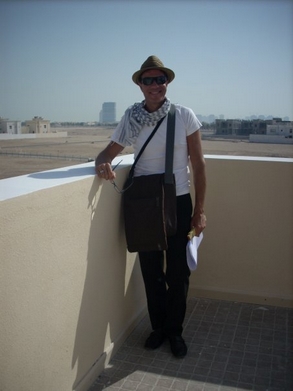 -Did you feel all that while you were there?
-At first I didn't realize it, but then I did. Anyone with a democratic, republican background rooted in absolute freedom can sense it right away. I knew very little about Qatar's unique characteristics and ideology, and even less about its religion.
-How did you adjust to Qatari culture?
-At first, everything seemed so rosy, like any new experience. I took the risk of leaving, with all that entails, because you have to leave your country and make a pretty abrupt break from your daily life and work. I approached the experience with a lot of enthusiasm and joy. At first, I felt like a tourist. I didn’t really realize that I had to make a huge effort to be there, do my job, and also build a life—which took place on the weekends, when we could have fun and connect with other people.
-Were there any Uruguayans?
-There are a few Uruguayans working here. Most of them are architects.
-Beyond all those challenges, do you feel like it helped you grow? Yes, I feel like there’s a before and after to this experience. In all modesty, for me it was a milestone in my career. Beyond the professional aspect and what pertains to interior design, the experience of being able to connect, get to know that culture, and meet people who are working abroad is truly a very rewarding experience. It gives you a different perspective on the world and on life in general.
-Do you think it's necessary to have these kinds of experiences to grow as a professional?
-Yes. I had the chance to do it at this stage in my life and I took it, but I think you should do it earlier, when you have more energy and can make the most of opportunities. After experiences like this, you can easily move to another country. I stayed in touch with universities there so I could eventually share my knowledge and teach classes, which is something I enjoy. In those countries, education and teaching are important because foreign universities are coming in to educate and train the population. The fields of education, architecture, design, and engineering are really booming there.
-Would you go back?
-Given all the difficulties I mentioned, when I left I was happy to be able to return to my country. There were many things I missed. But today, with a different perspective and now that I’m familiar with the situation, I think I’d go back. I don’t know if it would be Qatar, but I’d go back to Dubai, Oman, or some other one of these countries that, thanks to the resources they have, give you opportunities to have a lot of really enriching experiences in a short amount of time.
*Carlos Francia holds a Bachelor’s degree in Interior Design from the School of Architecture at Universidad ORT Uruguay, where he serves as a tenured professor of Drawing. He has a certificate in University Teaching from the Institute of Education and a diploma in Architecture and Construction Business from the University of Belgrano in Buenos Aires. He is an assistant architect and engineer at the University of Labor of Uruguay (UTU).
Interview published in March 2012
News
In Qatar, a Uruguayan: Carlos Francia
March 11, 2012
Carlos Francia, a graduate of the Bachelor of Interior Design program and a professor in the School of Architecture at Universidad ORT Uruguay, traveled to Qatar in February 2010 to work for a local company.