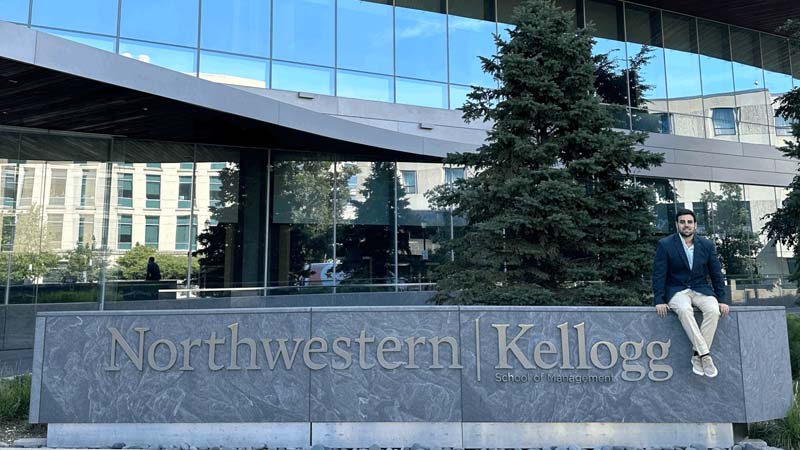
In this interview, he tells us why he decided to pursue an MBA, what challenges he faced during the admissions process, and what his future plans are.
What was the application process like for admission to the Kellogg School of Management?
It was quite a long and challenging process. First, I had to take an exam, which is usually the GMAT (Graduate Management Admission Test) or the GRE (Graduate Record Examination) for business schools. Then, I took an English proficiency test, which could be the TOEFL or the IELTS.
In my case, I chose to take the GRE, which is used for business schools but also for PhDs, master’s degrees in science, and other programs. When I first started applying, I hadn’t yet decided exactly which program I wanted to apply to—whether I would apply for an MBA or a hybrid science and MBA program—so I saw that this was the one that best fit my options.
Can you tell us a little about your experience writing your applications and why you chose this university?
Each university has its own application process, which can be quite complex. Some required up to six essays, while others asked for three or two essays with specific and abstract prompts. It was a time-consuming process. I applied to seven schools, all in the second round of applications, which could be submitted in September or January. After a few weeks, I started receiving responses, ranging from “thanks, but we’re not interested” to offers of admission with or without a scholarship. I chose Kellogg for its collaborative culture and its specialized program in biotechnology and public health.
It’s a university that fosters a collaborative environment, and that really resonated with me because, in my field—biotechnology—collaboration is essential. It’s a multidisciplinary industry, and it’s impossible to tackle a problem by approaching it from just one discipline, so that really appealed to me. Finally, this university also offers an additional program in biotechnology, public health, and biopharmaceuticals, which is what ultimately convinced me.
Another important point to mention is that the program includes visits to companies in various cities across the United States, as well as a mentor who specializes in the specific area of biotechnology you want to work in and the location where you’d like to live in the future. It offers specific courses, such as health economics and biopharmaceutical marketing—very focused and interesting topics, at least for me.
On November 15, we have our first field trip, during which we will visit two companies in San Francisco, in Silicon Valley—two of the most prominent biotechnology companies, Gilead and Genentech.
How did you prepare for this experience, and what advice would you give to someone who wants to apply to similar programs?
Talking to people who have gone through the process was essential. It’s important to talk to those who went through it years ago, months ago, and those who are currently going through it. This will give you different perspectives on what the experience was like and how to approach it. It’s also essential to take it one step at a time, without getting overwhelmed by each stage of the process. Preparing ahead of time and staying determined are key.
To talk to people who have completed these types of programs, I reached out via LinkedIn or email to a lot of people I didn’t know, asking for a meeting, an interview, or just a few minutes to chat—something I feel we aren’t really used to doing here in Uruguay. The response rate is actually very high. Everyone who comes to do these programs usually talks to a lot of people beforehand, so they’re all very willing to set aside some time when someone reaches out to them.
How do you feel about your previous education, and how has it prepared you for this new phase at Kellogg?
The education I received at Universidad ORT Uruguay provided Universidad ORT Uruguay with a solid foundation for understanding and tackling projects in this field. It has enabled me to understand, analyze, and study any project or technology related to biotechnology—both from a theoretical perspective and in terms of its practical application.
Do you plan to return to Uruguay in the future or stay in the United States?
At this point, I haven't made a final decision. In the long term, I'd like to work on developing biotechnology projects in Latin America, whether in Uruguay or elsewhere, such as Santiago, Chile, or São Paulo. My goal is to use biotechnology to tackle important issues and create value in the region.