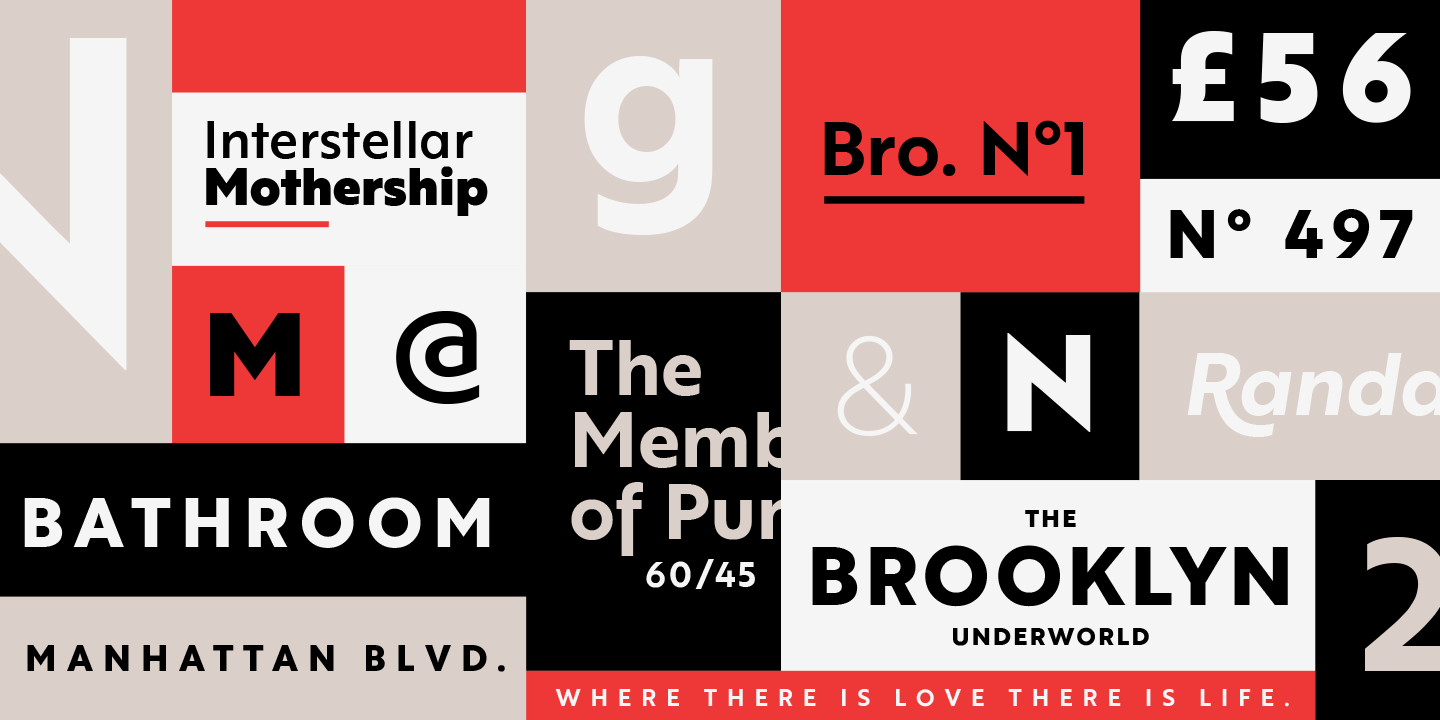
Interview withFernando Díazabout one of the world’s best typefaces of 2016, according to Typographica.
When did you create Brother 1816 together with Ignacio Corbo?
The idea of creating a typeface together came about in mid-2015. From that point on, we worked full-time on the project: the type design process is a long one; in our case, it took a little over a year. Fortunately, all that work paid off.
What was your idea at the time? What were you aiming to achieve?
Nacho is one of the most talented designers and illustrators I know, having worked in the industry and understanding designers’ typographic needs firsthand. With his help, we identified a niche in the market that we found interesting.
What is Brother 1816 like?
It is a sans-serif typeface that allows users to choose between two complementary styles: geometric and humanistic. On one hand, one can choose to use it as a geometric sans-serif—ideal for large sizes in posters, packaging, logos, etc.—or as a humanistic sans-serif—effective for medium- to long-form text in publishing, web, signage, etc. Additionally, the designer can choose to blend both styles to create something unique. The result is a versatile and robust typeface.
What does it mean that it offers 32 fonts?
Brother 1816 is a typeface family, meaning has variants of weight and style (regular, italic, bold, bolditalic, black, blackitalic, etc.). Each variant, in turn, has characters that support different language sets. In total, the complete family includes more than 14,000 characters. We’d like to expand it in the future.
How did it end up among the best typefaces of 2016?
The selection is made by typographica.org, one of the most important typography websites, with very high standards. The selection is overseen by Stephen Coles along with other renowned international figures. You don’t apply; they simply choose you, which is extremely gratifying for us.
What does this recognition mean?
I don’t think it’s up to me to say what it means for others or for Uruguayan typography, but personally, it’s an incentive to keep following this path, which began 10 years ago as a hobby encouraged by one of the best teachers I’ve ever had: Vicente Lamónaca, who is now my partner and friend.
For me, it demonstrates several things. First, how important a teacher can be in a student’s professional and personal life. Second, linked to the first point, is that if you do what you love most, the results will eventually come. Brother 1816 is available for purchase on Google Fonts, MyFonts, and Fontspring—the world’s leading typeface distributors—as well as on our website. I estimate that, just one year after its launch, there are more than 2,500 designers using the typeface, mainly in the United States and Eastern Europe.
How many typefaces have you created so far?
Officially, five. Some took me a year to complete, others four. Unofficially, I have at least three typefaces halfway done.
What are you working on now, and what are you doing in New York?
Studio work, teaching, and research are important in my professional life. I really enjoy them. I think I was raised that way—always wanting to keep improving (without losing sight of how far I’ve come) and sharing with others. That mindset brought me to The Cooper Union for the Advancement of Science and Art in New York over a month and a half ago. I’m taking an intensive typography course (12 hours a day, every day) taught by some of the best instructors I could ask for. In the course, we’ve encountered figures like type designers Matthew Carter and Gerard Ünger, and we’ve visited special collections at libraries such as Columbia University in the City of New York to analyze medieval manuscripts and printed materials. For me, it’s a dream come true.