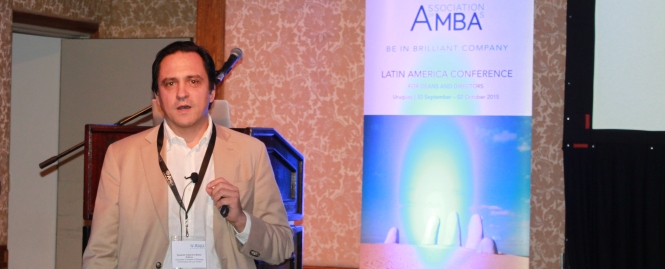
Interview with Dr. Ezequiel Reffico, editorial director of the CLADEA BALAS Case Consortium and associate professor at the School of Business Administration at the University of Los Andes, on the occasion of his participation in the 12thLatin AmericaConference for Deans and Directorsorganized by the Association of MBAs (AMBA), held from September 30 to October 2, 2015, as part of the 25th anniversary of the MBA program at Universidad ORT Uruguay.
Reffico also coordinates the development of teaching cases for the Social Enterprise Knowledge Network, a collaborative network comprising leading Ibero-American business schools.
The CLADEA BALAS Case Consortium is an organization comprising, among others, EGADE at the Tecnológico de Monterrey, ESADE in Spain, IAE Business School in Argentina, and INCAE Business School in Costa Rica; Universidad ORT Uruguay a member since 2014.
The goal is to create a curated collection of case studies from Latin America to be published and distributed globally through the Harvard Business Publishing website.
-What is the significance of a consortium like CLADEA-BALAS in the business and academic worlds?
-The case study method has proven to be very effective, but one historical limitation we have faced is that the cases used are drawn from different contexts—specifically, developed countries—and this undermines its effectiveness.
For the methodology to work, students must put themselves in the shoes of the decision-maker; as a result, the lack of relevance in the case studies has historically been a barrier to its adoption.
The second barrier is what some call “the chicken-and-egg problem” or the problem of coordination costs. Since there was no channel for systematically connecting with the global demand for case studies, most professors wrote cases that ended up in a drawer or were given to their friends.
The lack of an established market complicates supply, and the lack of supply prevents demand from ever taking off. This creates a kind of negative snowball effect—a global market failure that undermines the implementation of this methodology.
Finally, there is what we call the “network effect.” Historically, case studies were scattered across the websites of different organizations, and no one had the time to search through five, six, or ten different business school websites to find the case they needed. It’s just like Facebook, which is a valuable network because everyone is on it; if there were fifteen different networks, each one would be worth less. The same is true for case studies.
Right now, the Harvard Business Publishing website is the go-to platform for business cases—much like Facebook or Amazon. One of the major benefits of this initiative is that it enables Latin American business cases to be distributed globally. Users can access a single platform and find all the cases they need for their courses.
-Is CLADEA-BALAS the Amazon of regional cases?
-Exactly. These are real-world examples from the region, so the first issue—relevance—is addressed. They are examples that speak to students about the same reality they encounter when they leave the classroom.
-How can teaching through the case method impact business?
-It has a direct impact. When I teach a student an analytical tool on the board, the implicit assumption is that once I’ve explained it, they’ve understood it, internalized it, and will know when to apply it. What we’re telling them is, “Now that I’ve explained this to you, go out into the real world and everything will be fine.”
There is a huge, almost acrobatic leap between the opportunity to learn and the opportunity to apply what you’ve learned. Why? Because the context in which the tool is used is very different from the context in which it is introduced. There isn’t a teacher standing at a whiteboard; the information that comes in is messy and jumbled—not the perfect information you’d find in a PowerPoint presentation. Most of the time, people stumble and struggle with that leap, and the learning isn’t effective.
Educators say that the context in which the tool is introduced should be as close as possible to the context in which it will be used. In this methodology, we ask students questions that mirror those they will encounter in the real world, making learning much more effective; the methodology has a direct impact on the business world because it leads to more sound decisions based on stronger analytical foundations.
-Why is it important for schools not only to study cases but also to create them?
-For two reasons. The first is that one draws on cases from one’s social and political environment, from one’s own reality. The closer the case is to my students, the greater the chances of success; that is why it is much better to use a Latin American case than one from a Nordic country.
Ideally, the case study should focus on a company I might work for after graduation—one that’s relevant to a student’s daily life. That fosters empathy, makes it easier for me to relate to the decision-maker, and helps me engage with the analysis.
The second point is that if a school is committed to case writing, its professors are much more likely to be effective facilitators of case discussions. Those who write cases have a much better understanding of the methodology.
-Both generate knowledge in their own way, but what does the case study offer that research through academic papers does not?
-In reality, there isn't really a conflict, because the best practice for writing case studies is to make them part of a research agenda. You choose a company that is operating successfully, analyze the situation, and write an educational case study—one designed to spark questions and reflection—while simultaneously building on what you've learned.
Once you have five cases on the same phenomenon, you can draw cross-cutting insights that apply across the entire sample: that is a qualitative paper. If you continue to add cases to the sample, you end up with a mixed-methods paper, and eventually you can take the hypotheses developed during the exploratory phase and use them to produce a more quantitative and traditional academic study based on a representative statistical sample.
These are two aspects of the same process of learning and knowledge-building. The teaching case study is the aspect that focuses on the classroom, while the paper is the aspect that focuses on the peer community—the academic community.