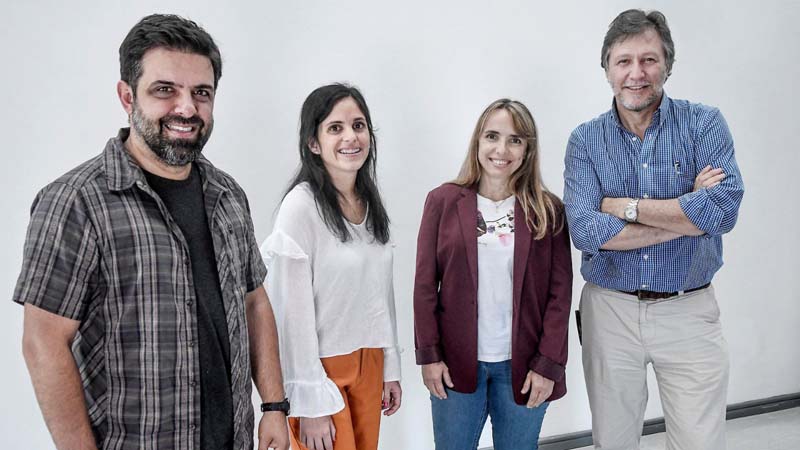
In this article, Pía describes the development process and shares her expectations for the clinical trial in humans: “We are on the verge of something historic: this may be the first time a drug developed by Uruguayans begins clinical trials under Uruguayan leadership, ” explains the graduate of Universidad ORT Uruguay.
How did Eolo Pharma come about, and what is your role on the team?
Eolo Pharma was founded in 2016. In 2014, I was finishing my degree in Biotechnology Engineering at ORT and applied to the Pasteur Institute to write my thesis on obesity and related complications.
That’s where I met Carlos Escande, and shortly thereafter, the opportunity arose to start a business with him and two other researchers. After a project that didn’t pan out, we realized in 2016 that a patent they had “sitting on the shelf” could be highly valuable to the market. That’s how Eolo Pharma came to be.
Today, I am the CEO of the company. I focus on managing the business, securing investment funds, and handling everything related to coordinating with the contractors we hire as we move forward with product development. I play an active role in business development and also serve as a sort of project manager when it comes to overseeing the various stages the drug goes through.
How does Eolo Pharma operate?
There are four of us founders, and we have many young researchers working with us. We collaborate with institutions and individuals from all over the world: the United States, China, India, Australia, Spain, and Italy, for example.
We’ve always worked very collaboratively, going beyond our defined roles. We’re a multidisciplinary team, and there’s great synergy between the work of our more experienced members and the contributions of our younger colleagues.
“Eolo Pharma found that its lead compound, MVD1, possesses pharmacological properties against obesity whose mechanism of action appears to differ, at least in part, from its activity as an inhibitor of chronic inflammation.”
What does this discovery mean?
At Eolo, we have 60 molecules that were designed by us and are protected by patents in the United States.
When we first began designing (molecules), we did so with the aim of creating anti-inflammatory agents, since obesity and its associated complications involve an underlying process known as low-grade chronic inflammation.
Based on this, we designed the drugs, but just as happened with Viagra (which was initially designed as a vasodilator), we observed that this MVD1 drug did not act solely as an anti-inflammatory agent. It also has an unexpected emergent property that exerts its "anti-obesity" and "anti-type 2 diabetes" effects through thermogenesis (a process in which excess fat is released as heat, causing the person to lose weight and potentially alleviate metabolic complications).
What steps did the Eolo Pharma team take following this discovery?
Like any startup, we knew we wanted to develop a drug through clinical trials. That was our dream, but no one had ever done this in Uruguay at the time, and we had no role models to follow.
At first, we were a bit overwhelmed, trying to tackle ten diseases and working with 60 drugs at once. The first step was to "bring the idea back down to earth" and realize that we needed to focus on a single disease. Even back then, we could see that MVD1 was very effective at promoting weight loss, but we had to figure out how it worked and, at the same time, ensure its safety.
Once we identified how the drug works, we were able to administer it more precisely in animal models. This encouraged us to test it in humans. We are now much more confident that the human studies we are going to conduct will provide evidence of weight loss and reduced blood glucose levels.
Following the latest round of funding, in which Eolo Pharma raised $3 million, the company plans to begin its first human clinical trial (Phase I) in 2023.
What is this clinical trial about, and how will it be conducted?
We planned to conduct the clinical trial from the very beginning. That was always our goal, even though we weren't sure how we were going to achieve it.
In 2022, once we have determined how the molecule works in mice, we plan to conduct an ambitious clinical trial: in addition to studying the molecule’s safety, we will look for evidence of certain biomarkers to assess its effectiveness. While efficacy is studied in depth during Phase II, we will begin to see indications of its potential efficacy during Phase I.
The human clinical trial will be conducted in Australia, which is one of the world's leading countries in this field and allows us to remain competitive in terms of timing.
What results are expected from this clinical trial?
In the clinical trial, we hope to assess the drug’s efficacy. In other words, we want to see if the molecule is able to target the biomarkers we’ve selected. For example, we want to see if blood glucose levels are reduced in patients with prediabetes. Another objective is to observe whether these patients lose weight.
What does this project mean for Uruguay and the region?
When we first started out, we at Eolo Pharma didn't have anyone to ask for advice on how to do this. There were only a few isolated examples in Argentina and Chile.
That is why it is important for us to share what we are doing. We want to encourage more researchers to develop drugs and bring them to the clinical stage, in order to position Uruguay as a country where clinical research can be conducted for the rest of the world.
All the medications we use come from abroad (the United States and Europe), and we don’t develop any of our own. That’s why it’s important for more companies like Eolo Pharma to take this step. If we’re not mistaken, this may be the first time a drug developed by Uruguayans has begun clinical trials under Uruguayan leadership.
What are your plans for the coming years?
The next major step, in the short term, is to find a pharmaceutical company to which we can sublicense MVD1 and continue working on the other 59 molecules.
In the coming years, we envision continuing with new developments and expanding into other areas, not only in obesity but also in autoimmune and neurodegenerative diseases.
Why is this project attracting so much attention?
I think this project is drawing attention because a historic milestone is taking place—one that we ourselves are sometimes not even aware of: for the first time, a drug developed in Uruguay is entering clinical trials.
So far, we have raised $7 million in funding rounds, which—by Uruguayan standards—is a lot of capital (though by industry standards, it’s very little).
From a team and personal perspective, developing something that makes it to market is every researcher’s dream, and in the field of human studies, it’s extremely complex. To me, it’s “crazy” to think that we started dreaming about this project back in 2016, and now it’s finally coming to fruition. It’s fantastic, and it’s a great culmination of the work we’ve been doing.