How and when did the idea for The Last YouTuber?
In 2015, I was working as a content consultant for Montevideo Comm, which owned Canal M, and I started working with Martín De Benedetti, a very talented young man who created content for the internet. I thought it would be interesting to combine my experience with his fresh perspective and digital native background, so I suggested we brainstorm a project together. He wanted to do a comedy project with YouTubers and combined that idea with a zombie apocalypse concept, inspired in part by the mockumentary *What We Do in the Shadows*.
This is an idea that came about five years ago but is only now being launched—what was the process like?
Based on that idea, we developed the project together.
We applied for the ICAU Development Grant for other projects, but it wasn’t until our third attempt that we were awarded it. Although it wasn’t a large sum and was intended solely for development, we tried to secure additional funding, but it wasn’t easy. Furthermore, there was no prospect of a production fund. So we decided to shoot it with the few resources we had—which were minimal, just enough to cover transportation and food costs and pay a token fee to everyone involved.
Post-production took a long time because we no longer had the resources. It’s also important to note that we had already established contact with UN3TV before we started filming. In other words, we had already thought through and negotiated the distribution platform before we began shooting.
This is a transmedia production that can be viewed on UN3.TV and social media. What role do you think new platforms play in the audiovisual sector? How does content production for social media work?
The platforms are already in place, and the current situation is the boost they needed. I think we’re at a point where the distribution system is being restructured because production also needs to become viable.
Creating audiovisual content that plays out like a series but includes complementary elements on social media is very interesting. It requires a lot more work, but it opens up more possibilities. You need to plan ahead for what you’ll need because these other elements (like posts, stories, etc.) must be included in the shooting schedule—they open new avenues to the content: maybe a complementary video hooks you into watching the series, and that video isn’t necessarily promotional; it’s part of the story itself.
In the midst of the pandemic, what role does audiovisual content play in the daily lives of people staying at home?
This pandemic has put many things into perspective and shaken up the hierarchy of what matters and what’s useful. People are devouring the audiovisual content on streaming platforms, and many of them will soon run out of content, so there will be a shakeout. The main problem is that there’s a lot of content out there, but people gravitate toward the most obvious options, like Netflix, which—let’s be honest—has some good stuff and a lot of filler. So, there’s still the issue of what content I, as a viewer, actually end up watching.
There are other platforms, such as Mubi, Retina Latina, Mowies, and Qubit, that offer some very interesting films, but they aren't as popular.
What is *The Last YouTuber* about? Who is its target audience?
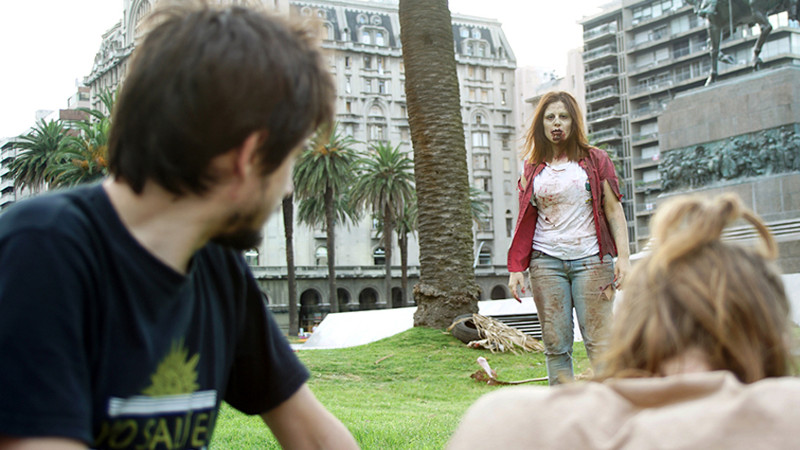
"The Last YouTuber " is a comedy-science fiction story. It follows three twenty-somethings from Montevideo who have survived a zombie outbreak. One of them is Victor, a dramatic YouTuber who keeps filming videos for a nonexistent audience. Mauro, his cousin, is just trying to survive and can’t stand Victor. The third is Damián, a man of few words, who spends his time filming everything.
Each episode features a new video by Víctor, in which he films the kinds of content YouTubers typically create—vlogs, challenges, songs, and so on—while a story unfolds about the relationships between the main characters. The web series begins when the guys meet Fernanda, a survivor. She is a woman who moves in with them, sparking conflicts among the young men as they compete for her attention.
This product is aimed at a young audience, aged 15 to 35.
How have you been experiencing the airing of *The Last YouTuber* since it began?
For us, it was a successful experience. Since we were published by UN3, we managed to surpass 13,000 views with the first episode. We also received press coverage, even though it was right in the midst of the pandemic.
On the other hand, there was a good response on social media; people jumped right in to create memes based on the ideas we put forward.
We hope to participate in festivals now and make connections so that we might be able to produce a second season.