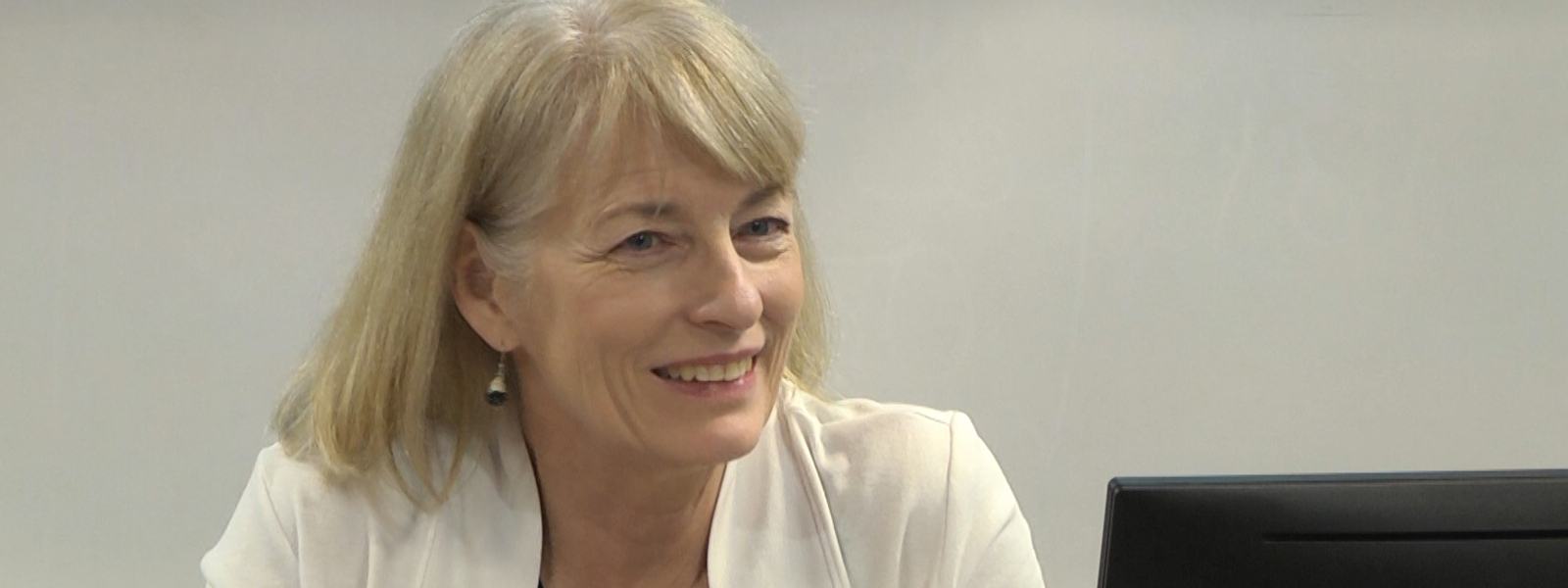
“We need human rights even more than before,” said Professor Kathryn Sikkink during the lecture “Reasons for Hope: Challenges to Human Rights in the 21st Century.” The talk, which was the thirteenth lecture in the Department of International Studies’ annual series, took place on Monday, December 18, 2017, in the Hemiciclo on the Pocitos Campus.
Kathryn Sikkink is the Ryan Family Professor of Human Rights Policy at the Kennedy School of Government and the Carol K. Pforzheimer Professor at the Radcliffe Institute for Advanced Study. She is also a member of the American Philosophical Society, the American Academy of Arts and Sciences, and the Council on Foreign Relations.
“Reasons for Hope: Human Rights Challenges in the 21st Century” is the title of the book that Sikkink will publish in June 2018.
The Uruguayan connection and optimism
Sikkink began the lecture by talking about his connection to Uruguay. He recalled arriving in the country on a student exchange program in 1976 and said that much of his interest in human rights stems from his experience of life during the dictatorship.
“I decided I had to write this book because we were inundated with a series of books that were very pessimistic about the legitimacy and effectiveness of human rights,” he explained, citing examples of authors who speak of the end of the era of human rights.
This pessimistic view was also evident among several human rights activists, which deeply concerned the scholar. The book consists of three parts, which address the legitimacy of human rights, their effectiveness, and their role in the 21st century.
International protection and Latin America's role
For Sikkink, the origins of international human rights protection are far more diverse than some American scholars suggest, who limit their perspective to the United States and Western Europe. Thus, the continuity of such protection appears to be a viable prospect.
In the author’s view, Latin America played a very important role in advancing human rights and their international protection. The Mexican Constitution of 1917 was the first in the world to recognize economic and social rights alongside political and civil rights.
It was not until after World War II, at the San Francisco Conference that led to the founding of the United Nations, that the idea of international protection of human rights took on an institutional dimension.
Sikkink recalled that at the Dumbarton Oaks Conference—held prior to the San Francisco Conference, where Great Britain, the USSR, the United States, and China drafted a proposal for the creation of the United Nations—human rights were barely mentioned. China requested the inclusion of an article addressing discrimination, but that request was not accepted.
He also said that the Chapultepec Conference was convened because Latin American countries were concerned about the lack of plans for economic development and the protection of human rights. Consequently, the participating countries requested that the Inter-American Juridical Committee draft a Declaration of Human Rights.
Women's Rights and Uruguayan Participation
The speaker recalled the vigorous efforts made by the Latin American delegates at the San Francisco Conference to secure the adoption of articles concerning women’s rights. She went on to explain that Martha Lutz of Brazil, Minerva Bernardino of the Dominican Republic, and Isabel Pinto de Vidal of Uruguay succeeded in securing the inclusion of gender equality without the cooperation of their colleagues from the major powers.
Sikkink referred to Article 8 of the UN Charter as “the Uruguayan article,” in recognition of the efforts made by the Uruguayan representative in drafting and securing its adoption.
“The Uruguayans wanted to have a legally binding version of the International Bill of Human Rights as early as 1945,” said the expert. “They didn’t succeed,” she noted, recalling Dardo Regules’s failed attempt to include the declaration of human rights in the treaty of the Organization of American States (OAS).
The expert explained that it was the Brazilian government that proposed, in 1948, the creation of an Inter-American Court of Human Rights. This could not be achieved immediately, as the process required the drafting of a convention first; the rise of dictatorships in Latin America made it difficult to achieve that goal.
“When dictatorships take hold in the Southern Cone, the Inter-American Commission on Human Rights is already in place. What’s interesting is how the Commission manages to be an effective institution,” he said.
Justino Jiménez de Aréchaga was the Uruguayan representative on the Commission at that time. Sikkink noted that Jiménez de Aréchaga’s role is generally little discussed and recalled some of his actions.
Genaro Carrió, the Argentine representative, wrote that Jiménez de Aréchaga “was the driving force behind transforming the Commission into an efficient institution for the defense of human rights.”
The legitimacy of our rights and the hope to keep fighting
“Legitimacy is tied to the issue of neoliberalism,” the expert explained. She noted that in the United States, some people criticize human rights because of their overlap with neoliberalism, and she explained why, in her view, this criticism is unfounded.
“Criticism of the legitimacy of human rights is often based on incomplete and biased accounts,” he argued. “We need human rights even more than before.”
“All advances in human rights around the world have been achieved through struggles—often by oppressed groups. If we lose faith in the legitimacy and effectiveness of human rights, we may lose the energy to keep fighting. In the face of many challenges, I offer reasons for hope without complacency,” he said.
“To keep fighting, we need both anger and hope,” he added. “Hope grounded in history and facts, not a utopian hope. We must strive to build a better world.”
Collective Rights and False Suffering
“I believe there are important reasons, especially in indigenous communities, to consider collective rights,” she said when asked by the audience. “Many collective rights can be protected by safeguarding individual rights. Individual protection is usually effective in protecting the community.”
“Human rights generally go against the will of the majority. It is rare for majorities to embrace human rights,” he remarked, explaining that “human rights protect minorities from majorities.”
“Most people around the world believe that there has never been as much suffering as there is today. But the data shows that’s not true,” he clarified. Indicators such as rising life expectancy and falling infant mortality rates contradict the popular theory of suffering.
Video of the conference:
https://youtu.be/N-LrLO-hIOo?si=FVrgfKn3hN4osXBO