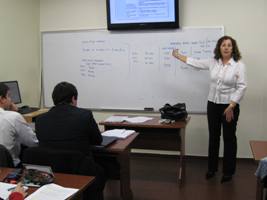
 Silvia Stamato, who holds a Master’s degree in Project Management from the CAECE University, Bachelor of Business Administration from the University of Buenos Aires and an SME consultant, she served as a visiting professor at the School of Business and Social Sciences for the Specialization Diploma in Accounting, the Specialization Diploma in Taxation, and the Master’s Program in Taxation and Accounting Standards—IFRS.
-What knowledge do you hope students will gain from the classes you taught?
-My two classes focused on economic and financial planning for small and medium-sized enterprises (SMEs). My goal is to encourage reflection on:
- Key factors affecting profitability
- Key components of the cost structure
- Integrating activities within the value chain and how to capture value within the chain?
- What is the relationship between the value chain and the current and future composition of customer segments?
- Business-specific factors that must be considered on a case-by-case basis.
-What information do you think is important for an SME to prepare and present these days?
-From my perspective as a manager, I believe it is important to prepare reports designed to support decision-making and the management of small and medium-sized enterprises.
-Why do you think the specialized graduate programs in Accounting and Taxation are important?
-I think it’s important for practicing accountants because it gives them an opportunity to build on the knowledge they gained during their undergraduate studies and stay up to date. It’s a great opportunity to share knowledge and experiences with professors and colleagues.
-What do you think of the students who have attended your classes at Universidad ORT Uruguay? Is there any particular trait you would highlight about them?
-The students I have had the pleasure of teaching have struck me as extremely proactive, open-minded, and eager to learn, displaying an assertive and constructive attitude that is certainly worth noting.
-In addition to being a visiting professor at the university, you teach at the School of Continuing Education of the Professional Council of Economic Sciences of the City of Buenos Aires. In this process of internationalizing education, what are the advantages of universities having professors of different nationalities who live in various countries?
-I believe the benefit is that the educational process is enriched when we share knowledge, experiences, and research from other countries; it’s an opportunity to learn how things are done in different cultural contexts. But it’s not just the visiting professor who gives and the students and the university who receive. Every time I visit ORT in Uruguay, I feel enriched myself and learn a great deal from this exchange with the faculty’s professors and students.