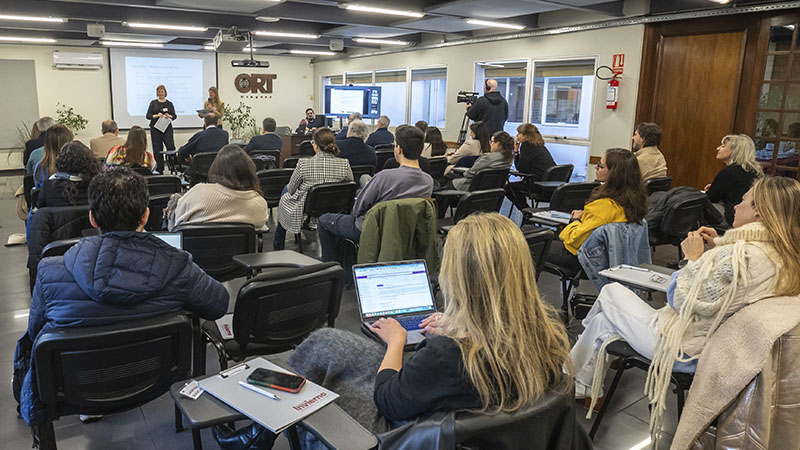
On August 5 and 6, the first edition of the Winter School titled “Higher Education and Technology: The Strategic Role of Artificial Intelligence in Learning” was held; this training program was specially designed for faculty members at Universidad ORT Uruguay.
Organized by the Center for Continuing Education in Higher Education (CAES) with support from the People Project, the initiative sought to create a space for co-creation and experimentation regarding the pedagogical use of artificial intelligence, as well as to foster the development of a community of practice committed to improving learning.
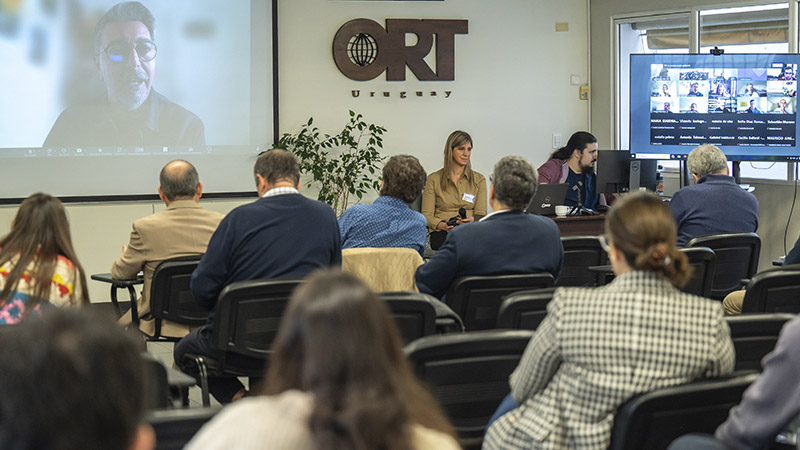
Featuring international speakers and presenters from various departments, the Winter School brought together more than a hundred participants—both in-person and online—with the aim of establishing itself as a regular forum for discussion and reflection on the concerns of faculty members at Universidad ORT Uruguay.
The 2025 edition of the Winter School focused on the dilemmas, tensions, and opportunities presented by artificial intelligence in higher education.
Learning: Part of a Teacher's DNA
In a university landscape still coming to terms with the rapid changes brought about by the pandemic, the emergence of generative artificial intelligence has once again shaken things up. “I don’t think anyone would have imagined that such radical changeswould have been introducedin recent years, ”said Dr. Carlos Marcelo, professor of Teaching Methods and School Organization at the Faculty of Education Sciences at the University of Seville (Spain).
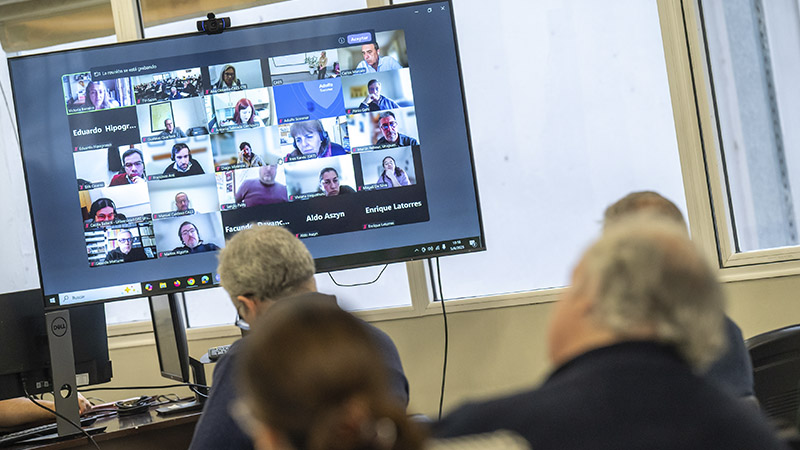
During the conference titled “Integrating Digital Technologies into Higher Education: Approaches and Challenges,” he emphasized that, nowadays, there is a perception that “everything remains to be done”: “It seems like we have to reinvent everything and start from scratch, because what we were doing is no longer valid and we need a new approach.” However, for Marcelo, that is not the case, and it is not good to convey to teachers the idea that “nothing that has been done before is valid” and that we have to start “from scratch.”
“The business sector is changing and will continue to change inexorably, but it won’t lead to a catastrophe, ”he said. He immediately added: “Those of us with gray hair have already experienced the idea that ‘technology is going to change the world,’ and, obviously, it does change, but the world remains recognizable.”
For Marcelo, the key lies in stopping viewing innovations as threats and starting to see them as a tool to support teachers. That means not denying the potential that artificial intelligence offers: to personalize instruction, to design digital resources more efficiently, to integrate and analyze data when making decisions, and to create new learning opportunities, to name just a few.
https://www.youtube.com/watch?v=LwNg4cdu72s
In this context, where artificial intelligence is here to stay, the professor believes it is essential to rethink education so that students will be able to take advantage of the opportunities that technology offers. And to that end, the role of teachers becomes even more important.
Learning is always part of who we are: pushing ourselves further, reading, exploring, sharing, and spreading the word.
Dr. Carlos Marcelo
According to Marcelo, one key point to keep in mind is that university professors must inevitably learn: “If we don’t learn about artificial intelligence, we can hardly teach it.”
At a time when he estimates that 50% of his students’ work is generated by artificial intelligence, he explained that we must shift “from detection to education.” In short, we need to create opportunities for students to become familiar with and learn from the tool: help them understand the importance of disclosing when and how they use it, teach them that the results are biased, and emphasize that they must verify the information generated.
“This means there’s more work to be done. If anyone thought that artificial intelligence was going to take our jobs away, it might take over some of our tasks, but then it will give us new ones,” Marcelo summarized.
Teachers' Superpowers
What if, in the coming years, there were no longer any distinctions between what is false, true, imagined, and synthetic? What if we delegated our cognitive abilities to generative artificial intelligence to the greatest possible extent? What if universities lost their role in preparing students for the future?
With these thought-provoking and provocative questions, Dr. Carina Lion —a professor in the Department of Education at the University of Buenos Aires (Argentina)—began her presentation at the Winter School, titled “Best Practices for Integrating Artificial Intelligence into Teaching.”
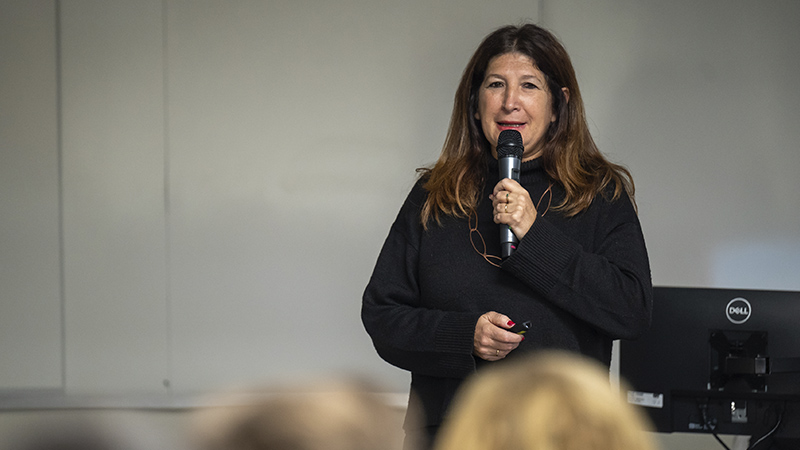
One of his goals was to debunk the most common myths surrounding artificial intelligence today. First, the notion of “solutionism” — the idea that these tools “come to solve” deep-seated educational problems. Second, the belief that “technology inherently drives innovation.”
And third, the belief that they have “superpowers”: “We attribute a lot to these tools. They are powerful, but we also need to consider what power we give them and what our own superpower is as teachers.”
We face a huge challenge: understanding the times we are living in. Who are we educating? For what kind of future? For what kind of work? For what kind of world?
Dr. Carina Lion
Educators often tend to“react to what’s coming”rather than“anticipate what might happen”: “These technologies don’t ask for permission; they just burst onto the scene. And the first thing we ask ourselves is, ‘What do we do? How do we use them?’”
In Lion’s view, the key is to understand that artificial intelligence provides “a toolbox and a new way of building knowledge.” It can“solve problems,”but human intelligence “should decide which problems are relevant”: what can be delegated and what cannot.
And, above all, to examine how to foster meaningful learning and valuable experiences that are “worth having at university.” “What experiences are we creating that are unique, valuable, and cannot be fully replicated by artificial intelligence?” the professor asked.
https://www.youtube.com/watch?v=vo05X6k2x88
These are discussions that need to be revisited, especially since the current generation of educators is at a turning point. “We are a generation that bridges two eras. We have to act as a bridge and begin to envision that future so that we can serve as an even stronger bridge,” Lion concluded.
Inspiring experiences
Following the international conferences, the Winter School participants broke into small groups, where they shared teaching experiences from their various departments and discussed the challenges and opportunities these present for teaching.
Later, in a group setting, the discussion that had taken place was summarized, and both Marcelo and Lion commented on the initiatives that had been presented.
IA-ORT Teaching Assistant
With the launch of the IA-ORT Teaching Assistant, Gonzalo Mordecki, M.A. —a professor in the School of Business and Social Sciences—provided an update on the platform and demonstrated how it can be integrated into daily work.
“What we did was develop a tool for teaching processes: a class activity generator, a lesson planner, a midterm exam generator, a rubric generator, and a feature that handles the grading of required assignments,” explained Mordecki, who also noted that the tool has currently generated nearly 3,500 results.
https://www.youtube.com/watch?v=Wh4MzQ1FQ10&t
Dr. Andrea Tejera Techera, academic coordinator of the Center for Continuing Education in Higher Education (CAES), presented a report on the Teaching Assistant program, which is available to all ORT faculty members. In her remarks, she emphasized the need to “take advantage of all the resources the university has today.” Above all, she noted that it is a “valuable tool for supporting the transition to teaching practice”and for utilizing artificial intelligence.
While he did point out certain concerns—such as the fact that the tool can provide automated responses—he emphasized that“it is the teacher who makes the decisions”: “It is the teacher who decides what to present to their students and which aspects of the technology to incorporate or set aside.” Finally, he noted that it is a “living” resource, which is expected to continue being updated as teachers work with it and provide feedback.
- You might be interested in: The PPT for the IA-ORT Teaching Assistant presentation.
Punch UY
Diego Miranda, a professor in the School of Design, presented Punch UY: an exercise in which students were asked to create a zoomorphic character representing Uruguay using artificial intelligence, with the aim of integrating this technology into teaching and learning processes.
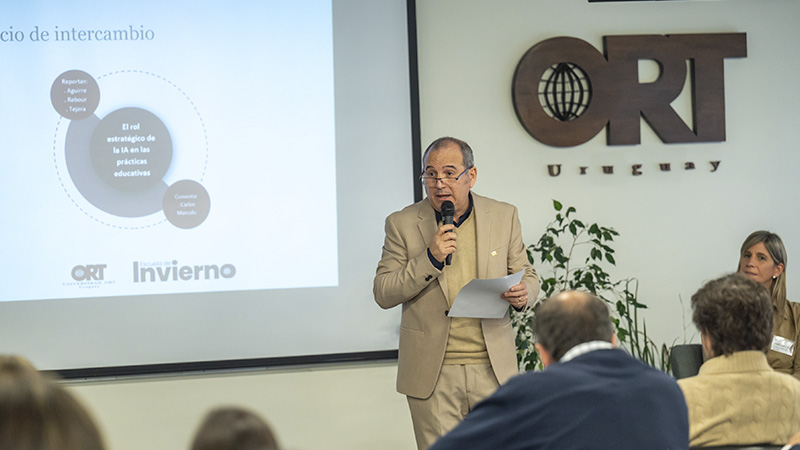
The dean of the School of Design, Oscar Aguirre, was chosen to present the report. When he took the floor, he noted that the initiative helped clearly define the role education should play in relation to the use of artificial intelligence in the university setting.
In that regard, one of the key points discussed was the need to promote the exploration and thoughtful use of these tools, without neglecting the“elements that are unique to humanity.”
In closing, he emphasized that it is essentialto “redefine teaching strategies” and that creating opportunities for peer assessment, for example, can become “a very effective tool for learning” by fostering collaboration, feedback, and the shared construction of knowledge.
What ORT is doing is exactly what we should be doing: creating open, ongoing spaces where we can all continue to learn together.
Dr. Carlos Marcelo
- You might be interested in: The Punch UY presentation slides.
AutoGrade
On behalf of the School of Engineering, Dr. Inés Friss de Kereki gave a presentation on“AutoGrade”:an automated grading system that uses artificial intelligence to evaluate midterm exams. The web application allowed instructors to take a photo of the assignments, generate and apply a rubric, and view the grades suggested by the artificial intelligence.
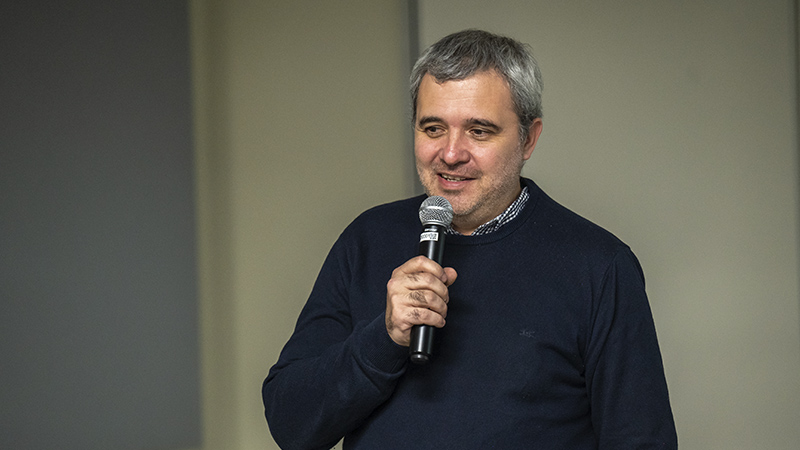
“They touched on a very important issue—one that is causing a great deal of stress for us teachers right now,” said Dr. Martín Rebour, an advisor on graduate programs at the Institute of Education, who was tasked with reviewing the project submitted by the professor from the School of Engineering.
One of the reasons for the presentation was the need to remain creative when it comes to assessment.
Dr. Martín Rebour
What was interesting—to him—was that a double-checking process was carried out: the teachers graded the assignments using traditional methods and then reviewed the grading using artificial intelligence. This process led them to conclude that, in the simpler exercises, there was a higher percentage of agreement between the teachers and the artificial intelligence. In more complex exercises, the agreement decreased.
As Rebour emphasized, it is a tool designed “from the perspective of an assistant” and“not as a replacement,”which allows for faster corrections and the identification of previously undetected errors. “The teacher remains an integral part of the process,” he concluded.
- You might be interested in: The AutoGrade presentation slides.
IAG to Promote Understanding
“We are convinced that writing is thinking; it is what makes us human. If there is an object that writes for me, then where is the epistemological function?” said Hecsil Coello, M.A., a professor in the School of Communication, regarding one of the challenges posed by artificial intelligence today. “When models seem to write very well and very quickly,what are we going to teach our students?” added Leroy Gutiérrez, also a professor in the School of Communication.
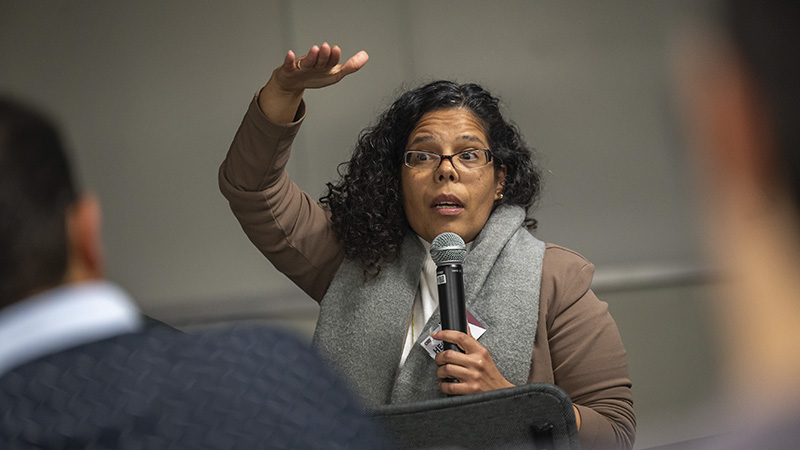
Those initial questions served as the impetus for both teachers to develop the project “Using AI Models to Promote Understanding and Application of the Fundamentals of Writing.” Drawing on the methodology of the Artificial Intelligence Ladder in Education (PENT-FLACSO)—originally designed for teachers —they proposed a progressive approach to introducing students to this technology.
The project aims to help students understand that the language model does not generate texts of the quality they assume it does.
Leroy Gutiérrez, B.A.
https://www.youtube.com/watch?v=hUwAfsZQ_Og&t
Dr. Esteban Zunino, dean of the School of Communication, summarized the discussion that took place during Coello and Gutiérrez’s presentation. The project, in addition to bringing artificial intelligence tools into the classroom and “drawing valuable conclusions,” allowed teachers to consider how to modify rubrics and instructions to discourage students from using AI models to complete assignments without any input from them.
At the same time, the dean emphasized the value of the teachers’ work, having pointed out some common features in the students’ writing, in contrast to the“hallmarks of robotic prose.” “That systematic approach should be included in the kit we hand out on the first day of class,” Zunino noted.
- You may be interested in: IAG presentation slides to promote understanding.
EPICA
Finally, the last project presented was that of Dr. Guillermo Lockhart and Fernando Pino, a technical specialist, representing the School of Architecture, titled EPICA (Exercise in Integrating AI Tools to Enhance Creativity in Architectural Research).
This initiative addressed the challenge of guiding students toward developing original proposals that address current issues in the field of architecture, by helping them overcome initial obstacles and making the most of the time allocated to topic research.
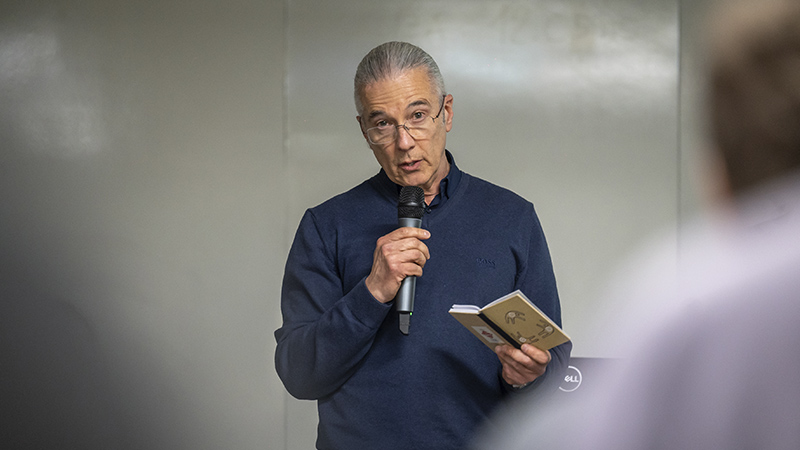
The dean of ORT’s School of Architecture, Architect Gastón Boero, explained that, at first, the students’ questions “were always the same,” so the use of artificial intelligence proved crucial in linking individual interests to valid research questions.
Among the strengths identified, he highlighted the possibility of devoting more time to the development of critical thinking and in-depth research. The project also provided an opportunity to reflect on potential risks —such as the possible normalization of results—without overlooking the opportunities —such as scaling the initiative to other departments within the faculty and even to the rest of the university.
I applaud the presentation of these innovative initiatives. Having an institutional policy that enables and creates the conditions for them to succeed is, in itself, a tremendous achievement.
Dr. Carina Lion
- You might be interested in: The EPICA presentation slides.
https://www.youtube.com/watch?v=mPuROqn_6vE
Workshops for Building the Future
In addition, three specialized online workshops for the faculties were held on the afternoon of Tuesday, the 5th, and the morning of Wednesday, the 6th:
- AI Action: Activity for Faculty Members in the School of Design.
- From Sketch to Video: AI-Assisted Visual Creation Workshop: An Activity for Faculty Members of the School of Architecture.
- Assessment for Learning: Challenges in University Teaching in the Age of AI: An Activity for Faculty Members in the School of Communication.
In these forums, faculty members discussed topics of particular interest to each department, created spaces for “thinking” and “doing” where resources were shared, and identified projects of mutual interest.

Views and Perspectives
Teachers as Ambassadors of Change
“The Winter School aims to be a special space for reflection and analysis of the issues that lie at the heart of our work as educators,” said Dr. Pablo Landoni.
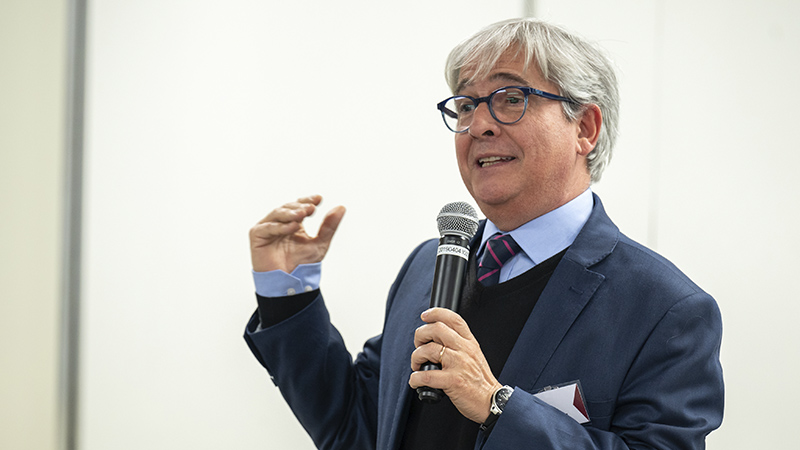
For the academic vice president of Universidad ORT Uruguay, it is “truly a joy” to have this initiative in place so that faculty members can exchange ideas, learn together, build a sense of community, and foster feedback among the various departments within the institution.
It’s a great opportunity to learn about what’s being done, as well as to share our own experiences, lessons learned, questions, and concerns.
Pablo Landoni
The theme selected for the 2025 edition of the Winter School is of great importance to the university. That is why Landoni outlined some of the initiatives developed for its faculty members in the field of artificial intelligence. These include the training sessions led by Eduardo Mangarelli, dean of ORT’s School of Engineering; CAES training on the subject; and teaching innovation projects involving artificial intelligence, to name a few examples.
Finally, during his opening remarks at the conference, the vice president encouraged the faculty to make the most of the opportunity and, at the same time, to“serve as ambassadors” by sharing what they had learned with the 1,500 teachers at ORT. “We want these topics to permeate the university’s faculty,” he stated.
Create waves
“We wanted to make waves, and I think we’re making waves, ”said Dr. Andrea Tejera Techera, academic coordinator of the Center for Continuing Education in Higher Education (CAES).
In his words, “it is a joy” to have brought to fruition an initiative like ORT’s first Winter School, designed to address opportunities and challenges that will have an impact on “the practice of teaching for the benefit of students.”
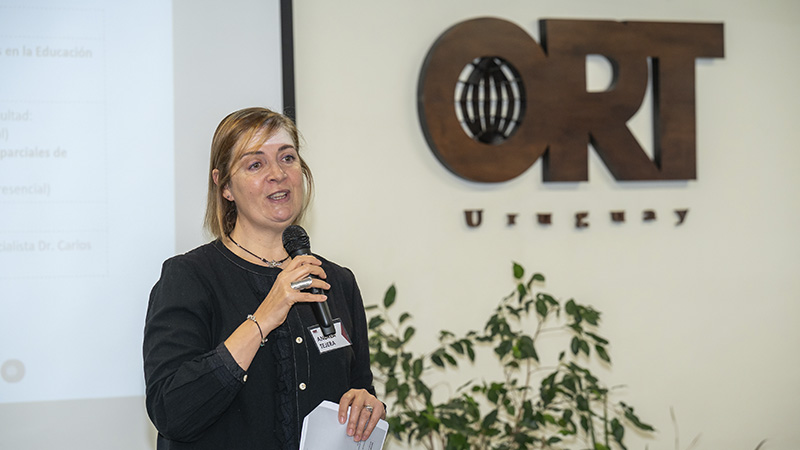
During the two-day event, he emphasized that “the goal is not to make broad decisions, but rather to document the valuable contributions that have been made,” in order to share what has been learned and “create opportunities for future action.”
And, along those lines, he emphasized the importance of building on the insights that have emerged. “Fortunately, we have other forums for coordination and reflection where we can begin to put these ideas into practice,” he concluded.
The " h " in "human"
“What matters is the ‘h’ in ‘human,’” said Dr. Teresa Cometto, dean of the School of Management and Social Sciences.
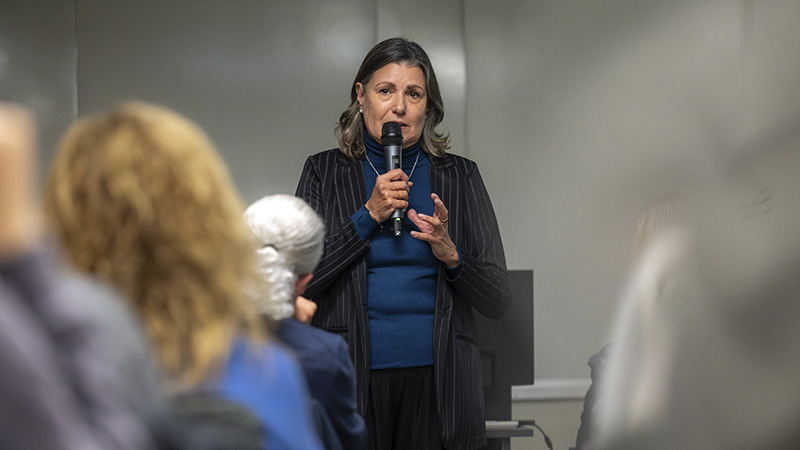
In his closing remarks at the Winter School, he emphasized the importance of the event, which provided an opportunity not only to reflect on the role of teachers but also on how to advance the learning process for students —which, ultimately, “is what drives us.”
“I welcome and applaud this first Winter School, which I am sure will be the starting point for many more, ”he said.
Celebrating Shared Learning
“It is ironic that the overarching theme of the Winter School was artificial intelligence and technology. However, the key to the success of the two-day event was the human element—the shared learning and collaboration among the various groups of teachers who participated,” noted Dr. Denise Vaillant.
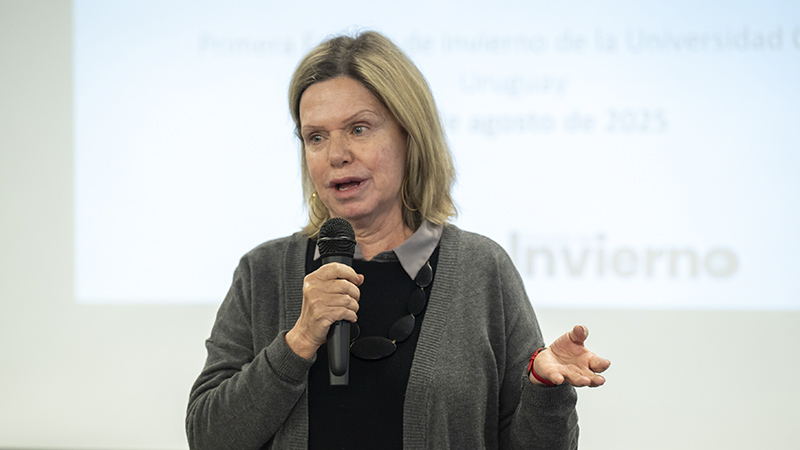
The dean of the Institute of Education thanked the“extensive collaborative network”that made the two-day conference possible. The Center for Continuing Education in Higher Education (CAES), the People Project, the Center for Educational Technology (CTE), and educational technologists; members of teaching innovation projects involving artificial intelligence; deans and faculty members; and the various university departments that collaborated to make this possible.
The fact that teachers are participating both in person and online shows that all of us gathered here have a genuine interest in training better professionals for the world of tomorrow.
Dr. Denise Vaillant
In closing, Vaillant emphasized that those who participated in the first edition of the Winter School “are pioneers,” as he also announced that the program will be held again next year, with the aim of making it open to colleagues from across Latin America.