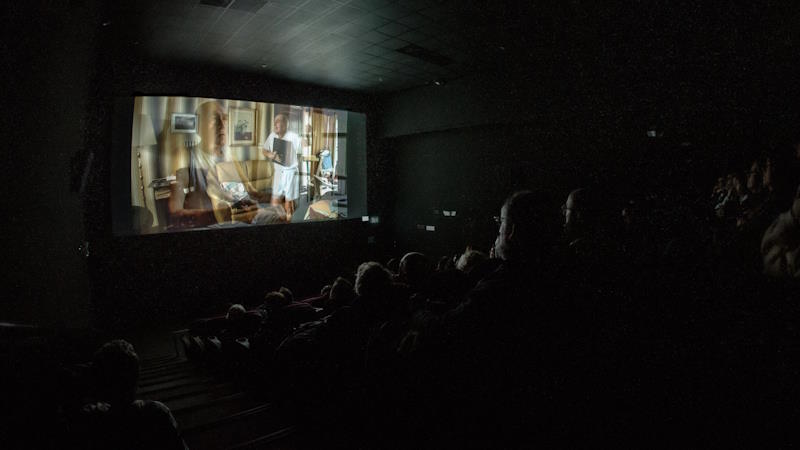
At 88 years old, my grandfather Fernando suggests we make a movie together. He makes the suggestion when I tell him I’m moving out of his house. So we start filming—me with my camera and him with his. Although we’ve lived together for over 20 years, it’s through the camera that we see each other in a way we never have before.
Produced by Monarca Films and Andrés D’Avenia, *Ese soplo* premiered on June 1 in Uruguay and will make its international debut this month at the Philadelphia Latino Film Festival in the United States.
Valentina Baracco is a film and television producer and director. She earned a bachelor’s degree in Communication with a focus on Audiovisual Studies from Universidad ORT Uruguay, where she also teaches. This project marks her debut as a director, and it is her first feature-length documentary.
In this interview, she reflects on the challenges of viewing her grandfather as a character as well: “Even though we lived together for over 20 years, there were many things about my grandfather that I didn’t know: I didn’t know what brought him joy, what made him sad, how he dealt with loneliness, or what his relationship with death was like.” He also reflects on the importance of teamwork in the film industry and emphasizes that every role is essential to making “that film unique.”
Our struggle to make this film turned into a struggle to keep our bond alive. Accepting that bonds must change in order to endure meant facing that transformation—a granddaughter growing into an adult and a grandfather growing older. This process led me to grapple with feelings of “guilt” when I couldn’t visit him and to confuse the “wanting” to go with the “needing” to be there. How do we keep the bond alive after leaving home? What is it that separates us and what is it that unites us?
How did *Ese soplo* come about?
The day I decided to move out of my grandfather Fernando’s house—where we had lived together for over 20 years—and finally found the courage to tell him, he responded with an invitation: to make a movie together. His proposal took me by surprise, but his confidence in knowing exactly what he wanted to film and his need for me to help bring it to life convinced me to go along with it, without asking why.
I have to admit that I didn't have the courage to hear the answer and preferred to hold on to the one certainty my grandfather had given me: a movie that was going to be called *Ese soplo*.
Above all, it’s an incredibly moving project. What challenges did you face as a filmmaker on such an intimate and personal feature film?
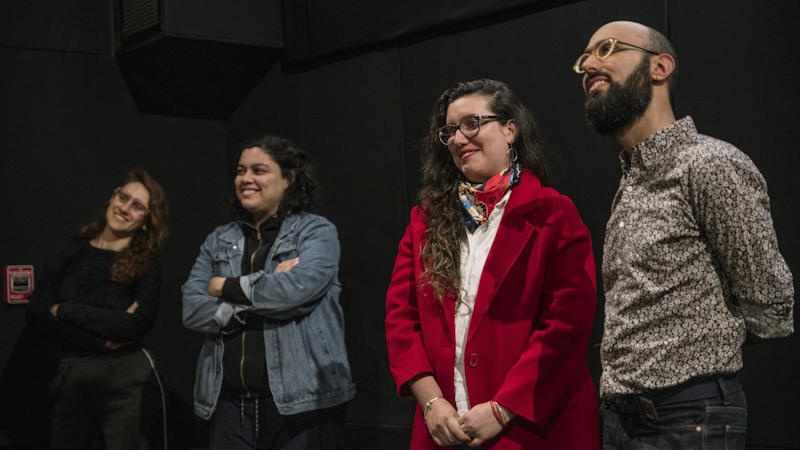
The first challenge was realizing that the film was the link and the connection between the two of us. It wasn’t easy for me to accept that I was also a character; it meant revealing myself, putting myself out there, and embracing my vulnerability. In this sense, the entire team—but mainly Magdalena Schinca (editor) and Andrés D’Avenia (producer)—were the ones who helped me discover, define, and build this. If this film exists, it is mainly thanks to the two of them.
This also presented a technical challenge: on set, it was just my grandfather and me, without a camera or sound crew, relying on our intuition and the emotion of the moment, and striving to capture that feeling in the images.
Did you have to step back from the story in order to make progress on the production?
Absolutely. These films are as complex and challenging as they are simple and beautiful; their raw material is life itself; it is life itself that is in the material—that grandfather and those encounters and misunderstandings—which also stay with me outside the film.
When you’re making a film, you’re constantly thinking about it. It was a part of my life for 12 years—more than a third of my life—and it’s difficult to separate the film from my personal life. That’s where the importance of the team comes in—people who accompany you through the process and help you maintain that perspective and distance that you often can’t sustain on your own.
*Ese soplo* is your directorial debut, but you’ve already come a long way in the audiovisual world, especially as a producer. How did you feel in the role of director?
I remember an anecdote from my time at university, involving Professor Álvaro Buela in the fiction workshop. Back then, when we introduced ourselves in the first class, we showed a short film we’d made in the documentary course with Gerardo Castelli. My short film was with my cousin Manuel and a bird I had saved. At that moment, Buela highlighted my way of seeing things and asked me if I was interested in directing. I replied very firmly that no, I wasn’t interested in directing. And here I am today, premiering a film as a director.
It’s a film that found me and taught me that, no matter how attentive we are to observing and discovering stories to tell, we can go through life looking without really seeing. Directing is a role I felt comfortable in because, as a producer, I’m a strong advocate for the producer’s creative role, as well as for working closely with the director. But it was also very challenging, with uncertainties and moments when I wanted to throw in the towel—and that’s where the team comes in again. I believe that to take on any role in film—and in the audiovisual industry—one must understand that it is a collective effort and that everyone will make that film unique, not just the director.
Who is your grandfather Fernando to you?
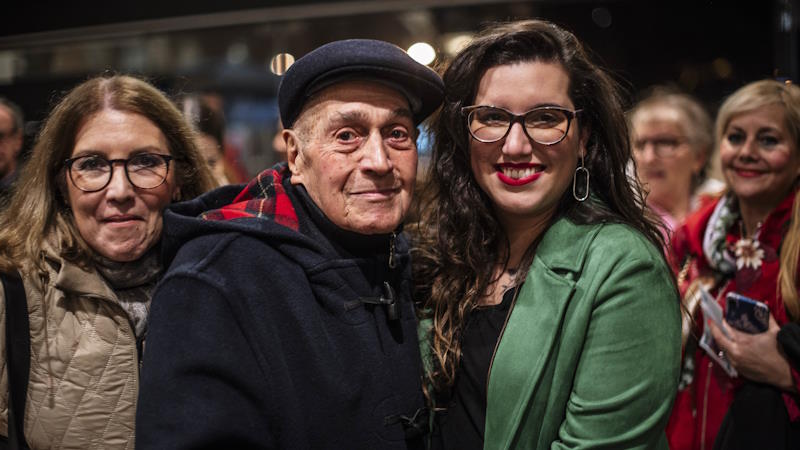
My grandfather was someone who was always there for me, along with my grandmother and my mother, ever since I was very young. So, filming someone with whom you have such a close relationship has its challenges.
He’s my grandfather, but he’s also a character: you have to bring him to life with all his nuances, his moments of brilliance, and his shadows. Another challenge and lesson in filming with my grandfather is that he is an elderly person, with a different pace than someone in their 30s. That’s where it was important to manage anxiety and cultivate patience, to understand that things can happen and won’t be repeated—perhaps you won’t even get to capture them: one day he might be full of energy, and the next day he might be very tired.
The passage of time in older people was also a major revelation; in my grandfather’s case, in particular, that passage is reflected in the seasons and the weather—he withdraws and grows older in winter, and blossoms and rejuvenates in spring, just like the flowers.
Why is the documentary called *Ese soplo*?
My grandfather Fernando chose the name. It comes from Carlos Gardel’s song “Volver,” which says, “to feel that life is but a breath.” The film is exactly that—that breath that is life—a film about life, connections, love, death, and what it means to be alive.
What did you think of the final product?
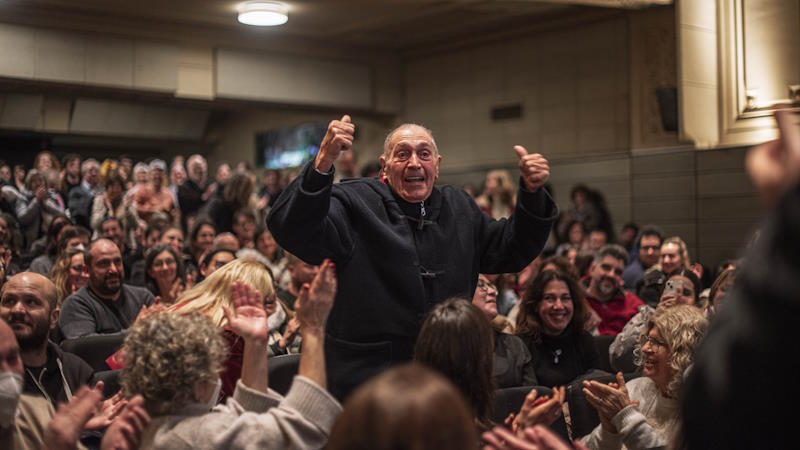
We’re both really happy and grateful for the feedback we’ve been getting. It was very moving to hear the laughter and tears in the room, and to hug people you don’t know who are holding back their emotions.
I think my grandfather had a good idea, and together we created something like life itself: an imperfect film that allows the viewer to immerse themselves, step inside that house, look out the window just as we did, and feel. It’s a film to feel and to contribute to the conversation about our connection to old age, what separates us and what unites us with other generations; how we transform those bonds so they endure over time because, after all, we all want to walk this path together. I think we’re succeeding, but there’s still a long way to go.
https://www.youtube.com/watch?v=tAXY3UlG7iw
-
Technical and Artistic Specifications
Director: Valentina Baracco Pena
Produced by: Andrés D’Avenia Frávega, Valentina Baracco Pena, and Eugenia Olascuaga Fierro
Associate Producer: Ilaria Gambarelli (Aretusa Films)
Director of Photography and Camerawork: Valentina Baracco Pena
Editing: Magdalena Schinca Damián
Color correction: Elisa Barbosa Riva
Sound design: Andrés Costa Carbajal
Original music: Hernán González
Post-production coordination: Valentina Gedanke Abelenda
Graphic design: Magdalena Domínguez
-
Participation in festivals
DocMontevideo (Uruguay) Documentary Week
Nuevo Detour Film Festival (Uruguay)
Philadelphia Latino Film Festival (United States)
-
Funding and support received
Film and Audiovisual Development Fund (INCAU-MEC, 2018).
Montevideo Filma Fund (Municipality of Montevideo, 2018).
Montevideo Audiovisual Partnership Fund (Municipality of Montevideo, 2021)
Uruguay Audiovisual Program (INCAU-ANDE, 2021).