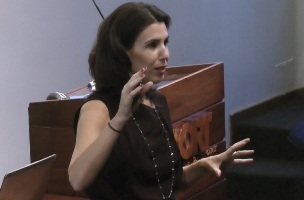
 On March 5, 2013, the Faculty of Administration and Social Sciences at Universidad ORT Uruguay hosted Universidad ORT Uruguay conference “Strategic People Management: How to Align HR with Business Strategy,” presented by Carolina Bellora, a visiting professor at the faculty for the Specialization Diploma in Human Resources and the Master’s in Human Resources Management, and a faculty member of the Human Resources Program at Torcuato di Tella University in Argentina.
In her speech, the expert placed special emphasis on the need to revamp current human resources (HR) plans, adapting them to the needs of the times and safeguarding a company’s most valuable asset. Bellora explained in her presentation that, in addition to providing a positive customer experience, companies must take care of their staff to ensure optimal results.
“Today we’re talking about HR from a strategic perspective, and that’s because there’s a need for it,” the professor said, noting that every organization needs talent—and that talent comes, quite simply, from people. “People are what set us apart from the competition. It’s easier to copy technology and design than a group of people who are passionate about providing service,” she said, though she added that it’s expensive.
Bellora said that addressing people’s perceptions is key to ensuring they have a positive impression of the product or service they purchased. “The experience is the sum of all the interactions a person has with a brand,” he said, adding, “Some say that the experience accounts for up to 70 percent of the connection.”
Who is responsible for shaping this perception? According to the expert, it is young people, who make up 25 percent of the workforce and will account for 50 percent within three years. However, she noted, intergenerational dynamics within a company can complicate this situation. Each generation expects something different from the workplace. This 25 percent expects, above all, a good quality of life. “Today, younger employees ask the company what it has to offer them,” says Bellora. “Today, there is talk of beginning to incorporate emotional attributes into workplace value propositions, just as marketing specialists do when advertising products or services in the market,” she stated, referring to emotional and personalized compensation.
Bellora spoke about the education leaders need to achieve these goals and the skills a CEO (Chief Executive Officer) must possess: attracting talent, building employee loyalty, and developing new strategies.
Another challenge, according to the professor, is how the HR department will respond to these innovations. Ideally, she said, this department should see itself—and be seen by others—as a business partner, a strategic partner. To achieve this, it must make concrete, results-oriented proposals, demonstrating just how important talent is to the company. The steps to follow, according to Bellora, are: understanding the external realities of the business, defining a differentiated value proposition, establishing HR practices for the 21st century, defining an HR strategy and organizational structure, and developing the competencies of the HR team.
Finally, the HR specialist said it is important to “break with tradition. Just because something worked in the past doesn’t mean it will work now.” “In HR, we are at a crossroads where bold decisions are needed,” she emphasized.