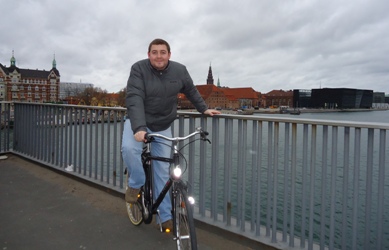
 Santiago Larzábal, a student in the Bachelor of Business Administration program who is currently working and studying in Denmark in 2013, shared his personal and professional experiences.
-How did you end up working in Denmark?
-I started working at Maersk Uruguay in 2006 through a management trainee program, first in the Finance department and then in Operations. I spent many years working on the control, analysis, and reporting of operating costs for container ships and containers in Uruguay. I then took on a position of greater responsibility for the Río de la Plata Cluster (Argentina, Uruguay, and Paraguay), where I also served as a Process and Cost Analyst, reporting to headquarters in that capacity.
In 2011, a global Business Controller position was created to oversee land transport costs (trucks, trains, and barges, with an approximate annual cost of USD 2.4 billion) at the headquarters in Copenhagen, Denmark. I applied internally and was selected for the position. I currently serve as a Performance Manager in the Business Performance Management section of Operations.
-What has your professional experience abroad been like? How has it enriched you?
-It has been an enriching experience both professionally and personally. Professionally, I would highlight that I have learned to work from a different perspective. About 2,000 people from all over the world—from Asia to Africa, Europe, and the Americas—work at the headquarters. This means that you have to engage with different cultures and learn to work in a way that differs from what I’m used to in Uruguay. In addition, from the headquarters, you interact with colleagues in 325 offices across 125 countries worldwide, each with different realities and backgrounds. This, in turn, has allowed me to build important professional networks.
I also had the opportunity to lead a project to develop a new global operational cost management system, which allowed me to work directly with the company’s top management —something that would have been hard to imagine while based in Uruguay—as well as with consultants from the renowned Boston Consulting Group (BCG).
-What's life like for you in Denmark?
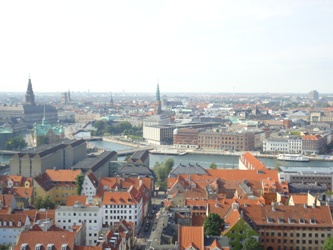
-Denmark is a small country with a population of just over 5 million, and it has a large immigrant community. The Danish language is one of the most difficult in the world; therefore, Danes must learn English to communicate with others, which means that English is spoken by the entire population and facilitates social interaction. The standard of living is, like in the rest of the Scandinavian countries, among the highest in the world. Unemployment is virtually nonexistent (before the crisis it was only 1%) and crime is almost nonexistent. A reflection of this is that when a family goes out to dinner at a restaurant or to the supermarket, they leave their children in their stroller on the sidewalk, out in the open without anyone watching them. This really catches our attention, as does the fact that there are no security bars, except in some stores selling high-value items.
It’s a country with a strong environmental consciousness, so there are large and numerous green spaces in every city, and people prefer cycling or public transportation over driving. In fact, Copenhagen alone has nearly 400 kilometers of bike paths. Of course, both my girlfriend and I have adapted to this lifestyle and use our bikes to get to work and go for rides. One downside is the weather; it’s a very cold and generally cloudy country. In “summer,” the average temperature is around 20 degrees, but luckily there are more hours of daylight, reaching nearly 18 hours in June. In winter, of course, it’s the opposite, with as few as 7 hours of daylight in December. That’s why when we go to Uruguay, we don’t complain about the weather at all!
In our free time, we enjoy traveling, reading, and getting together with friends.
-What does your job at Maersk involve?
-I currently hold the position of Performance Manager at the headquarters in Copenhagen, within the Global Operations Center. In recent months, I have been leading a project for a new global variable operating cost management system, with an annual budget of $12 billion, an SAP-based analytical application, and a comprehensive enterprise management system. In developing this system, I have been able to learn technical aspects I was previously unfamiliar with and new business dynamics, as it is a global application with approximately 300 users from operations and finance.
 My work as Performance Manager It also involves responsibility for managing the cost performance of the Global Operational Fleet, which comprises approximately 600 vessels and has an annual cost exceeding $6 billion. This includes establishing and monitoring performance metrics to ensure the achievement of the company’s strategic objectives and providing support for the development of initiatives to improve operational efficiency.
-What does the company do?
-Maersk Line is the core shipping business of the A.P. Moller – Maersk Group and is the world’s leading container shipping company. “Containerization” is a global system of intermodal freight transport using standardized containers, which can be loaded and sealed intact onto container ships, trains, planes, or trucks safely, quickly, and at lower cost. Today, more than 90 percent of goods in the global market are transported in containers. Modern container transport has changed the way goods are transported around the world and plays a key role in globalization.
-In addition to working, you're taking classes at CBS University. How has your experience there been?
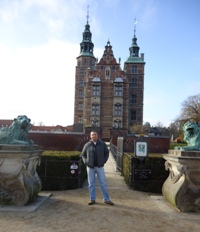
-I have been fortunate to attend Copenhagen Business School since 2012. This business school has 20,000 students, of whom nearly 25 percent are international students. It is currently ranked 40th among the best business schools in Europe according to the Financial Times. Overall, it has been a very positive experience. I have been able to meet and work in teams with people of different nationalities, apply the knowledge I’ve gained to specific cases, and participate in enriching discussions with faculty members dedicated to business research.
 -How would you rate the education you received at Universidad ORT Uruguay relation to your work?
-I can say that my bachelor’s degree in Management and Administration was a crucial stepping stone in the development of my professional career. In my case, I’ve been able to directly apply the knowledge I gained in college, as well as bring my work experience into the classroom—whether through case study discussions or required assignments. That combination, while it required a lot of effort—since I had to work and study simultaneously—helped me grow within the company quite a bit and relatively quickly. In the seven years I’ve been at Maersk, I’ve held five different positions, each with progressively greater responsibility.
-And how would you rate the education you received at university compared to the studies you're currently pursuing in Denmark?
-I believe that the Bachelor’s Degree in Management and Administration at Universidad ORT Uruguay of high quality. I can say that I have not encountered any difficulties in the courses I have taken at CBS; in fact, I have earned excellent grades. At ORT, the professors generally have a high academic level, and the course content is highly relevant to the degree program. I have been able to participate in case discussions in class without any problems, just as I learned to do at ORT. In many cases, CBS students do not participate out of fear of making mistakes or because they are accustomed to “lecture-style” classes where the professor “dictates” the content. One of the functions of a university is to foster critical thinking in students and graduates, especially when addressing practical cases in management problem-solving, and I believe ORT achieves this through its learning methodology, by encouraging class participation, group projects, and fieldwork.
On my first day at CBS, I was struck by the architectural design and the use of technology on campus. When I walked into the classroom, not a single one of the 60 students was without a MacBook or an iPad. I showed up with my notebook and pen to take notes, as I was used to doing in Uruguay, and of course I couldn’t help but notice the stares from the others.
-What are your goals at the company?
-My main goal is to continue learning every day, both in terms of management skills and in the specific field of logistics. As a transportation company, Maersk is a key link in the supply chain for many businesses, which gives me the opportunity to learn a great deal about operations and other areas of the company.
-Do you want to go back to Uruguay?
-Of course. Uruguay is the country where I was born, and where I plan to return to continue growing professionally and, on a personal level, to enjoy time with my family and friends—and, of course, the food, places, and customs of Uruguay.
I believe that Uruguay has tremendous potential for development, both economically and socially. This is particularly true in the logistics sector, where there has been and will continue to be sustained growth, especially due to Uruguay’s unique geographical location; however, there is much to be done in terms of improvements in infrastructure, connectivity, and education specific to this economic sector. If one wishes to specialize in logistics in Uruguay, there are limited academic options, and one generally has to look to other countries in the region or on other continents.
-What are your plans for the future?
-I would like to return to Uruguay to apply the experience I’ve gained abroad, and in the future, continue my academic career by specializing in logistics and supply chain management. One of my goals is to start my own business in this sector.